
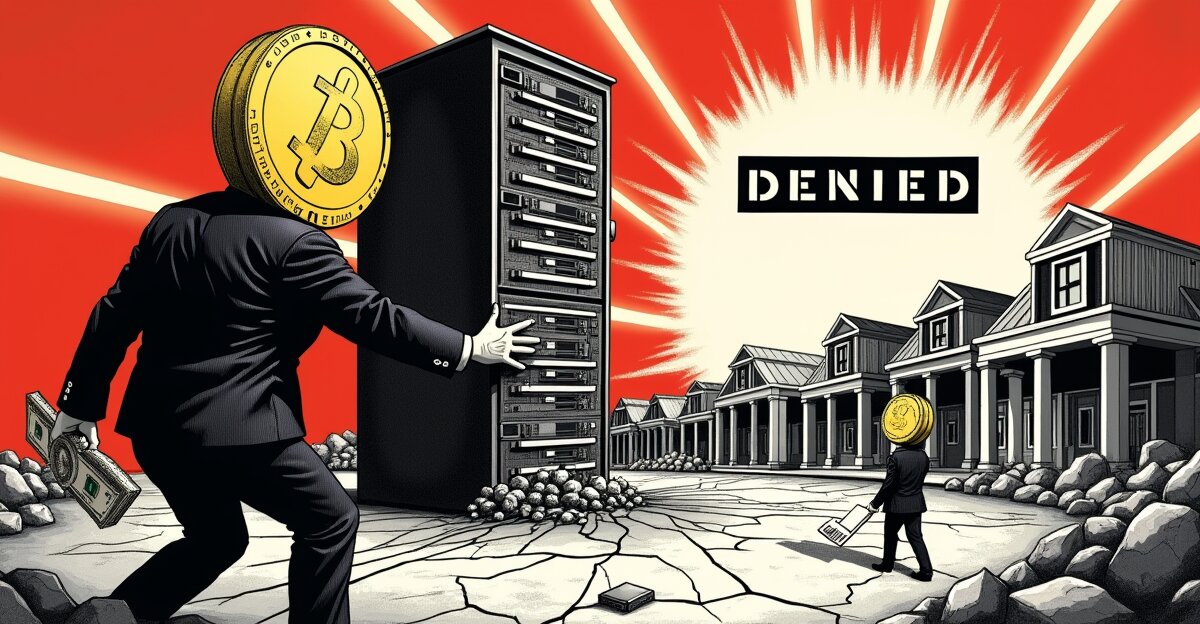
The tech industry betting trillions that America would swallow its AI future just watched the country vote, 40 times to 1, not to.
"What's good for the AI industry is clearly not good for average voters."
— Shobita Parthasarathy, University of Michigan public policy professor, after the November 3 elections
Washington is already reducing the 2026 midterms to one party, one president, one wave. That framing is understandable and probably true. But buried in the same ballot boxes was a cleaner result, and a more interesting one, that has nothing to do with who is in the White House. Across thirteen states, voters put forty-one questions about artificial intelligence data centers on the ballot, and forty of them passed. In Edgewater, Florida, 77 percent approved an outright ban on new facilities. In Alhambra, California, 82 percent did the same. In Ohio, the state that fielded more data center questions than any other, voters in eleven municipalities banned the buildings outright and seven more imposed rules on them.
Translation: the buildout the tech industry calls inevitable just ran into the people who pay the electric and water bills, and it lost.
The opposition was not a footnote to the election. It was the election, at least in the suburbs and small towns where these facilities actually get sited. A May Gallup poll found seven in ten Americans opposed to a data center being built in their area, citing noise, water use, environmental damage, and health risk. A Blue Rose Research poll from December 2025 found that Americans would rather live next to a prison or a nuclear power plant than next to a data center, a bar the industry had to clear to break ground. NBC News exit polling on Election Day put opposition at roughly three in four voters, and 56 percent of them named data centers and AI as a crucial or major factor in how they cast their ballot.
Gallup's own senior editor, Jeffrey M. Jones, put the industry's problem in one line: "Overcoming this opposition stands as a major hurdle in the expansion of AI computing." By the time voters headed to the polls, more than 500 local jurisdictions had already approved moratoriums or bans. The November ballots did not start the revolt. They ratified it.
The industry knew the revolt was coming, and it paid accordingly. In the Ohio Senate race, incumbent Republican John Husted was backed by Oracle cofounders Larry Ellison and Safra Catz, and a crypto-linked PAC tied to firms like Coinbase spent $55 million to defend him. The Democratic challenger, Sherrod Brown, ran ads calling Husted "the face of data centers in Ohio," a state that now hosts 226 of them. Brown won.
The panic on the other side of the ledger was not subtle. An internal memo from the National Republican Senatorial Committee, first reported by Axios, described the problem as "the anchor hanging around Husted's neck." It warned that if Husted lost and data centers took the blame, "politicians across the country will take notice, and they will not go near the next one." They did not go near it. In deep-red South Carolina, Democrat Annie Andrews unseated incumbent Darline Graham after accusing her of being bought by developers, even as a pro-AI super PAC spent $2.5 million on her. And the newly elected governors of Georgia, Ohio, and Texas have all promised moratoriums on new construction.
The money did not just fail. It revealed who the industry thinks it is buying.
Then came the rebrand. OpenAI quietly started calling its data centers "compute campuses." Amazon pledged to disclose more about its water use and to improve the environmental rating of the backup generators that keep its sites running. Google announced it would stop requiring local officials to sign nondisclosure agreements before they could see a project. And days before the vote, President Trump, who had spent months praising data centers as a job and patriotism story, called on AI companies to pay impacted communities a "dividend" for allowing them to build. "I have watched the process closely," he wrote, claiming unpopular data centers "became extremely popular when a financial deal was struck." He offered no evidence this had ever happened.
Sam Burleigh, who helped found a group fighting an Amazon-backed project in Pennsylvania, had a word for all of it: "propaganda." "What I see is them realizing they have more resistance than they ever dreamt of," he told the Associated Press. "And so now they have to find some way, some method, to break through that resistance."
The scale of what voters are pushing back on is hard to exaggerate without sounding like a warning label. Forbes estimates the projected U.S. buildout at between $2.8 trillion by 2030 and $10.3 trillion by 2032. That is not an industry growth plan. It is a land grab wearing a server rack, a wager that the grid, the aquifer, and the ballot box would all bend in the same direction. So far the ballot box has not.
The industry also knows the fight is not over, and it is already adjusting. Mitch Jones of Food & Water Action noted that AI super PACs cut their general-election spending to a trickle, with only about 5 percent of direct money going to contested races, once the mood turned. They are not quitting. They are waiting for a locality with less organized pushback. Parthasarathy expected the same: "I don't think their thirst for data centers is going to go away. They might move into localities where there is less organized pushback."
For two years the pitch was simple: the future is coming, and it needs space. It needed your town, your water, your grid, your tax breaks, and your silence. What it did not budget for was a single word printed on a piece of paper in eleven towns in Ohio. The future is still coming. It will just have to build around the voters now, not over them. The question was never whether the data centers could be built. It was whether anyone in the room would pay for them. Forty ballots to one, the room has answered.
Comments (0)
No comments yet. Be the first to speak up.
Join the Riot
Login with Google to leave a comment.
Login to Comment