
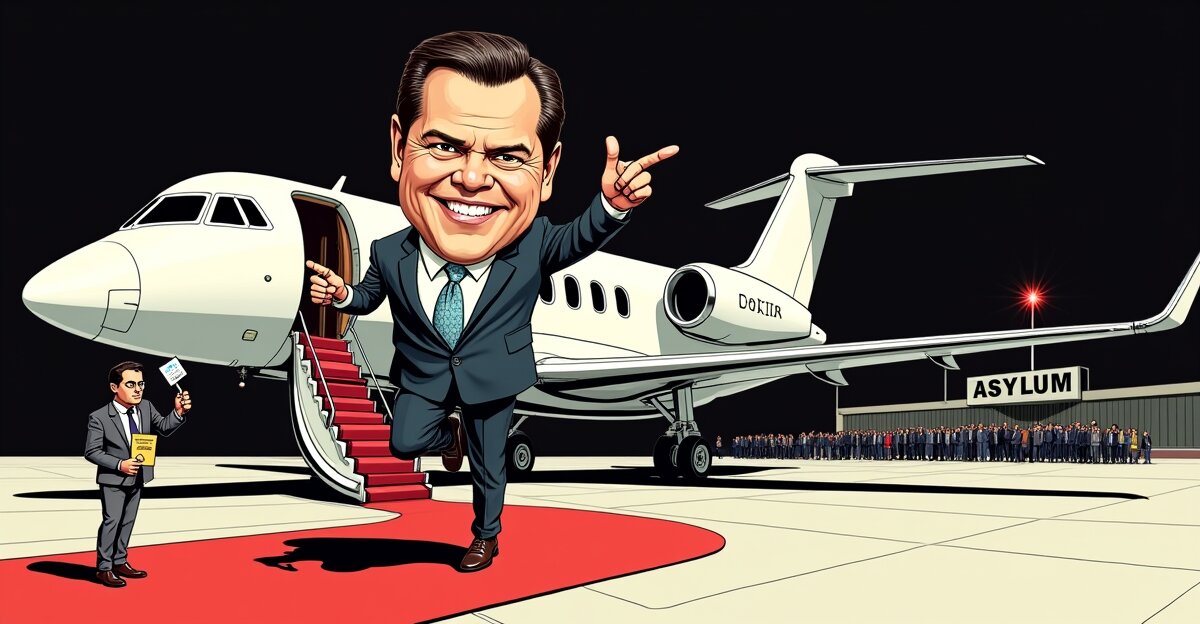
Twenty-four hours after swearing on camera that he had never thought of leaving Brazil, the country's defeated presidential candidate was gone, and the United States had already promised him a visa.
"Those who are not liable do not fear. A fellow that secretly leaves his country, that's because he is liable for something."
— President Luiz Inácio Lula da Silva, at a celebration of his 81st birthday in Brasília, October 27
Flávio Bolsonaro stood outside his election bunker in Brasília at 10:40 p.m. on Sunday and did what his father had done four years earlier: refused to accept a defeat. Brazil's electoral court had just announced Lula's fourth term with 51.79 percent of the vote, a margin of more than four million votes. Bolsonaro, the 45-year-old Rio de Janeiro senator and standard-bearer of the far right, demanded the election be annulled.
The next morning, the performance of piety. In a Monday video, he said he had "never thought about leaving the country" and that he would "hand over my passports and defend myself against this travesty, which is a clear attempt to intimidate me." He added a line his followers were meant to frame: "I wasn't the one who lost. The system won."
The deadline to surrender his passports, set by a confidential order from Supreme Court Justice Alexandre de Moraes, came at the end of Tuesday. Bolsonaro did not show up. His Brazilian and diplomatic passports were cancelled. He was not seen at his Brasília residence. By early afternoon, the Workers' Party had confirmed a filed request for preventive detention and an INTERPOL red notice. By evening, Brazilian authorities were calling his whereabouts unknown, and the State Department had already told ABC News it would issue visas to him and his family and let them into the country.
Translation: the door was open before the fugitive knocked.
The order the senator ignored was not the kind you ignore without a plan. Justice de Moraes had required Bolsonaro to surrender both passports, barred him from traveling, and forbidden him to contact Willer Tomaz, the lawyer accused of laundering more than a billion dollars by skimming unauthorized deductions from pension payments. The order cited flight risk and Bolsonaro's "significant financial resources."
The investigation is one of several. Federal police found that Bolsonaro had "master user" access to bank accounts at Alcazar Holdings, an offshore company owned by Tomaz; the money-laundering case grew out of a probe into betting platforms and transactions linked to him. A separate inquiry examines the millions Bolsonaro allegedly raised from Daniel Vorcaro, the disgraced banker at the center of the Banco Master fraud, to finance a biopic about his father. A third covers a sports betting case; the cluster is variously described as corruption, money laundering, tax evasion, and foreign currency violations. On Tuesday, a justice ordered yet another probe, this one into possible illegal foreign financing of Bolsonaro's presidential campaign, including alleged ties to the donor network of U.S. Vice President J.D. Vance.
Bolsonaro has not been charged, and he denies wrongdoing. But the arithmetic of his situation is simple: a man under multiple criminal investigations, a court deadline, a fortune, and an Italian passport obtained in 2023. By every metric Brazil uses to define a flight risk, the former front-runner was exactly that.
Here is what makes the story strange: the United States knew.
Two U.S. officials told ABC News the Trump administration had been tracking Bolsonaro's plans and expected he would try to exit Brazil for the United States. A senior State Department official confirmed visas would be issued to him, his wife Fernanda, and their two daughters, ages 14 and 12. On Wednesday, he told reporters he "would approve" of Bolsonaro coming to the country. "I think they're fine people," Trump said, adding that the election "was very strange, and I thought it was terrible."
He had already made his position clear on Monday, when he told reporters the Brazilian vote "looked like another rigged election, frankly." "I just think it had a very bad look, the election, the way it was tabulated," he said. "The extension given was very strange." He offered no evidence. The math disagrees: Lula won by more than four million votes, and fewer than 35,000 votes, roughly 0.03 percent of the total, were cast during the two-hour extension Trump objected to. Vice President Geraldo Alckmin called the president's claims "completely wrong."
Translation: the State Department had the destination mapped before the senator left the capital.
The family pattern should worry anyone who calls this just one more ugly chapter in South American politics.
The father, Jair Bolsonaro, refused to accept his own 2022 defeat, incited a violent insurrection in Brasília, and fled to the United States. Last year, a five-judge panel of Brazil's Supreme Court convicted him 4-1 of attempting to overturn the election and sentenced him to 27 years and three months; he is serving under house arrest due to poor health, banned from office for the rest of the decade. Eduardo, the eldest son, was convicted in June, unanimously, of coercion after prosecutors alleged he tried to use the Trump administration's tariffs and sanctions to pressure the judges prosecuting his father. He was sentenced to four years and two months. He has lived in Texas since 2025.
Now Flávio has joined them: three Bolsonaros, three versions of the same move. When the institutions catch up, cross a border. The father is at home, in a house, wearing an ankle monitor. The sons are where the U.S. government says it will take them.
The details that have emerged since Tuesday are almost too neat to be believed. His campaign manager, Rogerio Marinho, said he received one text from his boss: that he would "let some time pass today and then talk with us." "That was the only communication we had." The deputy leader of Bolsonaro's Liberal Party said he had fled "into exile." Argentine officials confirmed that a private jet was flown from Buenos Aires to Puerto Iguazú, on the border with Brazil, to pick up four passengers; Argentine migration officials later said the family entered "with valid travel documentation and without any legal impediment" before a private flight toward Guayaquil, Ecuador. An anonymous Brazilian foreign ministry official told the Washington Post he may have gone via Venezuela. The BBC reported he landed in Florida, where his brother was waiting. No one in government has confirmed where the senator is or how he got there. The route is a rumor. The visas are not.
One more dark detail for the lawyers. The justice who ordered the passports seized is himself under scrutiny: the New York Times reported, citing a police dossier, that Vorcaro texted de Moraes asking for help to avoid arrest, and that he mentioned paying millions to the law firm of de Moraes's wife. De Moraes denies wrongdoing. In a country where the judges are part of the story, even the handcuffs come with a side dish.
In Brasília, the reaction was not subtle. Guilherme Castro Boulos, the secretary-general of the presidency, told reporters: "Leaders face things head-on! Rats run away!" He said Bolsonaro "slapped his supporters in the face and left them on the side of the road." "Almost 60 million Brazilians trusted him as political leadership to run the country, and 24 hours later, he flees," Boulos said. "Bolsonarism is made of cowardice."
In Washington, the objections are coming from the left, which is a first. Texas Democrat Joaquin Castro wrote on X: "Losing an election is not grounds for asylum. Yet the Trump administration is giving Flávio Bolsonaro safe haven in the United States." He added that the administration "owes Congress answers on its role helping Bolsonaro flee Brazil in contravention of Brazilian law." Researchers at the Center for Economic and Policy Research noted that the United States has long been the destination of choice for right-wing Latin American figures fleeing prosecution: Panama's Ricardo Martinelli, Bolivia's Gonzalo Sánchez de Lozada, Nicaragua's Anastasio Somoza. "The list is extensive." Perhaps the most elegant line came from CEPR co-director Mark Weisbrot, who suggested this may be what the "Shield of the Americas" was for.
Here is where the story stands: a man who said he would stay is gone, the country he fled has issued a red notice, and the country he fled to has issued a visa. He is the defeated candidate, the defendant, the son of a convicted coup plotter, the brother of a convicted fugitive. All at once, he is also a guest.
The United States spends its days lecturing the world about elections, the rule of law, and the dignity of institutions. It turns out that dignity has an exit velocity. When the institutions of a foreign country finally move against a family of demagogues, the American answer is not a press statement. It is a boarding pass.
The question was never whether the door was open. The question is who was holding it.
Comments (0)
No comments yet. Be the first to speak up.
Join the Riot
Login with Google to leave a comment.
Login to Comment