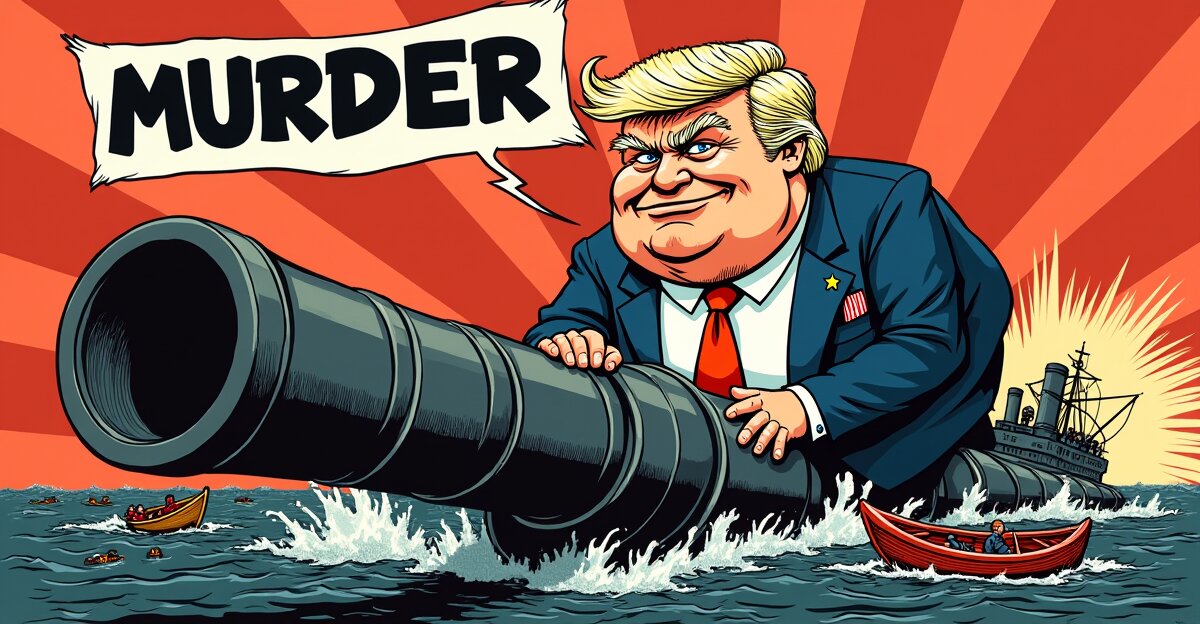
The United Nations has concluded that the United States is plausibly committing crimes against humanity at sea. The American response is to sink more boats.
"The United States military attacks are, however, contrary to international law, violate the human right to life, and plausibly constitute crimes against humanity."
— Ben Saul, U.N. Special Rapporteur on human rights and counterterrorism, September 2026 briefing note
For one year, the United States military has been sinking boats in the Caribbean Sea and the eastern Pacific. The official story is that each vessel was smuggling drugs for cartels the president has designated as terrorist organizations. The running tally, as kept by the U.N. expert who this week published the most serious legal finding ever leveled at a sitting American administration: 68 strikes, at least 223 dead, every one of them outside any country's territorial waters.
While world leaders gathered in New York for the General Assembly, Ben Saul, the U.N. special rapporteur on the promotion and protection of human rights while countering terrorism, released a briefing note that spares no part of the campaign. He is the U.N.'s designated authority on exactly the intersection this war claims to operate in, which makes him the expert the "narco-terror" framing was built to impress. His finding: the strikes amount to "serial extrajudicial killings," and every legal justification the government has offered fails when tested one by one. The report has already drawn parallel condemnations from the U.N. High Commissioner for Human Rights, the president of the International Narcotics Control Board, and the Inter-American Commission on Human Rights.
Translation: every institution that could have issued a pass on this campaign has declined to.
The administration's defense has been consistent since the first boat went down in September 2025. Trump informed Congress that the United States was exercising "self-defence and defence of others against the ongoing attacks by… designated terrorist organizations," and that "a non-international armed conflict" exists in the region, governed by the law of war. A January 2025 presidential order supplied the architecture, designating certain cartels as terrorist organizations so the war on terror's full toolkit could be aimed at fishing vessels.
Saul dismantles that architecture clause by clause. The cartels, he writes, have "not mounted any 'armed attack' on the United States so as to trigger a right of self-defence." Deaths from illicit drugs "are not assimilable to an armed attack under international law." There is no such thing as "an international right to use of force to suppress alleged 'narco-terrorism.'" And the claimed "non-international armed conflict" fails at the threshold, because no organized armed group has been waging "bilateral military hostilities of sufficient intensity" against the United States. "International humanitarian law cannot authorize the United States' attacks," he concludes.
Translation: the war on terror, but at sea, and against an enemy that has never fired a shot.
That leaves the report's headline finding, which uses a word the United States has spent eighty years deploying only against other countries. A crime against humanity under customary international law requires murder committed as part of a "widespread or systematic attack directed against any civilian population." Sixty-eight strikes in one year. Two hundred and twenty-three dead. No evidence released, no charges filed, no survivors ever accounted for. "There are reasonable grounds to believe," Saul writes, "that the reported 68 attacks that killed 223 people constituted crimes against humanity of murder under customary international law." On intent, the element that makes a killing a crime instead of a tragedy: "The killings of 223 people are unlawful and intentional under international law."
The report identifies the "civilian population" with surgical precision: "that part of the regional population in the Americas that is allegedly engaged in maritime drug trafficking towards the United States." In the U.N.'s legal framing, the people the U.S. has been shooting are the civilian population under attack. The victims, according to the report and to the families of the dead, include fishermen, migrants, and victims of human trafficking, not merely cartel members.
The precedent Saul cites is telling. Rodrigo Duterte, the former Philippine president, is on trial for "alleged crimes against humanity of murder for targeting suspected criminals, or criminals having criminal propensities, including drug offenders," over his domestic war on drugs. It turns out the United States has been running the same program at a higher altitude, with better aircraft, under a different name.
What the report demands of Washington reads like a subpoena. Conduct "prompt, effective, thorough, independent, impartial and transparent investigations." Provide remedies to the families of the dead. And, most pointedly: "prosecute the perpetrators (including military and political leaders who ordered the attacks) for crimes (such as murder and crimes against humanity)."
Notice who is inside that parenthesis. This is not an anonymous "perpetrator." The U.N.'s top counterterrorism expert is pointing at the office, not just at the gun. Saul also flags, almost in passing, questions about whether the strikes comply with the U.S. War Powers Resolution of 1973 or with the federal executive ban on assassination, a restriction older than the campaign it now constrains.
The report's hardest line concerns the soldiers. U.S. military law, he notes, requires service members to obey only lawful orders, and every combatant has a duty to refuse "a manifestly unlawful order." Then the observation: "The Government has regrettably penalized former military personnel who called on United States forces to disobey illegal orders, rather than those who allegedly committed unlawful killings."
Translation: at Nuremberg, "I was following orders" was rejected as a defense. The U.N. is warning that the United States is now building the inverse system, one in which the refusal is punished and the command is protected.
The drug math has its own verdict, and it came before the U.N. sat down to write. Senator Tim Kaine told a June hearing that the targeting criteria the military uses for these strikes have never included "evidence of narcotics on the boat." Customs and Border Protection data show little to no decrease in the flow of drugs into the United States since the bombing began. After each strike, the Pentagon has released no evidence that the boat it sank was carrying drugs. Families of the victims have filed legal complaints. And the killing has not paused for the report: days after it was published, the U.S. military announced four more deaths aboard a vessel in the Caribbean, lifting the running count to at least 234.
On land it is worse. Three additional vessels, including the Ecuadorian fishing boat Fiorella, sank in "suspicious circumstances" with no one claiming responsibility. An Ecuadorian prosecutor investigating the disappearances was murdered in June.
The briefing note also looks past the sea, and that is where the project's full shape becomes visible. Saul finds that the U.S. "transboundary abduction" of Venezuela's President Nicolás Maduro and his wife, and the military raid that accompanied it, constitute violations of international law. The report likens the operation to the 1989 U.S. seizure of Panama's head of government, who had been indicted in the United States on drug charges. The forcible blockade of Venezuelan oil tankers and the United States' "coercive control over Venezuela's oil revenues" amount to further potential violations. Trump's threats to use force against Cuba, Mexico, and Colombia over drug trafficking are prohibited by international law, the report finds. And under the "Shield of the Americas" initiative, joint U.S.-Ecuadorian operations carry reports of torture, arbitrary detention, and disappearance.
This is not one war gone wrong. It is a template: designate, blockade, abduct, seize, sink. And the U.N.'s expert on counterterrorism says every step of it is unlawful.
The label matters, and the United States knows it. "Crimes against humanity" was forged at Nuremberg, and Washington helped write the rulebook that followed, while insisting, to this day, that it does not accept the jurisdiction of the International Criminal Court. For eight decades the phrase has been a weapon pointed outward, at Syria, at Serbia, at everyone but the country that holds a permanent veto in New York. That the U.N.'s own counterterrorism expert has now turned it on the United States is not a small thing. "Plausibly" will not become a verdict in The Hague. But it is a record: names, dates, legal bases, and a duty to investigate and prosecute, written down by the institution the United States founded, in the same year its military kept the tally climbing.
The question is no longer whether the boats were full of drugs. The question is whether the country that wrote the rulebook will ever be judged by it.
Comments (0)
No comments yet. Be the first to speak up.
Join the Riot
Login with Google to leave a comment.
Login to Comment