
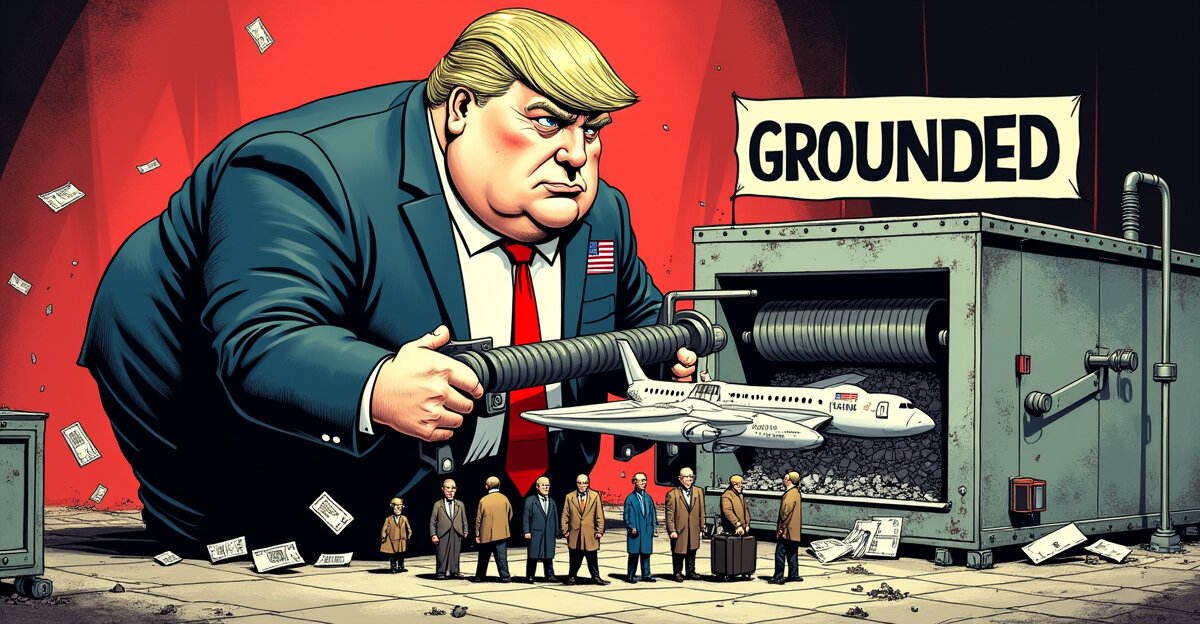
The most powerful weapon in the American arsenal has no barrel: it is an invoice, a deadline, and a note to every airport on earth that says, land that plane at your own risk.
"You cannot provide them with fuel, you cannot provide them with landing services, you cannot sell them tickets, or you will be knocked out of the dollar system."
— U.S. Treasury Secretary Scott Bessent, speaking on CNBC, September 21
On Monday, the American Treasury Secretary did something no government has needed to do before: he set a public deadline for an entire industry to cease existing, and dared the rest of the world to stop him. "On September 23, all the Iranian airlines will be shut down around the world," Scott Bessent said. Not the planes. The world. Washington is not sending a carrier group to tear up a runway in Tehran. It is asking every fuel farm, ticket counter, and airport operator from Dubai to Manchester to do the work for free.
That is the point. The shutdown of Iran's 27 commercial carriers is not a sanctions package. It is a conscription order.
The groundwork was laid on September 8, when the Treasury's Office of Foreign Assets Control added 35 entities to its Specially Designated Nationals list, including every remaining Iranian passenger airline that had not already been designated. Iran Aseman, Kish Air, Qeshm Air, Taban, Varesh, Zagros, Karun, Chabahar, Fly Persia, Mehr Airways, Soroush Air. The list reads like a who's who of a country's sky. It also includes Saha Airlines, which OFAC formally describes as the "Armed Forces Air Transport Service," a reminder that the line between civilian and military aviation in Iran has been smudged for a long time.
The designations reach well past the border. Treasury also hit a support network spanning five countries: ECT Aviation Support in the United Arab Emirates and Britain, iCargo in Malaysia, Tour Invest in Kazakhstan, and MES Cargo, S Sistem Logistics, and Sky Phoenix Airways in Turkey. These firms exist to perform the work sanctions were supposed to kill: moving parts, fuel, and freight for Mahan Air, which Washington has accused since 2011 of serving as a conduit for the Islamic Revolutionary Guard, a carrier that moves "personnel, weapons and military equipment" in the Treasury's own words.
The message to the private sector was delivered by Bessent personally, on X: "Let this be a warning to anyone doing business with Iran's remaining airlines, all of which we sanctioned today: You are at risk of being cut off from the global financial system."
You can tell a lot about a country's future by looking at its aircraft. For over a decade, Iranian carriers have been flying the same aging fleet, unable to buy new airframes, unable to secure parts, unable to obtain maintenance. When the first round of sanctions choked the sector, the planes kept flying out of stubbornness. Now they fly out of inertia. The September 23 deadline does not add new restrictions to an industry already on life support. It adds a date.
And the difference matters. Sanctions are a condition. A deadline is a weapon. A deadline means the world gets measured on a calendar. A deadline means compliance can be audited. A deadline means the Treasury can walk into any airport in any country and ask one question: did you refuel?
The world, it turns out, does not need to be asked twice.
Iraq has already ordered all flights to and from Iran suspended at every Iraqi airport, effective this week, without any public explanation. Britain is preparing legislation to bar Iranian aircraft from landing on UK soil unless an exemption applies. Europe, which has spent a year formally objecting to Washington while quietly following it, has reimposed its own restrictions and designated the Revolutionary Guard a terrorist organization.
But the most interesting compliance comes from China, America's only remaining rival for the right to write the rules. On Sunday, the day before Bessent's interview, Treasury met with Chinese Vice Premier He Lifeng. On Monday, Bessent reported that Chinese officials had been "very engaged" in the American pressure campaign, that Washington was holding "positive talks" with People's Bank of China Governor Pan Gongsheng about "compliance with US sanctions on Iran."
Read that again. The country that has bought the bulk of Iran's oil for a decade is being described, in the Treasury's own words, as cooperating in the strangulation of that country's aviation industry. The timing is not accidental: the talks land two days before the deadline and a day before President Trump sits down with Xi Jinping at the United Nations.
Nobody flies a national airline to make a point. The people on Iran's international routes are the diaspora going home, the students going to school, the families moving a child or a body, the medics chasing a transplant. When an airline is "shut down around the world," those people do not disappear from the problem. They simply stop being able to show up. Stranded in the middle of a war with no homecoming flight that does not require a miracle or a new passport, they become the quiet cost of a policy that is, on paper, aimed at a regime.
The regime, for its part, is not standing still. The war, launched by the United States and Israel on February 28, is now nearly seven months old. Iran still has the Strait of Hormuz in its grip, and its Houthi allies hit "sensitive" sites in Riyadh on Saturday along with an Aramco facility in Yanbu. Oil is still hovering near $100, and by one accounting the war has already cost America $38 billion. The Revolutionary Guard said Monday that if the United States strikes again, it will "definitely change the weapons and geography of the war."
And in the middle of all this, the American president offered his strategic options on a Sunday, in a Fox News interview, in a single sentence: "wiping Iran out, letting them rot economically, or making a deal." Then came the part everyone screenshotted: "My question is, if and when do I blow the entire nation up." Followed, for good measure, by: "They better behave."
Translation: the bombs and the invoices are the same sentence, just different punctuation.
The neat thing about the September 23 deadline is that it works whether or not it is enforced. If the airports comply, the Treasury has not had to fire a single round. If they do not, the Treasury gets a fresh list of names to sanction next week, which is precisely the cadence Bessent has promised: new designations "every week," starting with the banks. The shutdown is a trap with two doors, and both doors open onto Washington.
The United States does not need to ground Iran's airlines. It only needs to remind the world that the dollar still signs the boarding pass.
Comments (0)
No comments yet. Be the first to speak up.
Join the Riot
Login with Google to leave a comment.
Login to Comment