
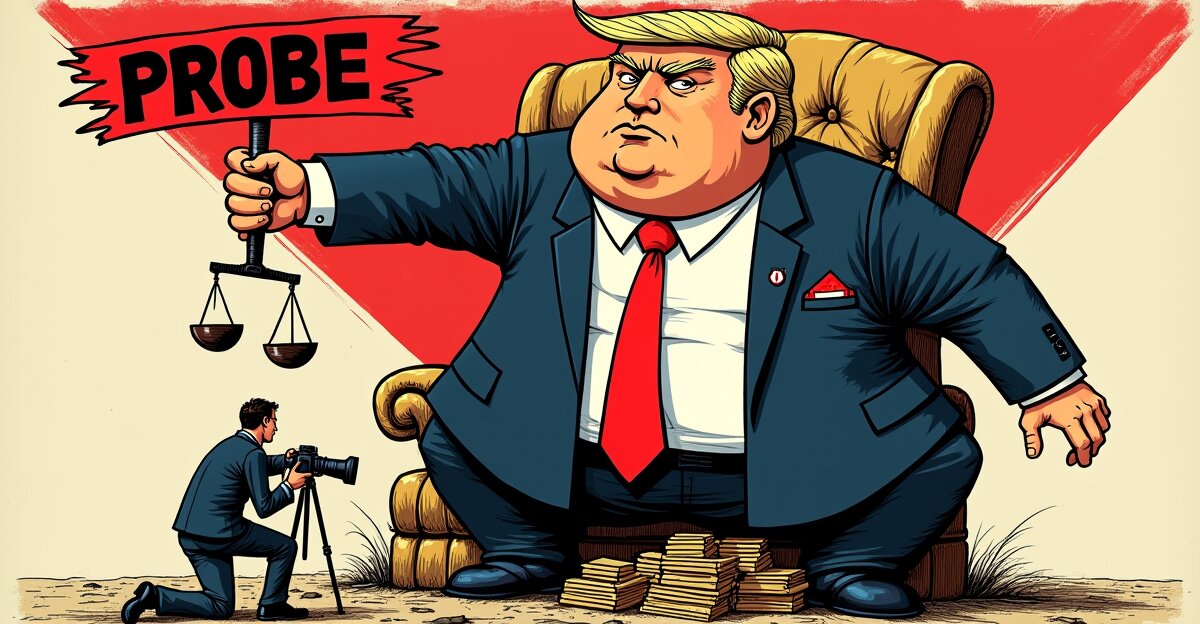
The Justice Department that spent two years abandoning antitrust enforcement against Big Tech has just pointed that same law at the news media.
"The investigation is nonsense. Trump may view the presidency as a business venture, but news outlets' standing up for their constitutional rights has nothing to do with antitrust law."
— Seth Stern, Freedom of the Press Foundation
The U.S. Department of Justice has opened an antitrust investigation into the five television networks that make up the White House press pool: ABC, CBS, CNN, NBC, and Fox News. The reason: for a few days in September, they collectively refused to film the president.
A Justice Department spokesperson, Emily Covington, confirmed the probe on Saturday. "Group boycotts among commercial competitors can violate the Sherman Act," she said. "The Antitrust Division is simply investigating to determine whether these news organizations have violated the antitrust laws."
Per The New York Times, DOJ officials contacted the networks on Friday and demanded communications and materials related to the White House TV pool. That is the setup. The federal antitrust office is now aiming a law written to break up monopolies and protect consumers at five news organizations that, briefly and in lockstep, declined to broadcast the man of the house.
The punchline is that the same division has spent most of this administration's tenure doing remarkably little of the work antitrust was actually designed for.
To understand why five commercial rivals would stand in unison, you have to start with what the White House did to three of them.
On September 18, President Trump announced that CNN, MS NOW, and Politico were barred from White House grounds. The following day their reporters were turned away at the gate. In a court filing, the administration argued the three outlets had failed to "maintain basic minimum 'standards of professionalism and decorum expected of those given access to the White House Complex, including' by 'publishing sensitive or classified information.'" The cited stories included CNN's reporting on the "top-secret" construction details of the East Wing bunker that anchors the president's $400 million ballroom.
The White House told the court that covering the president was "a privilege, not a right."
The president's televised coverage runs on an arrangement older than most of the people involved: the pool. The five networks split the cost of following the president, take turns operating the cameras, and redistribute the footage. When CNN was scheduled to carry the pool for the president's trip to the United Nations and the White House quietly stripped the assignment from them, the other four decided they would not step in.
On September 21, Bryan Boughton, the Fox News Washington bureau chief and current chair of the TV press pool, announced that "effective today, the TV pool will not be covering events designated as pool coverage of the president." He added, "There will be no replacement pool put in place."
Scott Nover, a media reporter at The Washington Post, summed up the effect: "There will effectively be no TV coverage of Trump's UN visit or other presidential events. This is a very big deal."
The three barred outlets sued. On September 23, U.S. District Judge Timothy Kelly, a Trump appointee, issued a temporary restraining order finding the ban likely unconstitutional and ordering the White House to "immediately return, reinstate, and restore" the credentials. The credentials came back on September 24. On October 8, the judge extended the block.
At that same hearing, the White House's lawyer defended the revocation, saying that "CNN, MS NOW and Politico engaged in apparently indefensible conduct." The outlets, for their part, argued the ban "brazenly discriminates based on editorial viewpoint."
That is when the story stopped being a First Amendment case and started being an antitrust investigation, and the optics began to fray.
Antitrust law carries a long-established exception for conduct protected by the First Amendment. The idea that a brief, collective decision to stop filming the president constitutes a "group boycott" among "commercial competitors" is, by most accounts, a stretch.
Jonathan Kanter, who ran the Antitrust Division for the previous administration, told CNN the networks' conduct is "not even in the same zip code of an antitrust violation."
"It's literally freedom of speech," he said. "It's no more an antitrust violation than the reporters coming together to form the pool in the first place."
Seth Stern, chief of advocacy at the Freedom of the Press Foundation, was blunter, noting the probe followed a public call by the far-right influencer Laura Loomer for an antitrust lawsuit against the networks. "Depriving Trump of the attention he craves is not a competitive harm," Stern said.
The deeper irony sits in the department's own track record. Antitrust law exists to keep the market from being swallowed by a handful of enormous players. For most of this administration, the Justice Department has done remarkably little to keep that promise against the players everyone actually worries about. It is now, suddenly, concerned about the competitive dynamics of five television newsrooms.
Translation: the division that has spent two years clearing the path for Big Tech is now doing paperwork on journalists.
Read plainly, the White House theory is that the presidency is a brand, attention is the product, and the news media is a competitor that has, on occasion, refused to distribute it. The Sherman Act, in this telling, becomes a tool for compelling a market in the president's own image.
Jose Zamora, the Americas director of the Committee to Protect Journalists, put the stakes plainly: "The government should not use antitrust investigations to intimidate news outlets defending press access. The public's right to know depends on that access."
The Justice Department says it is "simply investigating." The networks say they are exercising a right. A Trump-appointed judge has already ruled the ban likely unconstitutional. What remains is a department that has abandoned its actual mandate and repurposed it as a bludgeon, pointed not at the corporations that concentrate power and set prices, but at the journalists who refused to film the owner of the house.
The question is not whether five newsrooms that paused a camera for a week violated antitrust law. The question is what a government must think of the press to reach for that law in the first place.
Comments (0)
No comments yet. Be the first to speak up.
Join the Riot
Login with Google to leave a comment.
Login to Comment