
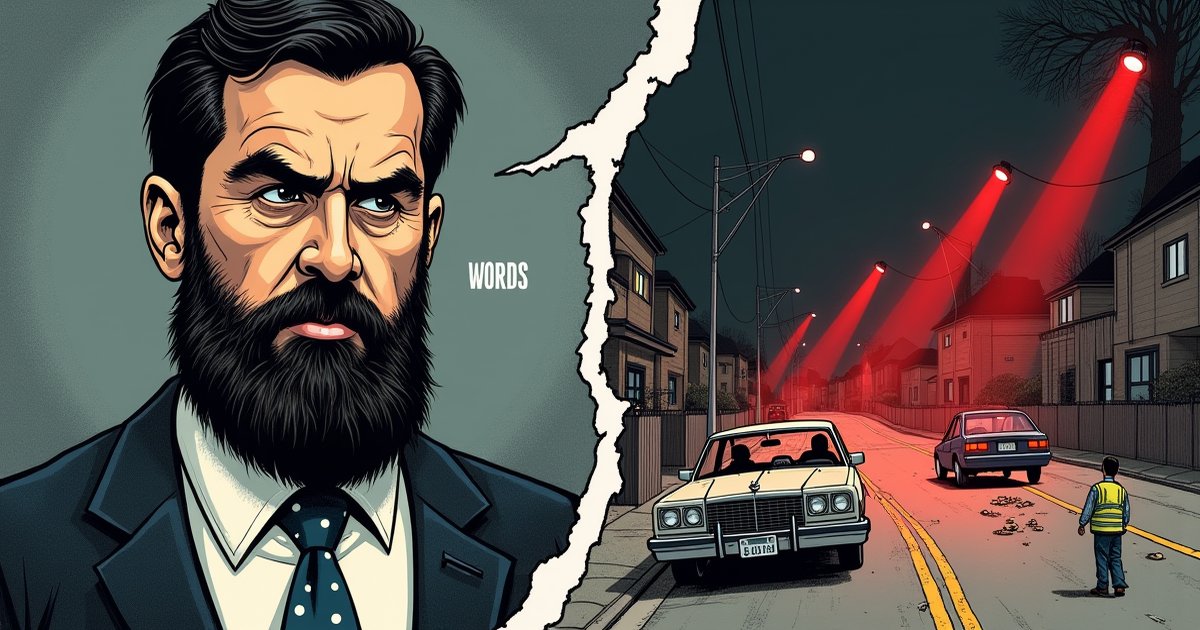
After federal agents shot a father in front of his five-year-old son, the mayor of New York learned that his city answers to no one he can call.
"There is no justification for what we have seen today."
— Mayor Zohran Mamdani, Marble Hill press conference, October 8, 2026
Around 4 p.m. on Thursday, a school in Marble Hill was letting out. The neighborhood is technically Manhattan, but it lives on the Bronx side of the river. A man got into his car, and his five-year-old son climbed into the back seat. Within minutes, federal agents had surrounded the vehicle. Witnesses later counted as many as seven rounds. The father, Oscar Belgal, 28, was shot in the neck. The child, according to city officials, was not physically injured.
In a photo of the aftermath taken by a neighbor, one of the agents wears a yellow construction vest, holding a modified rifle in one hand and a phone to his ear. The neighbor, Iris Rosa, told The Intercept that the man had been posing as a construction worker, and that she watched him peel the vest off and set it in a car afterward. The school let out. The shooting scene was the block.
That is the story in three paragraphs. The rest is about what it means that it happened in Zohran Mamdani's city.
The Department of Homeland Security called it a "targeted enforcement operation." In a statement, the agency said officers were attempting to apprehend "an undocumented immigrant from the Dominican Republic with a prior conviction for grand larceny," and that "an ICE officer discharged his weapon and the criminal illegal alien was injured." DHS Secretary Todd Mullin said ICE did not know a child was in the car. ICE also claimed Belgal struck two agency vehicles and drove toward officers, a version contradicted by witnesses and, per The Intercept, by NYPD body camera footage showing officers helping Belgal after the shooting.
It was the most prominent of at least 25 people shot by federal immigration agents this year, according to The New York Times. In July, after two fatal ICE shootings in Maine and Houston and a botched Las Vegas arrest by plainclothes agents wearing hooded sweatshirts, the agency mandated a new dress code for field operations. Three months later, an agent walked out of a construction vest in a residential neighborhood and fired into a car.
Translation: the dress code fixed the hoodies, not the mission.
Rep. Adriano Espaillat, D-NY, said he went to the hospital to see Belgal and that federal agents would not let him into the room. Gov. Kathy Hochul demanded "a full and transparent accounting." The mayor's office called the shooting "heinous."
The only federal agent captured on video brandishing a weapon at the scene has been identified by WIRED as Brenden Cuni, a supervisor in ICE's National Fugitive Operations team. His history, assembled from court filings, social media, and public records, reads like a case file the agency never closed.
In at least three federal cases this year, judges or the government found problems with Cuni's statements or arrest paperwork. One judge called an arrest warrant he signed "fraudulent." In another, U.S. District Judge Brian Cogan of New York's Eastern District said doorbell footage "largely contradicts" Cuni's sworn account of an arrest in which the man was handcuffed less than three minutes in, before Cuni had even filled out the warrant by hand. In a third, government lawyers withdrew what a judge described as Cuni's "inaccurate, sworn representations." In a Bronx case, Judge Gary Brown found that Cuni searched five databases for a man, found nothing, and then signed a warrant claiming the searches had confirmed his status. ICE later added the man to those databases, creating the exact record Cuni had said already existed. Brown ruled the detention illegal, writing that Cuni tried to "reconcile these falsehoods" after the fact.
Lawsuits name him in arrests where a handcuffed man in the Bronx was allegedly Tasered multiple times and called a "maldito Mexicano." Activists say he was among the agents who forced a pregnant woman to the ground in Minneapolis last winter; WIRED could not confirm that identification. In a deposition last month, Cuni said he did not recall ever making a warrantless arrest. "Now, if you're questioning my credibility, I don't know," he told lawyers, "but again, I am, I can only tell you what I'm aware of."
His Instagram handle was "shooter.cuni," now "shooter.914." A September post shows a bolt-action rifle at a range with "Cuni" embossed on the stock. The caption: "the finest form of relaxation."
Translation: a warrant a federal judge called fraudulent is not a paperwork problem. It is a design feature.
So the mayor. Mamdani stood side by side with NYPD Commissioner Jessica Tisch, a holdover from the Eric Adams administration that his own base wants fired, and said, "We know that ICE is rotten to its core." Earlier that day, he had accused the Trump administration of "terrorizing our city" and said he would ask the president to end all ICE operations in New York.
That is as far as it goes. A mayor cannot order a federal agency out of his city. New York's sanctuary laws and a state provision signed in August prohibit an NYPD partnership with ICE, but the practical seams stay open. The department has been notified of ICE operations in advance, including a Chinatown raid, per PIX11. It shares fingerprints with federal agencies, which share them with ICE. And on Thursday night, two rapid responders told The Intercept that Pete Gizas, who is simultaneously the director of the White House National Security Council and the acting special agent in charge of Homeland Security Investigations in New York, was at the scene for hours, speaking with NYPD and federal personnel while HSI officers went door to door in apartment buildings.
"If NYPD is in fact an agency that is controlled by the mayor of New York and by the people of New York, then why is a crime scene, a shooting scene, being presided over by Homeland Security Investigations?" one of them asked.
Translation: sanctuary in New York means the police can't help ICE make arrests. It does not mean they can't watch ICE run the crime scene.
The protest that night produced five arrests, all ticketed, and footage of officers pushing demonstrators, including Darializa Avila Chevalier, a Democratic congressional nominee knocked to the ground. The city's DSA chapter called for Tisch's firing without mentioning the mayor by name. A Politico piece from three days before the shooting could have been written that night: allies, it reported, are losing patience with Mamdani's light NYPD touch.
That is the shape of the mayor's problem, and it is not the kind that dissolves in a press conference. On the campaign trail he promised to rein in the NYPD, then he kept its commissioner. On the left he is now the pragmatist who won't disband the police. On the right he is the socialist who can't control the feds. In the middle, the agency that shot a father is being investigated by the FBI, by HSI, and, presumably, by the White House. The only lever the mayor has is a demand he must deliver to a man he has never met.
Murad Awawdeh, of the New York Immigration Coalition, put the political arithmetic plainly. The mayor's rhetoric is "a great first step." "But what is the city going to do other than deliver that?" he asked. "What are the actionable ideas that they're planning? We're gonna keep being in the same situation."
There are options. City Council members have reintroduced two bills that would limit data sharing between city agencies and ICE; they had been sitting for years, per the Immigrant Defense Project. Naureen Shah of the ACLU noted the surge New York is seeing is national, and that cities cannot stop ICE but "can hold officials accountable for the abuses they commit." The mayor's office announced a review of "all of the events of the last 24 hours," including "the staging of ICE operations in privately-owned parking lots," a strange admission, suggesting the city knew where operations were being staged, that it was on private property, and said nothing until the bullets flew.
None of this stops the next operation. Only people in Washington can.
The question is not whether Mamdani could have stopped what happened in Marble Hill. He couldn't. The question is what it means that the most popular politician in the most photographed city in America had to answer a federal shooting with a review, a demand, and a line about rot, while standing next to the commissioner his base wants out.
Mamdani said there is no justification for what New York saw on Thursday. He's right. But "no justification" is not a weapon. It's an epitaph.
Comments (0)
No comments yet. Be the first to speak up.
Join the Riot
Login with Google to leave a comment.
Login to Comment