
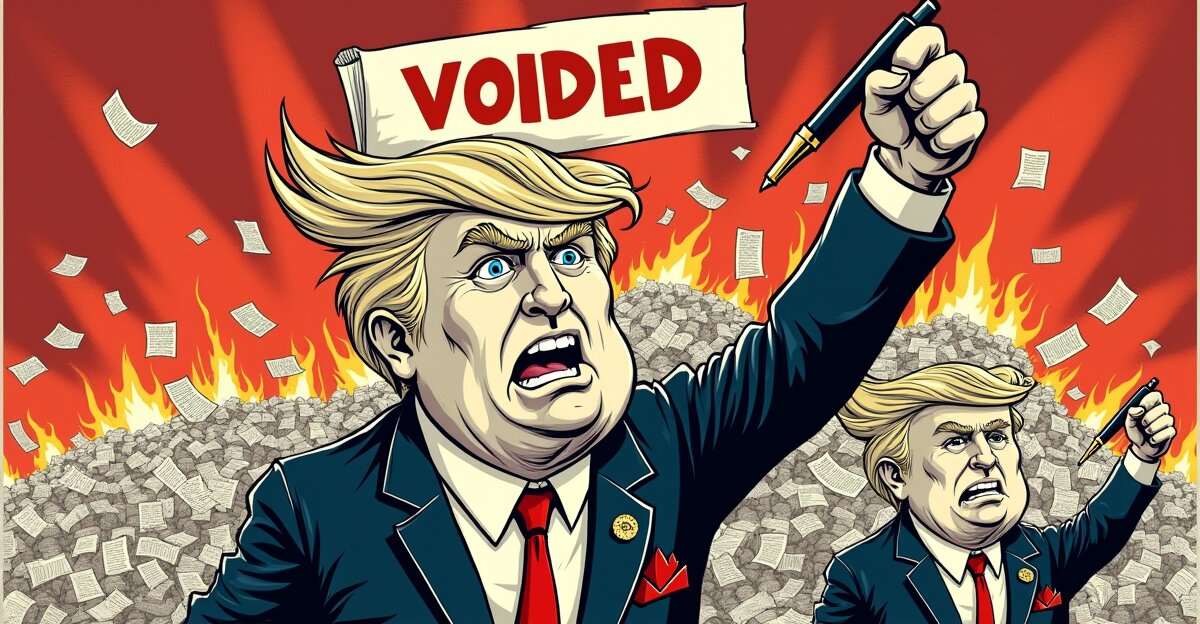
The president signs a bipartisan law in honor of a dead friend, then signs an executive order voiding it two weeks before the midterms, and the entire justification is one phrase: "the national interest."
"I am hereby waiving the application of such sanctions, restrictions, and duties provided for in the Graham Act."
— Executive order signed by President Donald Trump, October 16, 2026
Late Friday night, October 16, the White House website posted an executive order that erased one of the most bipartisan laws of the year. The order, signed by President Donald Trump, suspended the Lindsey O. Graham Sanctioning Russia and Iran Act of 2026, a package that would have imposed a 500 percent tariff on Russian goods, tariffs of up to 100 percent on goods from the five largest importers of Russian oil and gas (chiefly China and India), and 100 percent tariffs on the biggest facilitators of Moscow's shadow tanker fleet. It also named Vladimir Putin, Russian banks, and senior Russian officials as targets.
The timing is the real story. The order arrived two days before the law's own deadline. The tariffs were scheduled to take effect Sunday, October 18.
The Graham Act was no obscure statute. The Senate passed it 86-11. Senator Richard Blumenthal, D-Conn., co-drafted it. It was named for Senator Lindsey Graham, R-S.C., who died unexpectedly in July, days after returning from a trip to Ukraine, and the chamber rushed it through as a tribute. Trump signed it on September 18. At the United Nations on September 22, he presented the law as a weapon: "And if necessary, I will have to use them. It's time to stop the killing."
Twenty-eight days later, Trump signed its undoing. A law that took a year of negotiation, 86 votes, and a dead man's name to pass was dead in a month.
The order is short, and its justification is shorter. It certifies that the waiver "at this time is in the national interests of the United States," and it suspends the provisions until the president or senior officials "determine that further action is appropriate." Read closely, that is not a pause. It is an open-ended suspension with no deadline, no conditions, and no mechanism for Congress to check it.
The White House's Saturday explanation, from press secretary Taylor Rogers, framed the waiver as diplomacy: "Enforcing the sanctions provisions now would impede ongoing U.S. efforts to negotiate a durable and comprehensive peace agreement between Ukraine and Russia."
Translation: the only stated reason for voiding a sanctions law is a peace process that has not yet produced a single ceasefire, and the White House has not explained how pausing enforcement advances any negotiation. The national interest certification is the same device this administration has used to pause, suspend, or rewrite obligations on demand. What is new this time is not the mechanism but the target: the target is a law this president signed himself.
The waiver did not happen in a vacuum. It arrived a week after Trump announced that the United States would buy Russian diesel: more than 300,000 tons immediately, another 500,000 tons in November, and 1 million tons "immediately thereafter," all aimed at pushing down fuel prices that spiked during the Iran war. Lawmakers from both parties argued the deal hands Moscow war revenue while doing little for the pump.
The arithmetic behind both moves is visible in the polling. An AP-NORC poll published October 1 found most Americans blame the president for higher prices and disapprove of his handling of the Iran war. His approval rating sits at a historic low, and Republicans must hold both chambers on November 3.
On October 13, a bipartisan group of 12 senators, including Thom Tillis, R-N.C., wrote to Trump demanding he rescind the diesel deal. Five days later, the Graham Act was suspended. Rep. Gregory Meeks, the top Democrat on the House Foreign Affairs Committee, has since introduced a bill to block the diesel deal. Congress is in recess until after the election, so there is no quick legislative counter.
Translation: the diesel deal was the appetizer, and the waiver was the main course.
The response was immediate and, unusually, bipartisan.
Sen. Tillis called the decision "beyond irresponsible" and asked, "What part of enforcing a law passed 86-11 by the Senate does the President and his advisers not understand?" Sen. John Cornyn, R-Tex., said simply, "Lindsey would be appalled." Even Sen. Ted Cruz, R-Tex., one of the president's closest allies, said on Fox News, "I wish the president hadn't done it," adding that the current path "unfortunately, just... benefits Putin and that's not a good idea." Rep. Don Bacon, R-Neb., wrote, "The President is prolonging the war, not ending it."
The Democrats were not softer. Senate Majority Leader Chuck Schumer said Trump handed Putin "the best birthday gift he'll get this year" (the Russian leader turns 74 on October 7) and added that "there's nothing America First about Trump caving in to Putin." Blumenthal, the bill's co-author, said the waivers "have nothing to do with our national security, and everything to do with sucking up to Vladimir Putin." Sen. Elizabeth Warren, D-Mass., accused the president of "thumbing his nose" at Congress.
The coalition of objection is the interesting part: Democrats objected because it helps Putin. Republicans objected because it was their law.
Nowhere is the irony sharper than in South Carolina. Lindsey Graham's sister Darline, who was appointed to his seat and is now running to keep it with Trump's endorsement, made the Graham Act a centerpiece of her campaign. After the signing, she said, "I wish Lindsey were here to celebrate this historic day." In a debate this week with Democratic nominee Annie Andrews, she said she was "so proud" to help pass the measure. Then, with evident self-awareness, she added that how the law is used is "up to him" as president.
It is up to him. He has now spoken.
Lindsey Graham died days after returning from Ukraine, where he had spent months pressing for exactly the pressure the act embodies. The tribute was signed in September. The erasure was signed in October. The campaign is still running on a promise the president can rescind at any time.
On the other side of the table, the reaction was fast and, in its own way, understated. President Volodymyr Zelenskyy posted on Saturday that "a decision was unfortunately made in America to completely disregard the Lindsey Graham Act, which was supposed to impose truly effective pressure on Russia to bring this war to an end." His country had just endured what Kyiv called one of Russia's largest energy attacks of the war that weekend. More than 15 power facilities were hit, people were killed and dozens wounded, and blackouts spread ahead of winter. "Russia is trying to cause a blackout in Ukraine," Zelenskyy wrote, "right before winter." Earlier in the week, Trump had called Zelenskyy "more difficult to deal with" than Putin. Zelenskyy, addressing the European Union, said it was nice to be among "real leaders."
Putin's envoy Kirill Dmitriev called the waiver "an important and truly historic moment."
That is the whole picture of one night: a law signed in a dead man's name, voided before it took effect, condemned by both parties, mourned by the country it was meant to protect, and celebrated in Moscow. Trump has signed a great many things. The Graham Act is the first major law of this term to be signed and erased within a single month. The mechanism is simple. One signature creates the law, one signature kills it, and the check on it is on recess until November.
The question is no longer whether the president can undo his own laws. He has. The question is which of his signatures you were counting on, and whether the rest of them are still standing.
Comments (0)
No comments yet. Be the first to speak up.
Join the Riot
Login with Google to leave a comment.
Login to Comment