
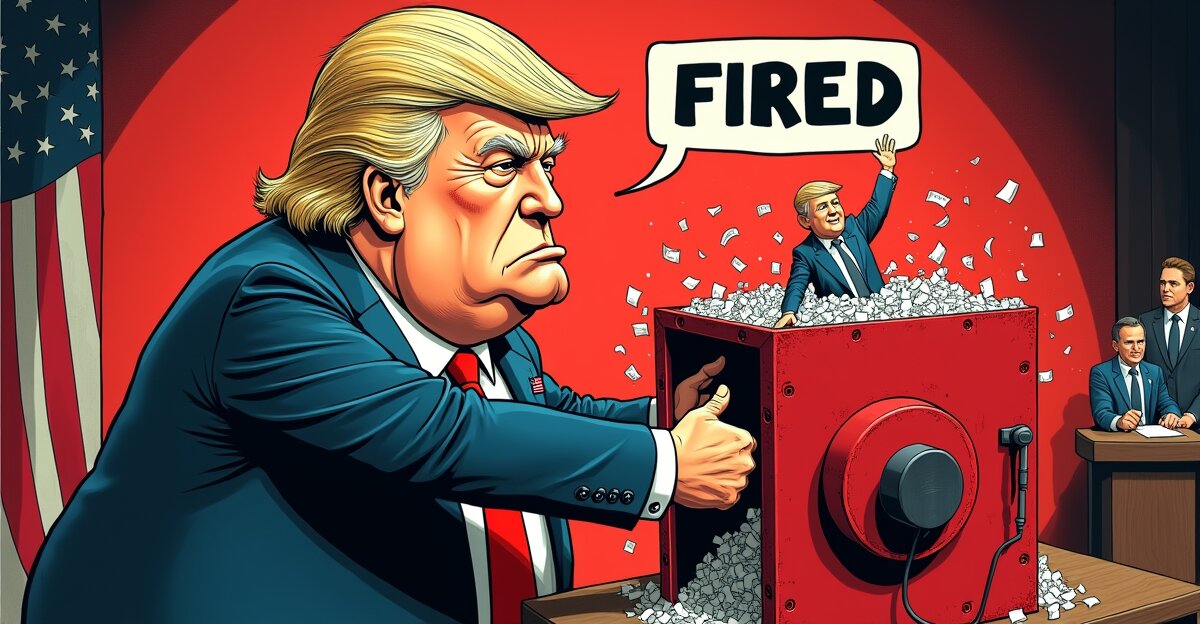
The White House press secretary lasted five days: hired on social media as an "attorney," fired before the country finished learning her name.
"She has suffered over the last few days. Maybe it's not for her."
— Donald Trump, on firing his press secretary five days after naming her
On Friday, President Donald Trump fired his new White House press secretary. It was five days after he announced the appointment, four days after her only briefing, and less than 24 hours after her interview on Sean Hannity's Fox News program. The official explanation, delivered by the president himself as he left for a rally in Georgia, had the ring of sympathy: "She has suffered over the last few days. Maybe it's not for her."
What's remarkable about the Katie Zacharia saga is not that the new press secretary failed. Failures happen in that job. What's remarkable is that the whole thing happened in plain sight, on the record, with the president's own words as the only source material.
The appointment began the way most appointments in this administration begin: abruptly, on social media, with credentials that would not survive the weekend. Karoline Leavitt stepped down as press secretary in late August, and the job sat empty for weeks before Trump announced Zacharia on Truth Social in a post that, among other things, described her as an "attorney."
According to Axios, which cited a White House official, even the president was "blindsided" when he learned she was not a lawyer, a detail the outlet said raised questions about the administration's vetting for high-profile roles.
The resume that emerged over the following days: a right-wing commentator who has spent years appearing on conservative news programs as a legal analyst. A reported stint at the Department of Homeland Security. Advisory ties to MAGA media. A history, per one report, of shilling a "sort of pyramid scheme." And, in her own tweets and public bio, the claim of being a lawyer. She has never passed a bar exam.
Her one and only briefing, on Tuesday, October 13, went the way briefings go for a first-time press secretary who is not an attorney. She appeared to read from a script. Reporters got few answers. At one point she reportedly mixed up the president with her own husband. Then came the question that ended it: a reporter asked which state she had passed the bar in.
The answer, in the clip that has circulated ever since, was that she had done so after moving to China.
Non-citizens are not permitted to sit China's certification exam for lawyers. And passing it would not, in any case, make someone a lawyer in the United States.
Dr. John Paul Garrison, a clinical and forensic psychologist who studies the body language of public figures, isolated a single moment in the footage: the instant the claim landed, Trump turned and stared at her. "That double take right there was the moment," Garrison said. "President Trump doesn't like surprises, and he doesn't like being embarrassed."
Translation: the president processed his own hire's lie faster than the briefing itself.
Then came four days of journalists doing, for the administration, what the administration apparently skipped. The pyramid scheme. The legal-analyst appearances. The tweets. Leaked text messages from inside the White House showed that people within the building had been wondering whether she was the person for the job, and one account put it more bluntly: even Trump reportedly conceded she had no talent, and installed her anyway.
On Thursday, Zacharia sat down with Sean Hannity, in what has traditionally been the safest chair in American media for MAGA-aligned figures. Politico reported that the interview was arranged in part by White House chief of staff Susie Wiles, who the outlet said had been unhappy with the appointment from the start. One source described the appearance as a "sanctioned hit." Another told Politico, "Danielle [Alvarez] and Susie fed her to Hannity."
Hannity opened by telling her, into a broad smile and a nod, that her briefing had "been widely panned, I'm sure you're aware."
The White House denials were nearly too colorful to count as denials. A senior official told Politico that "Susie and Sean do talk," but "Susie did not need to feed her to Sean or anybody else. It's not her style." Communications director Steven Cheung called the reporting "speculation" and "fiction that's not even creative," then delivered a eulogy for a job that lasted five days: "She is an amazing teammate and tremendous talent."
The president fired her less than 24 hours later.
The funniest part of the story is that MAGA's base, which has spent four years demanding that the president stop hiring for identity and start hiring for merit, is now furious about a DEI hire. On Saturday's "Table for Five," a panel that spans both parties, the verdict was near-unanimous. Cari Champion: "If you ask the question, 'Is this a DEI hire?' I would say that is, by definition, someone who got the job, who isn't necessarily worthy of it, nor has the actual qualifications. And based on what they look like, that's why they got the job. That's a DEI hire."
Abby Phillip framed the hypocrisy in a single line: "For years, MAGA has fought against DEI, arguing that merit should trump everything and that only the most qualified should ultimately get the job. So, it is interesting that the president gave one of the hardest jobs in government to someone whose qualifications are in serious question."
The pattern, former New York congressman John Avalon noted, does not stop at the podium. "Pete Hegseth isn't qualified to be secretary of defense. Kash Patel is not qualified to be FBI director. Robert F. Kennedy Jr. is not qualified to run HHS. So, this is a pattern." Even the panel's most forgiving voice, National Review's Noah Rothman, conceded: "But you've got to be able to go back and check your facts."
That is the administration's entire pitch, inverted. "My best people," Trump has called them, as if it were a term of endearment. The best people of this White House have one thing in common, by the evidence: they look like they belong.
The "blindsided" defense is the final layer, and the most telling one. A president can be blindsided by a leak, a court, a foreign power. Being blindsided by the bar-exam status of a person he personally named, in a post he personally wrote, describing her as an attorney, is not a defense. It is a confession. The vetting for the most important press briefing room in the world was apparently performed by someone who never asked the one basic question, and that one basic question is the one the country had to ask for him, on television, on day two.
The question isn't whether the White House vetted its press secretary. The question is what the vetting was actually vetting for. Every witness in this story, on both sides of the aisle, has now answered the same way: she got the job based on what she looked like. The "attorney" lasted five days. The vetting, by all accounts, never happened at all.
Comments (0)
No comments yet. Be the first to speak up.
Join the Riot
Login with Google to leave a comment.
Login to Comment