
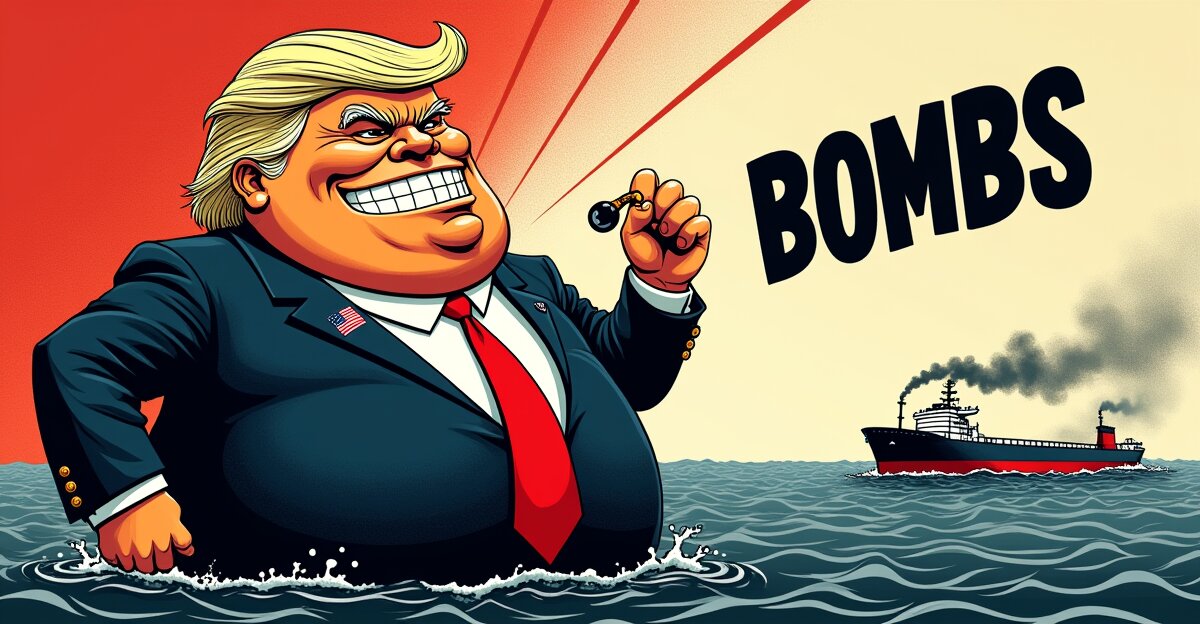
A war that could have ended in seven days now has a new deadline: November 3. The president, a self-described dealmaker, turned down the only deal on the table.
"I Rejected Their Deal. They Want To Make A Deal Where They Open The Strait Immediately Because They're Losing So Badly... We're Winning Tremendously."
— President Donald Trump, White House South Lawn, Saturday, September 26
The words came out on the White House South Lawn on Saturday, as the president climbed the stairs to Marine One, in the tone of a man announcing he had found a better price at the second store. Iran had brought a concrete plan, seven days to reopen the Strait of Hormuz and end the bombing. He looked at it and said no.
"We have total control of the Hormuz Strait," he told reporters. "They want to make a deal, and I think that's fine. I like making a deal, too. But that deal would not be acceptable."
It was not acceptable, the Wall Street Journal reported, because the war was on a different schedule. The paper, citing unnamed US officials, said the president was "privately sceptical" that Tehran would meet his demands and had told aides he expected to resume bombing Iran after the November midterms.
Translation: the war is now on an election-day clock. November 3 is not just the date of the midterms. It is the start date for the next bombing run.
The rejected deal had specific terms. The plan, delivered to Washington through mediator Qatar and announced Friday at the United Nations General Assembly, would have required the US to release frozen Iranian funds, lift oil sanctions, end the naval blockade on Iranian ports, and accept a maritime transit route through the strait that Iran and Oman had already agreed to. In return, Tehran would reopen the waterway within days and begin negotiating a final agreement by the seventh. A regional ceasefire covering Lebanon and Yemen was part of the package, according to Al Jazeera's account of the talks the Iranian foreign minister held with the president's envoy, Steve Witkoff, earlier in the week.
Seyed Abbas Araghchi, the Iranian foreign minister, told reporters his side could complete its steps in four or five days. Sina Toossi, a senior fellow at the Center for International Policy, told CNN that the proposal was "essentially the same bargain" as the June deal, "but with a very different sequence." This time, the United States moves first.
That is an unusual sequence for a country whose president spent the week threatening to "annihilate" Iran from a United Nations podium. It is also a familiar sequence for anyone who has watched this administration negotiate: the other side gets to trust again, eventually.
There was a deal before this one. In June, the two countries signed a memorandum of understanding laying out a temporary ceasefire. It collapsed within days after fresh strikes were exchanged. Iranian officials say Washington undermined it; the White House says the other side fired first. What remained was a closed strait, a hot economy, and a president who, early Saturday, posted an image of the waterway to Truth Social labeled the "Trump Strait."
Ryan Costello, a policy director at NIAC Action, the group that sued the administration on Thursday to stop the war, laid out the pattern. "Attack Obama for negotiating a successful deal. Tear up the deal, say you'll get a better one. Start a war instead, blowing up the economy. Strike a deal to end the war, stick to it for a fortnight. Refuse to go back to the deal heading into the midterms."
A ceasefire with an election-day expiration date is not a ceasefire. It is a holding pattern.
The holding pattern has a price, and it is showing up on gas pumps and in the polls. The closure of the strait, through which roughly a fifth of the world's oil flowed before the war, has sent diesel and gasoline prices soaring. The administration's economic blockade and secondary sanctions have grounded flights to and from Iran across the region and beyond. Araghchi has put the US cost of the war at $100 billion, a figure the Pentagon disputes but has not answered with a number of its own.
The American public has been doing its own accounting. The NBC News Decision Desk Poll finds 31 percent approval for the president's handling of the war and 69 percent disapproval, and the president's overall approval has hit a record low with fewer than six weeks until the midterms. When the Senate took up a resolution calling for the end of the war, Republicans voted it down, in lockstep with the man who had just called the conflict a personal victory.
The law is catching up too. NIAC's suit argues that a war without congressional authorization is unconstitutional. "No president should have the power to take this country into an indefinite war by himself," the group's president, Jamal Abdi, said.
Iran, for its part, did not read the rejection as a closed door. Araghchi posted on Saturday that the country "will not back down" on its conditions, noted that nothing had yet been conveyed through the mediators, and observed, with the weary precision of a man who has heard this voice before, that the American president "has also made many good remarks as well as many contradictory remarks, which unfortunately we hear from him frequently." On Sunday, on NBC's Meet the Press, he said only a "negotiated solution" could get the United States "out of this deadlock," and that Iran was "fully prepared for the war to be resumed," even "if it comes to a doomsday war."
President Masoud Pezeshkian, who was in New York for the General Assembly, was plainer still. "We have no trust in the American side and do not know on what basis an understanding can be reached with it," he told Al Jazeera. Amir Hatam, the commander of Iran's army, told state media that the war was at a critical and decisive stage: "If Iran cannot trade, if Iran cannot live, no one will be able to trade or live."
A POLITICO Europe newsletter this week called the diplomatic cycle "Groundhog Day," which is exactly what it looks like from the outside: the same offer, the same refusal, the same seven days that never arrive. Ross Harrison of the Middle East Institute said Iran's leaders likely were not surprised at all, since the proposal closely mirrors the failed June memorandum of understanding. Mike Hanna, Al Jazeera's Washington correspondent, called the plan "dead in the water" and said the president "is content to stay in the status of limbo," even as much of the American public worries the conflict is becoming another "never-ending war."
So the strait stays shut, the blockade stays up, and the calendar does the rest. There is something strange about a president who claims total control of the most important waterway on Earth and uses that control to keep the world waiting until he has finished counting his votes. Americans are paying for the wait at the pump. Araghchi says "it is up to President Trump to choose," which is true in the way a hostage's negotiator says "the decision is with the kidnapper."
The question was never whether Iran saw this coming. The question is what a war looks like in America when its only off-ramp has an expiration date, and the president holding the key says the door stays closed until after the polls.
Comments (0)
No comments yet. Be the first to speak up.
Join the Riot
Login with Google to leave a comment.
Login to Comment