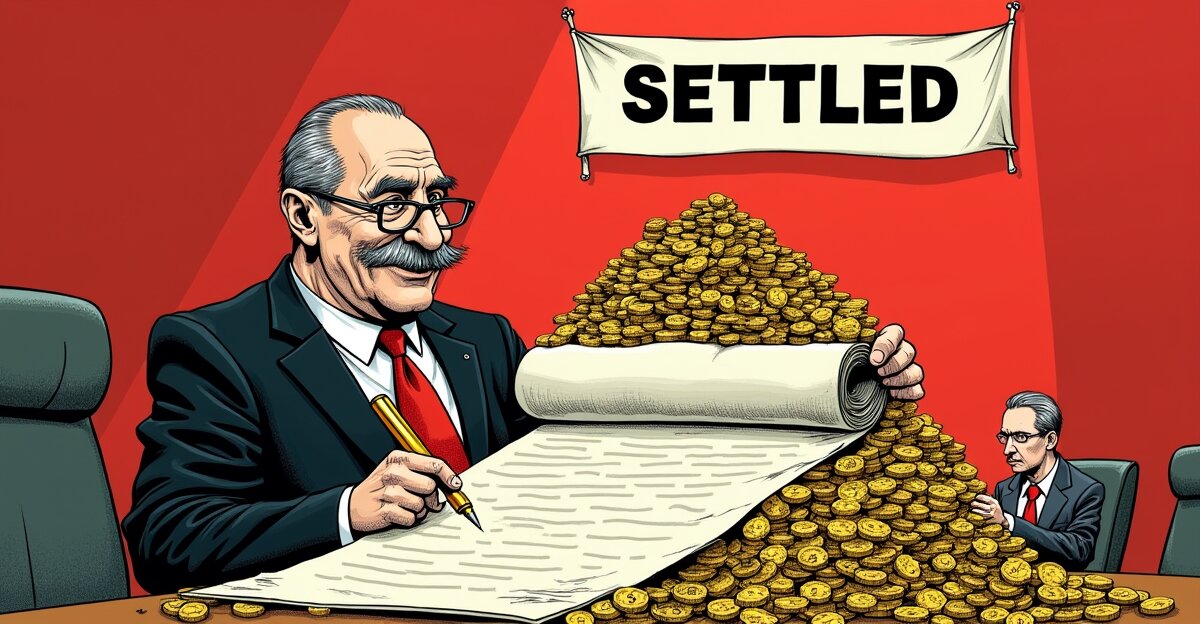
Twelve states sued to stop a $111 billion merger, then settled for a film quota, a worker fund, and a board called the "News Editorial Independence Board," and the family that owns Oracle got Hollywood.
"Citizens will be on their best behavior, because we're constantly recording and reporting everything that's going on."
— Larry Ellison, Oracle Financial Analyst Day, September 12, 2024
On Monday, September 21, California Attorney General Rob Bonta, flanked by eleven fellow state attorneys general, announced a settlement with Paramount Skydance that resolves the lawsuit his coalition filed in July to block the $111 billion acquisition of Warner Bros. Discovery. The suit argued the merger would lower output, raise prices, and hurt both workers and consumers. The settlement ends that lawsuit. In exchange, the merged company has agreed, for five years under a court-enforceable consent decree, to make more films, spend more on domestic production, pay for displaced workers, keep its cable channels in separate negotiations, keep Pluto TV free, and, in the most striking line in the entire document, create a "News Editorial Independence Board" to help CNN and CBS maintain their editorial independence.
Bonta's own press release contains a sentence that should be framed and hung over every newsroom desk in America: "Let me be clear: This settlement is not a vote of support for this merger."
The details read like a production schedule. Thirty films a year in the first two years, twenty of them wide releases, rising to thirty-two a year in years three through five. At least four independent films every year. If the company misses the quota in any year, it must divest Miramax Studios and pay $30 million per missed film into the healthcare and retirement trust funds of the Writers Guild, IATSE, the Directors Guild, and the Teamsters, plus a cut for the National Association of Attorneys General to fund more antitrust enforcement.
There is a $25 million independent film fund, an additional $1.5 billion for domestic production over five years (a meaningful number, because only about 5 percent of Paramount's production currently happens in the United States), and a workforce fund of $47.5 million for workers displaced by the merger. The domestic-production commitment is even tied to tax credits: if Congress passes a federal film credit of at least 20 percent, U.S. output must reach 20 percent of production in the first two years and 30 percent after, and up to 40 percent if California or New York adds a state credit of their own.
For five years, Paramount's basic cable channels and Warner's basic cable channels must be negotiated separately, so the merged company cannot hold cable audiences hostage to push prices up. An independent monitor will oversee compliance. Paramount is barred from selling or closing its Melrose Avenue lot or the Warner Bros. Burbank lot, and must run both "in a manner consistent with past practices."
Translation: the states that sued on antitrust grounds ended up negotiating the business plan of the largest media company on earth, and the central remedy for a merger that threatens to make less content is to make a quota sheet and check boxes on it.
Now consider who is getting all of this. Paramount Skydance is run by David Ellison, chairman and CEO, whose father, Larry Ellison, the Oracle co-founder, personally guaranteed $46.7 billion of the equity financing for the deal, according to Variety, while Paramount separately raises another $7.5 billion in debt. The Ellison family also controls CBS News. And the family has a track record that predates this deal by decades.
On September 12, 2024, Larry Ellison stood in front of Oracle investors and described the surveillance state he was building. Police body cameras would be always on, he said, streaming to Oracle data centers where AI would watch every feed at all times. His pitch included AI cameras that lock down schools the instant an unfamiliar person appears on campus, a new generation of autonomous drones deployed as first responders, and body cameras that cost seventy dollars, hang on a vest, and "don't really turn off." Officers could ask for a bathroom break, and Oracle would keep recording anyway, locked away until a judge ordered otherwise.
"The police would be on their best behavior, because we're constantly watching and recording everything that's going on," Ellison told the room. "It's unimpeachable. The cars have cameras on them."
Jason Koebler of 404 Media covered the presentation and its afterlife. Every technology Ellison pitched already exists in some form, and none of it has measurably reduced crime. What they have done, collectively, is cost billions and make the surveillance companies very rich. "Big Brother is here," Koebler wrote, "and, surprise, having AI 'supervision' has not created a crimeless utopia." In the meantime, Oracle has become a favorite of the American government, winning a roughly $7 billion Pentagon contract in July 2026, and, per the Intercept, is selling what one advocacy group calls "profoundly scary weapons" to foreign armies.
Seth Stern, director of advocacy for the Freedom of the Press Foundation, put the merger and the surveillance business in the same sentence the way they belong in one: "There's no better way for the Ellisons to accomplish that end than buying up as many media holdings as possible while their buddy is president. It's the perfect feedback loop: Stoke America's fears about crime, terrorism, and anything else they choose to inspire further public investment in Oracle's products."
So how did the states that filed the antitrust suit end up signing the deal into existence? The road was lined with money and threats. The Department of Justice closed its own investigation of the merger in June without seeking any remedies. During settlement negotiations, Paramount threatened to move its studio out of California, and Governor Gavin Newsom has said he took that threat seriously. Some in Hollywood now argue Bonta ultimately bowed to political pressure from Newsom and Los Angeles Mayor Karen Bass over jobs.
The day after the settlement was announced, entertainment workers marched past the Melrose gate of Paramount Studios under a banner that said "Block the Merger." The unions the settlement exists to protect, from IATSE to SAG-AFTRA to the Teamsters, issued endorsements within hours, and their statements read like a choir of gratitude for a deal their members were protesting. Paramount, for its part, has told Wall Street it expects to save more than $6 billion in costs, and a report commissioned by Los Angeles County estimates 4,500 jobs in the county could disappear over three years.
Then there is the part almost nobody is saying out loud. Senator Cory Booker, the top Democrat on the Senate antitrust subcommittee, wrote to the federal judge with a point that should make anyone in charge sit up: because the Justice Department walked away, this consent decree is "the only enforceable instrument that will govern" the combined company.
On Thursday, Judge Araceli Martínez-Olguín declined to approve the decree on the spot. "I'm not the only one who has some questions for you all," she told the parties. "There's lots of interest." The parties have until September 28 to answer her and Booker. David Ellison told employees the deal could close in about two weeks. David Zaslav, the Warner Bros. Discovery chief, told his staff it will close no later than early October.
Translation: the only court-enforceable rulebook for the largest media company in America is a settlement the states made to end their own lawsuit, and it is still not technically approved.
The funniest clause in the entire consent decree is the one with "independence" in its name. A settlement provision promising that a family which builds surveillance for governments, sells defense technology to the Pentagon and foreign militaries, and has publicly predicted that "citizens will be on their best behavior" under always-on cameras will somehow keep CNN and CBS "editorially independent" is not a remedy. It is a receipt. It is the moment the antitrust case stopped pretending the problem was competition, when the actual problem was power.
The question is no longer whether the Ellisons will own the largest media company in the world. The question is what the twelve states decided was a fair price to let them: a film quota, a worker fund, an indie film fund, a tax-credit escalator, and a board with "independence" in the name. America's next Big Brother does not carry a camera on his hip. He has a studio lot in Burbank, a news division, a $46.7 billion personal equity guarantee, and a consent decree signed by twelve state attorneys general. And somewhere in an Oracle data center, the cameras never turn off.
Comments (0)
No comments yet. Be the first to speak up.
Join the Riot
Login with Google to leave a comment.
Login to Comment