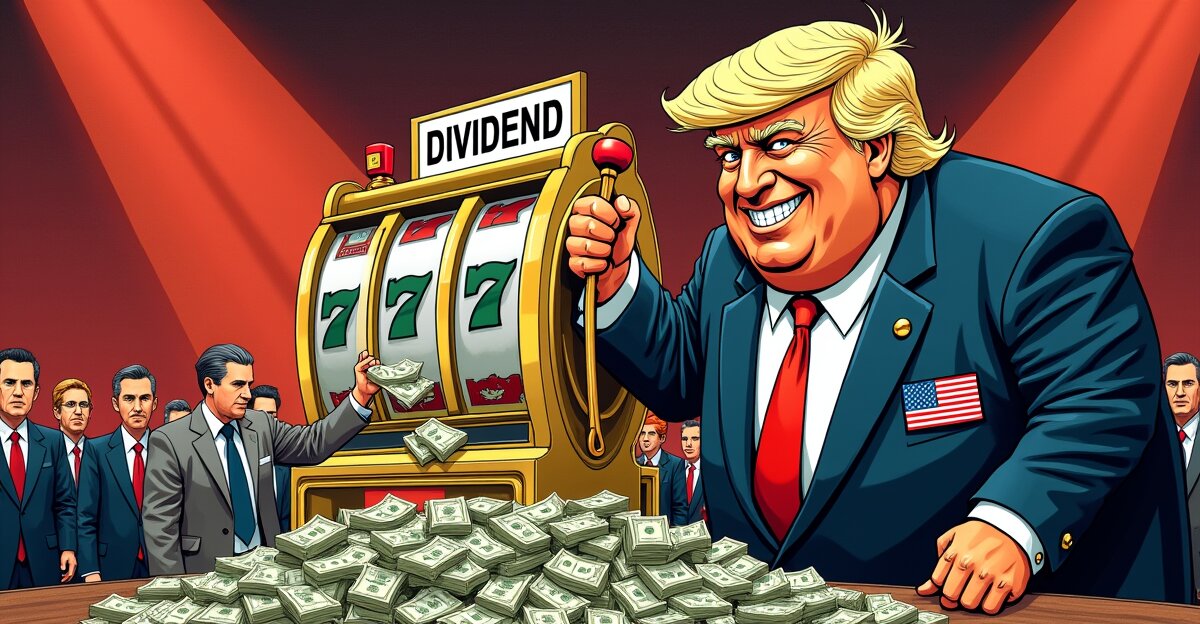
A president who has run up a $40 trillion national debt tells a crowd he can pay every adult American $5,000, and calls it a dividend.
"If the Republicans win, you win with us and you get $5,000. It will be called the Trump Dividend."
— President Donald Trump, at the Republican midterm convention in Dallas
The American Airlines Center in Dallas went loud on Wednesday night for a promise that does not exist in any budget, on any spreadsheet, in any office the president controls. Trump, standing before a two-day "Trump-a-Palooza" built to rescue his party's midterm hopes, offered every American adult a check for $5,000, contingent on Republicans holding both chambers of Congress in November. The check, he said, would be called the Trump Dividend.
A dividend is what a corporation pays its shareholders out of its profits. The United States is not a corporation, and it is not in the black. It is running a deficit of nearly $1.8 trillion a year, and the national debt crossed $40 trillion for the first time last month. The two facts do not sit together comfortably, but on a convention stage they are not required to.
The price tag is not subtle. The Census Bureau counts roughly 245 million American adults, which puts the payout at a little over $1.2 trillion before anyone thinks about the cost of writing and mailing the checks. Reuters, using a broader adult estimate of 270 million, landed near $1.35 trillion. That is more than the entire Pentagon's 2026 budget request, handed to 245 million people in exchange for a specific outcome at the ballot box.
Trump offered no funding plan. He gestured at "our tremendous strength and success economically" and called it a day. Within an hour, Vice President JD Vance tried to trim the edges off the idea: maybe not the wealthy, he suggested, and maybe tariffs could pay for it. That is the version of the story that makes the numbers work on paper. In reality, the United States collected about $195 billion in customs duties in fiscal 2025, less than one-sixth of what the dividend requires. And the Supreme Court struck down much of the president's emergency tariff program last year, prompting roughly $100 billion in refunds by August.
Translation: the revenue stream Trump has spent two years describing as a fountain of free money is, by his own administration's numbers, a stream you could fill a swimming pool with and never cover the mortgage.
There is a deeper problem than the arithmetic. The Constitution's Appropriations Clause is plain: money may not be drawn from the Treasury except through laws that Congress passes. The president cannot order Treasury to open a checkbook. Marc Goldwein of the Committee for a Responsible Federal Budget put the point bluntly. Trump has no authority to send this money without Congress. Dividends are what companies pay out of surplus, and Goldwein's verdict on the premise is a line you can hear in every office from here to the Hill: "The idea that we've had fiscal success is backwards and bordering on laughable. We don't have surpluses to give away."
That means the dividend is not a switch that flips after November 3rd. It is a bill. Republican Senator Bernie Moreno of Ohio already wrote that he would "get a bill ready" to pass the Trump Dividend immediately after the election, "because Republicans (and America) will win!" The word doing all the lifting there is the assumption buried in the parentheses.
A campaign economist who has watched this from the outside framed it the way the numbers do: "This is not a payment to be made. This is a payment to be argued about for years, if at all."
The convention had a second, quieter act that the cable feeds ran between the fireworks. Senator John Fetterman, the Democratic senator from Pennsylvania, appeared by recorded video, standing in front of a steel mill, to introduce his fellow Pennsylvanian and GOP rival Dave McCormick. He called him "a great American," declared that he would "work with President Trump to fight and defend the steel way of life," and spent his sixty seconds rejecting "the extremes and socialism and that anti-American way of life." He did not say his name when he said it, but everyone in the room understood who he meant.
The White House social account reposted the clip with a single word: "Based." Fetterman, who has spent a year voting with Republicans on shutdowns, nominees, and the Iran war, later insisted he is not switching parties. But the message landed the way the dividend did: a Democrat, on the Republican stage, endorsing the brand of a man who is paying his own side $5,000 to show up.
The midterms are where a party's patience runs out, and both things happened at once: a $1.2 trillion bribe on one channel, a defection on the other.
Trump has done versions of this before. A $1,776 "warrior dividend" for the military last year. A floating $2,000 tariff check earlier this year. A "DOGE dividend" that Elon Musk's spending cuts supposedly would fund, a sum that never materialized because the cuts themselves are a matter of legend at this point. What is new is the condition. Every earlier check was a general goodwill gesture. This one is a bet. Win the election, and the money appears. Lose it, and the American adult gets nothing. It is the only campaign promise on either side that pays out on a specific, verifiable outcome, which makes it look, to anyone who has ever sat in an actuarial office, exactly like what it is.
The enforcement is even murkier. Trump said recipients must "spend it in the United States," a clause that would require the Treasury to police every transaction a 245-million-person population makes, to decide whether a coat bought from a U.S. retailer made with imported fabric counts. Economists are unanimous that the condition is nearly impossible to administer and does little to ensure the money supports American production.
The irony is not lost on anyone who has opened a bank statement this year. The same administration that floated the dividend called it a reward for "tremendous strength and success." Americans are watching fuel prices at a record high on an Iran war they overwhelmingly oppose, debt they did not vote for, and a president who, at a fundraising convention where local parties were charging up to $20,000 a seat, decided the best use of the nation's surplus was to write it on a check.
The question is not whether the money is real. It isn't. The question is whether a $1.2 trillion promise, made in a sports arena to a crowd that paid $20,000 to be there, is a policy position or a scoreboard. When the president frames the entire election as a bet that pays the nation in cash, the answer stops mattering. The check was never the point.
The dividend is a lie detector, and the crowd is the lie.
Comments (0)
No comments yet. Be the first to speak up.
Join the Riot
Login with Google to leave a comment.
Login to Comment