
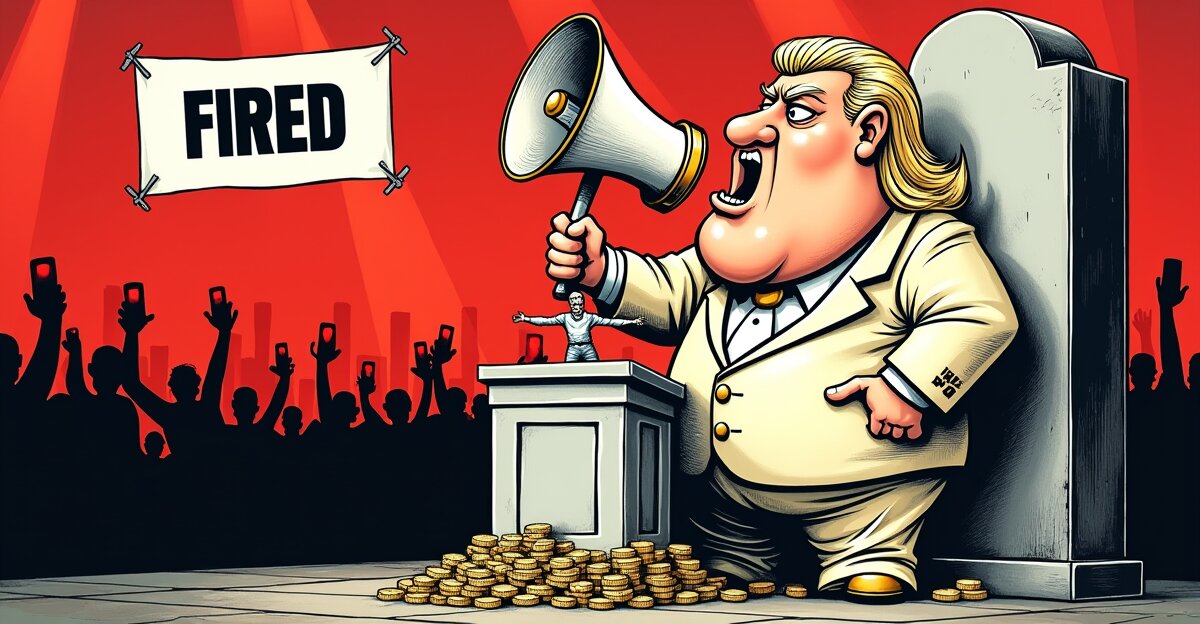
One year after his murder, Charlie Kirk's witch hunt is still destroying careers, and his widow now runs the machine from his grave.
"When you see someone celebrating Charlie's murder, call them out... And hell, call their employer."
— Vice President JD Vance, on his podcast, days after the killing of Charlie Kirk
On September 10, 2025, a lone gunman shot Charlie Kirk in the throat at Utah Valley University, killing the conservative commentator within minutes. He had been answering a student's question about his own conspiracy theory that transgender people cause mass shootings. His final words, as widely reported: "Counting or not counting gang violence?"
Within days, the dead man was canonized. President Trump called Kirk "our greatest evangelist for American liberty" to a packed memorial crowd, and the vice president gave his audience a practical instruction for the weeks ahead. It is the instruction that defined the next twelve months: call out anyone perceived as "celebrating" the murder, and then, if you do not mind, call their employer.
The right wing obliged. What followed was one of the largest mass censorship campaigns in modern American history, and exactly one year after the shooting, the people it wrecked have mostly not recovered.
The machinery was improvised, and it worked. Doxing lists circulated, naming people accused of "celebrating" Kirk's death. Less sophisticated users could simply search the name "Charlie Kirk" on X and harass anyone with a negative post. Big accounts like Libs of TikTok doxed critics and amplified the hatred to audiences of millions.
Allen Chaney, legal director of the ACLU of South Carolina, which has represented several victims, says the strangest feature of the campaign was how engineered it was. "One of the things that was really interesting and very destructive about the post-Charlie Kirk purge was how coordinated and manufactured the outrage was," he told The Intercept. "I don't think any other era has had the tools to do the sort of purging that is available now."
The government did not merely look on. Defense Secretary Pete Hegseth led a push to punish military service members over Kirk comments. The State Department revoked the visa of a foreign national who had tweeted that Kirk "won't be remembered as a hero." ABC temporarily pulled Jimmy Kimmel off the air over a joke. The Washington Post fired opinion columnist Karen Attiah for pointing out Kirk's deep anti-Blackness; an arbitrator only reinstated her last month.
Translation: a dead man was being avenged by a living government, and the paperwork came with a federal seal.
Under the spectacle were ordinary people, which is what makes the story so hard to watch.
Kimberly Hunt was 31, an HR professional in Scottsdale, Arizona. She made a short video noting that Kirk had said a few deaths a year were acceptable if it preserved the right to bear arms, that he "actively fought against women's rights," and that he "is openly Islamophobic." The internet found where she worked even though she had never listed it. The phones began to ring. "He explained that I had put him in a tough position because there were so many phone calls coming into our business that it was disrupting their operations," she recalled. A local sheriff later called to say she was on a "hit list." Officers surveilled her home for two weeks. She has not found a full-time job since September.
Dave Handler taught the First Amendment at an online high school in Minnesota. He posted that he would not mourn a "Nazi" and shared an article cataloguing things Kirk had said over the years. Someone complained to the corporation that owned his school. "I post basically 10 words and an article, and I lost my career," he said. He does not have the money to hire a lawyer.
Emily Taylor, a tenured English professor at Presbyterian College in South Carolina, did nothing so extreme as name anyone a Nazi. She wrote an essay for Ms. Magazine arguing that the violent masculinity she had studied for her career had led to the shooting that killed its champion. A state representative targeted her on social media. A lieutenant governor called for her to lose her tenure. A 29-year-old state representative, Luke Rankin, called for the state to pull funding from the small Christian college, and his colleagues co-signed the threat. Presbyterian has about 1,000 undergraduates. Taylor resigned in December to save it.
The First Amendment survived McCarthyism by being ignored. This one survived by being deleted.
The count keeps climbing. A Reuters investigation tallied more than 600 Americans fired, placed on leave, investigated, or otherwise punished in the aftermath of the killing. Lawsuits have produced at least $2 million in disclosed settlements. A handful of the fired got their jobs back, including a tenured art professor in South Dakota, a Clemson professor, and a Florida art history professor who was doxxed after roughly 48 quote-tweets about Kirk.
Reinstatement, though, is not the same as made whole. Karen Leader is back at Florida Atlantic, but she says: "I always, for the rest of my life, will be looking over my shoulder in case one person is still stewing over this who has my address." And the victims, as one of their attorneys puts it, were never positioned to absorb the damage. "My clients really were not high-income earners; we're talking about support staff," said Melody Fowler-Green. "A lot of the people who lost their jobs, they are people who are not in positions of power."
Even when the courts eventually pay out, the arithmetic is bleak. "That's the only thing our justice system can offer, right?" Fowler-Green said. "The people who are making the decision are not paying the money. It's not their money; it's my money."
Here is the twist that makes this an anniversary story rather than an obituary: the machine is still running, and it has a chief executive. Erika Kirk, the widow, now runs Turning Point USA, the organization her husband built. "He did enormous harm, and his organization continues to do enormous harm," said Leader, who had first encountered Kirk through the "Professor Watchlist," the roster of left-leaning faculty he compiled starting in 2016.
The right wing spent the fall trying to turn Charlie Kirk into its Martin Luther King. The internet tried something else and made him a meme. The cult is now arguing with the joke, and the joke is winning.
The one man who paid an actual price: Luke Rankin, the state representative who led the funding threat against Taylor's college, lost his June primary by roughly 20 points. Taylor has sued the four lawmakers with the ACLU, asking a court to declare their threats unconstitutional and to force them to rescind the letter. If she wins, the compensation will come from public money, not their pockets.
Kirk is buried. His ghost remains on payroll.
That is the arithmetic of the Kirk year. A movement organized around outrage, handed a murder, did what such movements do: it converted grief into a hit list, and the hit list into careers. The tools Chaney laments are real, and they have been used, and they will be used again, because the purge worked. It broke careers, it broke a small college, it broke a first-generation professor's faith in her profession, and it cost the country almost nothing, because almost nobody who ordered it had to pay for it.
The question isn't whether the purge was possible. The question is why anyone was surprised.
Comments (0)
No comments yet. Be the first to speak up.
Join the Riot
Login with Google to leave a comment.
Login to Comment