
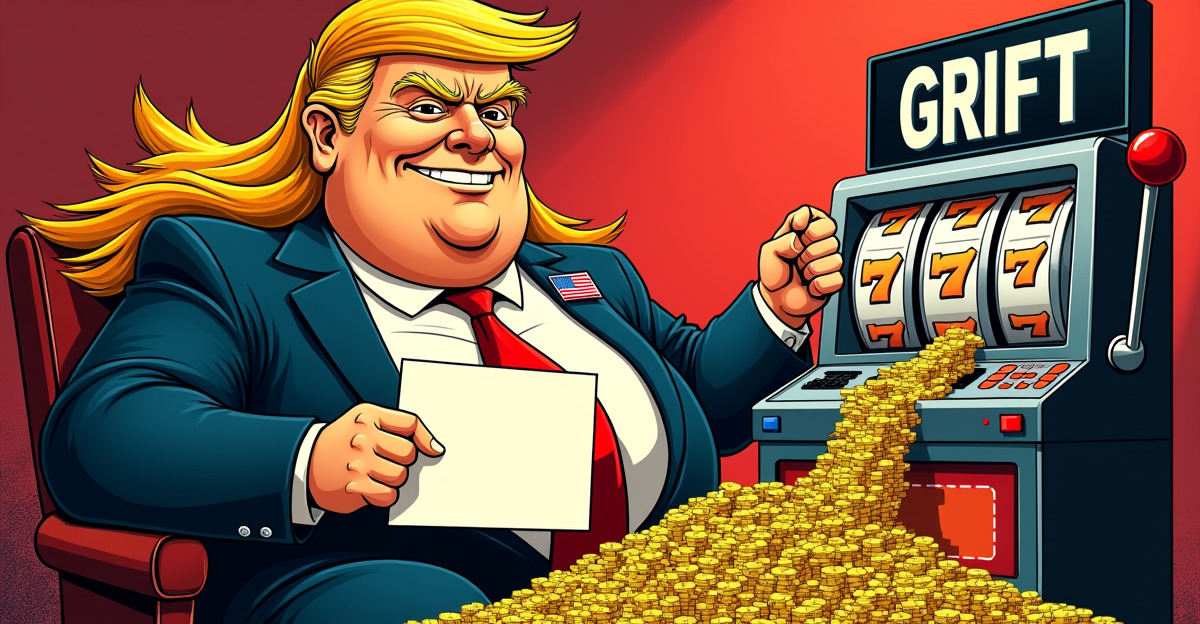
At a White House ceremony celebrating a $1,000 stock-market account for every American baby, the president confessed to a 2017 plan to bet the nation's retirement trust fund on Wall Street.
"Had we done that, Social Security right now would be the richest entity anywhere in the world."
— Donald Trump, White House remarks, October 7, 2026
On Wednesday, the White House threw a party for a financial product that is one year old: the Trump Accounts, tax-free investment accounts the government opens for American children, seeded with $1,000 for every newborn and padded by philanthropists and corporations. The dais was stacked with names. Treasury Secretary Scott Bessent. Social Security Commissioner Frank Bisignano. Senator Ted Cruz. Michael and Susan Dell. Brad Gerstner, the chief of Morgan Stanley. And the numbers were announced the way launches are announced. Nearly eight million accounts opened in three months. More than $4.5 billion deposited since July 4, the day the program debuted on the nation's 250th birthday. The Dells, committing $6.25 billion to seed 25 million children's accounts with $250 each. More than 70 companies, including Uber, Intel, and NVIDIA, pledging contributions.
And beginning Wednesday, every eligible minor child in America, roughly 70 million of them, is automatically enrolled. The president called the program "bigger than anyone ever thought even possible." He was right on one point. Auto-enrollment converts an optional gift into a default, national stock market investment aimed at every child.
The confession came about fourteen minutes into the event, after Ted Cruz had just finished describing the children as "a whole new generation of capitalists." Trump turned from the babies to the program that actually pays working people.
"I wanted to ride with Social Security being fully invested in the stock market in the first month of my first year, so 2016," he said, misremembering the year. He was elected in 2016 and inaugurated in 2017.
"Had we done that, Social Security right now would be the richest entity anywhere in the world," he continued. "But I was met with tremendous criticism by the Democrats and some Republicans because, you know, they felt it was risky."
Then came the sentence that will outlast the event: "I just felt the country had such upward potential... I wanted to do it so badly."
The room had just been told that the children's accounts are, in the president's own words, "a version of it." A preview of what privatizing the whole program would look like, except the children are the ones "riding the markets."
Sam Stein of The Bulwark did the math on the moment. "Peculiar line from Trump, who ran explicitly on not touching social security and now invites attacks that he may try to."
Translation: the man who won an election on a promise to leave the program alone just told the room where he has been pointing all along.
The promise he broke is one of the most durable in American politics. Across his three campaigns, Trump repeatedly insisted he would not touch Social Security; the Washington Post's fact-checkers had been recording the pledge since 2016. The program is the most popular major government program in the country. An AARP poll from August found that 95 percent of respondents consider Social Security important, and 91 percent want Congress to pass legislation protecting it for future generations.
There is precedent for a president who tried this exact play. In 2005, George W. Bush pushed a plan to let workers divert part of their Social Security into private investment accounts. The plan went so politically radioactive that it never drew a vote in Congress, and Republicans lost both chambers in 2006. The difference between 2005 and now is that the vehicle no longer needs a headline.
Because the backdoor is already open. The Trump Accounts were wedged into the One Big Beautiful Bill Act, the administration's signature 2025 legislation, and the door has kept widening. In April 2026, the president signed an executive order creating TrumpIRA.gov, a new market-based retirement account program for workers. In May, CNBC put experts to the question of whether the Trump Accounts are "a model for Social Security." In July, the Washington Post ran an analysis arguing the accounts "could help privatize Social Security," noting that, in that view, the only fix is "to transition to a private Social Security system."
The administration's own treasury secretary said the plain version. Martin O'Malley, who ran the Social Security Administration under the prior president, told Alternet in August that Bessent stated on the record that the Trump Accounts "were set up as their backdoor way of privatizing Social Security." O'Malley's verdict on the president's current operating mode: "He appears to be in a mode of wanting to privatize Social Security."
A $1,000 gift for a newborn is not a retirement system. It is a proof of concept: 70 million families enrolled by default and taught to watch a line graph instead of a promise.
And the timing is not accidental. The trustees of Social Security, in their June report, project that the Old-Age and Survivors Insurance Trust Fund will exhaust its reserves in the fourth quarter of 2032, one quarter sooner than last year's report predicted. After depletion, income would cover only 78 percent of scheduled benefits, falling to 62 percent by 2100. The trustees specifically identified the One Big Beautiful Bill Act as a law that worsens the fund's finances, because permanent lower income taxes mean less revenue from the taxation of benefits. The 75-year unfunded obligation widened to $29.3 trillion.
The academics who model this stuff have a consistent answer. Edward Lane of the Levy Economics Institute wrote in 2025 that "it is financially impossible to replace the scope of current Social Security benefits in the private market without a substantial increase in cost," and that the global record is unambiguous: "privatizing Social Security programs has not worked elsewhere... There is no reason to expect a different result in the U.S."
Trump's counterfactual, that the trust fund would be "the richest entity anywhere in the world" if it had been invested in the market, is not a projection. It is a fantasy with no date attached, offered in a room full of donors the day after another record close. The president counted them himself: 84 record closes in a little over a year and a half. A record market is exactly the condition that makes the gamble look safe. The same volatility that would build the "richest entity" in a good year is the thing that shrinks retiree benefits in a bad one.
The trust fund has about six years of runway left. The president is already describing the stock market as the exit plan.
The midterms are one month away. According to polling averages calculated by election analyst Nate Silver, Democrats currently lead by nine points on the generic congressional ballot, and the White House just handed them a gift. A sitting president, on camera, saying he wanted to move 71 million people's retirement income into the stock market, and blaming Democrats when the public stopped him.
Kendall Witmer, deputy communications director of the Democratic National Committee, did not let it rest. "Trump promised to protect Social Security, but he continues to turn his back on everyday Americans and go after lifelines that millions of people rely on."
That is the frame the next campaign will fight over. A $1,000 baby account is a headline. The trust fund is a paycheck. And the man who runs the White House just told the country, in his own words, that he wanted to do it "so badly." The question is no longer whether the promise was broken. The question is what happens when the market turns.
Comments (0)
No comments yet. Be the first to speak up.
Join the Riot
Login with Google to leave a comment.
Login to Comment