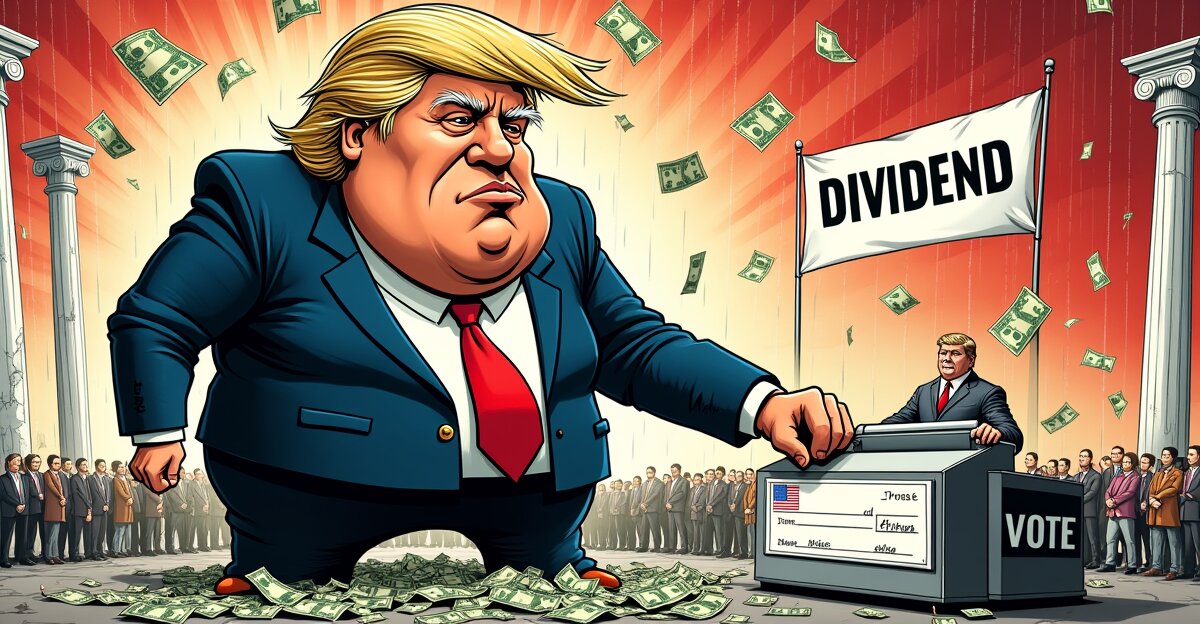
The president has priced the November 3 ballot: $90 if you are on Medicare, $500 if you bought your own health insurance, and $5,000 to every adult citizen if your party wins.
"That's not capitalism or socialism, that's just straight-up bribery."
— Martin O'Malley, former Social Security Commissioner, on the $5,000 midterm offer
For a month now, the White House has been handing out checks to America, one press release at a time. Last week, $500 "refund" checks started arriving for roughly a million Americans who bought unsubsidized health insurance on the federal marketplace. On October 2, the administration announced one-time $90 payments to 20.8 million Medicare Part B enrollees, due to arrive this month. And this past weekend, the president returned to the promise that started it all: a $5,000 check for every adult in the country, paid only if Republicans keep both the House and the Senate after November 3.
"If Republicans win the House of Representatives and the Senate in the 2026 Midterm Elections, I'm going to give all Adult Citizens in the United States of America, $5,000," Trump said in a Truth Social video. The offer first surfaced at a campaign rally on September 10, repeated itself at the Republican National Committee's first midterm convention in Dallas, and has now become the centerpiece of the party's final month.
This is not a stimulus plan. It is a pay schedule, and the only variable is the outcome of the election.
The administration has produced no detail of how a $5,000 check would actually work. The White House press release, titled "Trump Dividend: America Is Winning and Americans Should Win With It," does not say who would authorize the payments, how they would be distributed, or where the money would come from. The total, by the accounting CNBC has cited, is roughly $1.2 trillion. The payments require an act of Congress.
Trump has hinted that tariff revenue might fund it. That path is closed twice over: lawmakers did not include a tariff dividend in the One Big Beautiful Bill tax package, and the Supreme Court struck down the reciprocal tariffs in February. Senator Bernie Moreno of Ohio says he would introduce funding legislation, but the bill would need a 60-vote supermajority in a Senate where his own caucus is not unified behind it.
Even the party's own members are pushing back. Representative David Schweikert, a Republican from Arizona, told Reuters he would "throw everything of my heart and soul" into stopping the proposal, warning it could push interest rates higher. Representative Jamie Raskin of Maryland called it a "political bribe" in a CNN interview, and reminded the country which institution holds the purse.
Translation: the check is being sold before the money is found. A dividend without a dividend is just a vote.
The pattern of broken checks is the tell. In February 2025, the administration floated a $5,000 "DOGE dividend" funded by savings from Elon Musk's Department of Government Efficiency. Those checks never materialized, and the department is now defunct. In November 2025, Trump promised a tariff-funded dividend of at least $2,000 per person. The tariffs were struck down in February, and no checks were ever issued. In 2020, six weeks before the election, he promised 33 million Medicare beneficiaries $200 prescription-drug cards "in coming weeks." The cards never went out.
There is one exception, and it is instructive. Last year the government paid a $1,776 "Warrior Dividend" to roughly 1.5 million service members. That check cleared because Congress authorized it and the Treasury had the money. The $5,000 has neither.
Voters are starting to notice. A Rasmussen Reports survey found likely voters essentially split on the proposal, 47 percent to 48, with only 15 percent saying it would affect their vote. A Marquette Law School poll found 70 percent of Wisconsin voters opposed. An Economist/YouGov survey found 57 percent of registered voters doubt Trump would actually deliver, even if Republicans keep Congress.
The president's checkbook has a track record, and the track record is: announce, rally, dissolve.
The smaller checks reveal what the big one is for, because their targeting is remarkable. The $500 marketplace refund goes to the roughly 950,000 Americans who bought unsubsidized coverage in the 30 states that run their own exchanges, and the White House told PolitiFact the recipients will mainly be people above 400 percent of the federal poverty line. A Reuters analysis found 71 percent of the money, $339 million, lands in 13 states with some of the country's most competitive Senate and gubernatorial races. Eligibility is based on insurance status, not voting status, which is precisely why the distribution is surgical rather than random.
The $90 Medicare payment is a similar trick. It comes from the Medicare Improvement Fund, a fund Congress created in 2008 to make improvements to original Medicare. Money designated to improve the program is being spent on a rebate meant to soften a premium that costs most people about $203 a month, and the $90 covers less than half of one month. The check excludes Medicare Advantage enrollees, people whose premiums are covered by Medicaid, and higher-income payers, leaving about 20.8 million of roughly 64 million Part B enrollees eligible.
All of this lands against a backdrop the White House is desperate to paper over. A Reuters/Ipsos poll last week put Trump's approval at 32 percent, holding September's record low. A USA Today analysis of state polls found him underwater in 39 states. An AP-NORC survey found most Americans blame the president for high prices. These checks are not economic policy. They are a direct hit on the polling.
The same week, the president's financial inner circle has been making a different claim about the same voters. Treasury Secretary Scott Bessent and Elon Musk have spent months arguing that the country's largest social safety net, the $2.56 trillion Social Security trust fund, is riddled with waste that needs "reform." The trustees project the fund running out by 2032, which would trigger automatic benefit cuts.
O'Malley, who ran the agency under President Biden, offered the actual arithmetic. The fund is not dying from fraud or abuse; it is dying from the wage cap. Social Security tax is only collected on earnings up to $184,500, so a billionaire pays no more into the system than a family making six figures. Lift the cap, he said, and the 2032 cliff is manageable. "The most wealthy people in America should pay the same Social Security tax rate that all of the rest of us do."
He was equally direct about why billionaires dislike the program. "The reason Elon Musk doesn't like Social Security is not because he was able to find any gross inefficiencies and waste," O'Malley told AlterNet this week. "No, he dislikes the program because he thinks that some human beings are waste. People that are too disabled to work in his economy are waste, just elderly. They're waste."
A growing band of Democratic Senate candidates, including Josh Turek in Iowa, James Talarico in Texas, and Troy Jackson in Maine, are running on raising the cap as a plan to save the program. The White House's answer to the looting critique is an email from spokesperson Davis Ingle, which opened, "The doomers and naysayers have consistently doubted President Trump."
Translation: the man promising to hand out $1.2 trillion in checks is the same man whose inner circle wants to gut the $2.56 trillion fund those checks would come closest to touching.
The fine print resolves the puzzle. If Republicans win, the $5,000 check still requires new legislation, a funding source nobody has located, and a 60-vote supermajority that analysts say is unlikely. If they lose, it becomes the fourth broken check in a row after DOGE, tariffs, and prescription cards. Either way, the check is a campaign artifact. Its value is in the promise, not the clearing.
So the country now knows the price the president has tagged on the election: $90 for the seniors, $500 for the middle class, $5,000 for everyone else, conditional on the party line. The interesting part is not that he is trying to buy the midterms. It is that he has finally made the purchase public, itemized, and on the record. The only question left is whether the check will clear.
Comments (0)
No comments yet. Be the first to speak up.
Join the Riot
Login with Google to leave a comment.
Login to Comment