
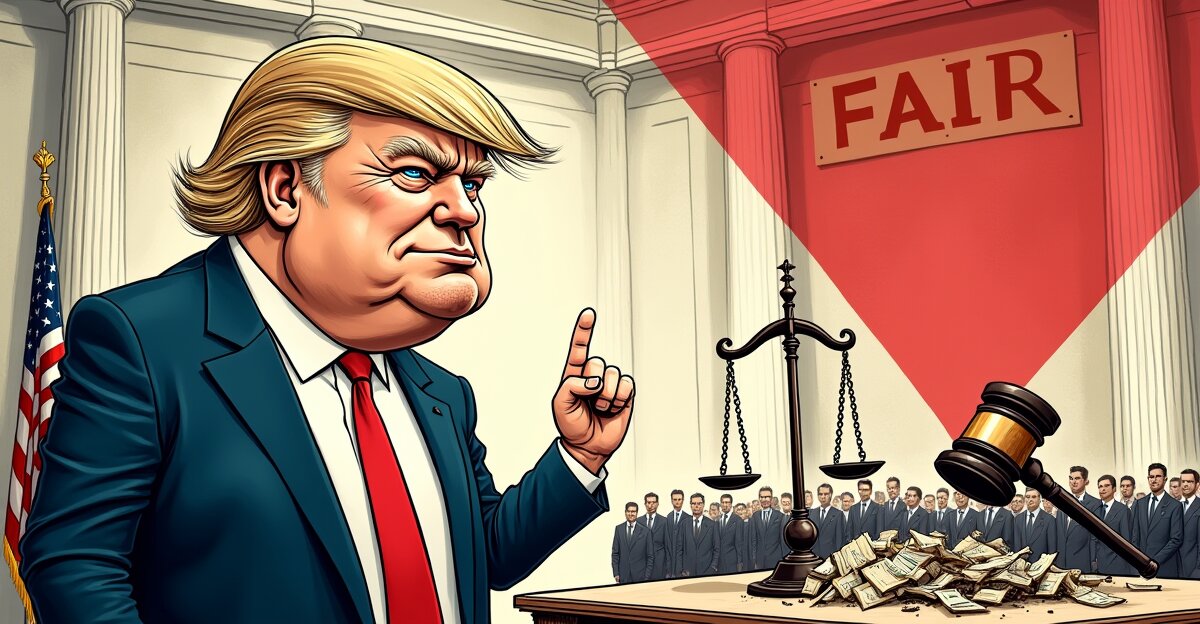
A president who once bought full-page ads demanding the death penalty for five teenagers now says he feels "badly" for men accused of drugging and gang raping an Ivy League classmate. The thing that set him off was not the victim. It was the prosecutor.
"I feel badly for whoever she's looking at because they won't get a fair shake. Letitia James is a corrupt person."
— President Donald Trump, White House press scrum, October 2, 2026
The South Lawn is a good place to audit a presidency: no record, no committee, no camera angle. Just a president, a bank of microphones, and a question that arrived with the Friday flight plan: what is New York Attorney General Letitia James going to do about the seven men accused of raping a Cornell student?
"I can't imagine it," Trump said, of her, as in her corruption. Then, in the same breath, of them: "I feel badly for whoever she's looking at because they won't get a fair shake."
The order of operations is worth pausing on. The assault was in the question. The answer was about the prosecutor.
Here is what the record says about the night in question.
On the night of October 19, 2024, a 20-year-old junior, identified in court records only as Jane Doe, arrived at the Chi Phi fraternity house in Ithaca, New York. A brother she had a crush on propositioned her for a threesome. The lawsuit, filed September 16 in Manhattan Supreme Court and running 101 pages, alleges the two pressured her into snorting ketamine, a powerful tranquilizer she had never used, and plied her with marijuana and high-proof rum. The assault, the suit says, ran from about 1:40 a.m. until just before 6 a.m., as more fraternity members drifted into the room.
The detail that set the country on fire is in the lawsuit's screenshots. While the assault was underway, one of the men allegedly posted in a 50-member fraternity Snapchat group called "Chi Phi Actives" that there was "free p*y" in the house. One brother replied that you could just walk in.
Doe's own account, recovered through the university's Title IX records, fills in the aftermath. For three weeks she kept texting the brother she had liked, until she saw an online post that the men had "gang raped a sophomore" and heard the story told as what it was for the first time. "I was a sex doll for all intents and purposes, which is sad," she told investigators.
What happened next is the part that makes the president's reaction legible.
She reported to campus police on November 8. In a November 14-15 interview that produced roughly 120 pages of transcript, she told officers, "I can say with 100% confidence I was raped." She said the drugs "felt like coercion," and that she kept taking ketamine hoping to pass out and end the night.
An officer condensed the interview into a six-page statement for her to sign, omitting, according to The New York Times, which obtained the Title IX records, her unequivocal statement that she had been raped. The six-page document described her participation in the drug use and the sex as "voluntary, conscious, and consensual." That document, plus one Snapchat screenshot, is all the Tompkins County District Attorney's office got. That was the whole picture.
District Attorney Matthew Van Houten said this week that his prosecutors "correctly determined the alleged facts as set forth in the statement do not constitute a crime." Cornell's own Title IX process, which ran 12 hearings and more than 50 interviews, found at least one man responsible for violating the school's sexual exploitation policy and expelled two of the seven. The rest, the lawsuit alleges, were allowed to "mitigate their conduct by submitting essays."
Translation: a woman's 100-percent certainty got shrunk to six pages, and the six pages did not contain a crime.
The case sat there for two years, until the lawsuit made it impossible to keep buried.
The sequence since has been a blur of walk-backs. On Monday, Van Houten defended his office, fielding threatening phone calls, and announced a grand jury. On Wednesday, the transcript surfaced. On Thursday, Governor Kathy Hochul moved, saying "new information has raised serious questions about how this case was handled, and I've lost faith in the Tompkins County DA's ability to fairly oversee it." She appointed James as special prosecutor, a move Van Houten supported, conceding that "we were not provided the full picture by the university."
At Friday's press conference, Hochul was blunt: "This young woman had already endured something that is utterly unspeakable. And then at every turn she was failed by people and institutions with an obligation to protect her." She also pointed at the statute: New York's sexual assault law excludes victims who voluntarily became intoxicated. "Voluntary intoxication is not a license for sexual assault or gang rape. Period." She pledged to work with the state legislature to close the loophole.
James kept it short: "We will review the facts, gather evidence, interview witnesses, and if warranted pursue prosecutions. I know that you want answers. I do, too."
Now for the part that turns a state prosecution into a national story: who the prosecutor is.
James is the woman who sued the Trump Organization over its real estate books. The 2022 fraud suit produced a $454 million civil judgment, later overturned by New York's state courts. The ledger flipped in 2025, when Trump's Justice Department charged James with bank fraud and making a false statement to a financial institution over a second home in Virginia she listed as her primary residence. A federal judge dismissed the indictment: the acting U.S. attorney who brought it, Lindsey Halligan, had been serving beyond the 120-day limit without Senate confirmation. In August, Trump backed James's rival in the New York attorney general race.
So when her name came up on the South Lawn, the mind went to the ledger instead of the case file. On Wednesday, asked about the case, Trump had been diplomatic: "I don't know that much about it, but Cornell is a fine school, and I'm sure they'll do what's right." By Friday, with the appointment confirmed, the ledger had caught up: "She's totally corrupt, and I can't imagine it."
The record does the rest of the work. In 1989, Trump bought full-page newspaper ads demanding the death penalty for five Black and Hispanic teenagers accused in the Central Park jogger case. They were later exonerated. He has never apologized. Since then, he has moved early and often for men accused of sexual assault, from Roy Moore to Brett Kavanaugh to his own Secretary of Defense.
Kelsie Taggart, vice president at American Bridge 21st Century: "Trump has never concerned himself with getting justice for victims of sexual assault, not his own victims, not Jeffrey Epstein's victims, and not Jane Doe at Cornell. Instead, he's shown repeatedly that the only thing that matters to him is himself and the power of those around him."
The "fair shake" comment deserves a second look, because it is preemptive.
James has not filed a single document. She has announced an investigation. And the president has already declared the outcome tainted, because the investigator is a woman who hurt him. That is not a legal argument. It is a verdict.
Meanwhile the record keeps moving. All seven men deny wrongdoing, and lawyers for three of them have issued statements. One accused man told Cornell investigators he, too, was "a victim of sexual misconduct," because the woman performed oral sex on him while he was "too incapacitated" to consent. The civil case now tests what Cornell knew and when, after the school first claimed it had shared "all investigatory information" with the district attorney, then walked that back to the victim's sworn statement and one Snapchat screenshot. Student protests are expected on campus this weekend. At a public forum, a junior who reported her own assault said, "I'm also speaking as a fellow Jane Doe."
Translation: before a single document has been reviewed, the White House has already rendered its verdict on the verdict.
In 1989, a young Donald Trump put his money where his mouth was: full-page ads, the death penalty, five teenagers who didn't do it. That was the first time the country saw what his sympathy costs, and who it is for.
This Friday, on the South Lawn, the arithmetic was the same. The president felt "badly" for the accused, he could not imagine a corrupt prosecutor doing her job, and he did not, in so many words, feel anything at all for the woman who told campus police she was 100 percent sure.
The question isn't whether the seven men get a fair shake. The question is whether the office of the president gets to decide who is corrupt before the evidence is in, and then count on the country forgetting which side it was on.
Comments (0)
No comments yet. Be the first to speak up.
Join the Riot
Login with Google to leave a comment.
Login to Comment