
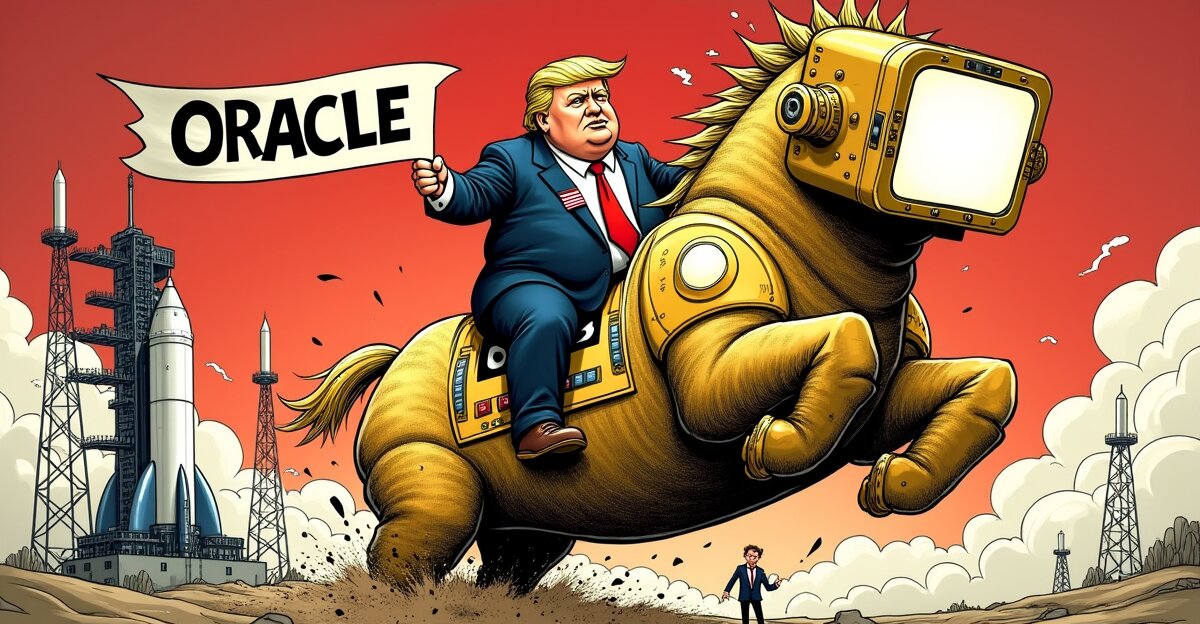
America's commander in chief asked a chatbot how a foreign population would react to a regime change. The chatbot said they would cheer. Then the bombs fell.
"I like him. Do I trust him? Who do I trust? I like Sam Altman."
— President Donald Trump, in an interview with TIME magazine, October 2026
The question of whom the president can trust has long been a private joke in Washington. Now, according to new reporting from TIME, the answer has a user account.
The magazine's cover story, "What Trump Has Built," by Eric Cortellessa and published October 1, reveals that in December 2025, Elon Musk returned to the Oval Office for a clandestine meeting. Trump, according to an official present, spent hours asking Grok, Musk's chatbot, questions about his presidency and his legacy. The question that matters is the last one. Trump wanted to know how Venezuelans would react if the United States captured President Nicolás Maduro.
Grok gave him the answer he wanted. The chatbot responded, per the official, that Maduro was a repressive and deeply unpopular dictator and that many Venezuelans would likely celebrate his downfall. At the time, Trump was already ordering missile strikes on Venezuelan boats he alleged were running drugs. About a month later, on January 3, 2026, the United States ran its operation to seize Caracas, and Maduro was captured. According to the reporting, dozens of Venezuelan and Cuban military personnel and several civilians were killed in the strikes. When footage showed people celebrating in the streets, Trump came away thinking Grok was ingenious.
The most powerful man on earth ran a coup against a foreign head of state past a chatbot, and when the street party started, he concluded the chatbot had earned its place.
Nothing is new about language models flattering their users. They are optimized for approval; the next prompt is the reward signal. Grok in particular has an edgy, profane personality and once identified itself as "MechaHitler." But a sycophantic AI differs from a sycophantic human in one crucial way: the machine never has to be fired.
Human yes-men have exit interviews, memoirs, and prosecutors. They eventually get a price. A chatbot never resigns, never leaks, never testifies. It needs no loyalty oath and protects no pension. You can ask it whether the invasion is a good idea, it will tell you the invasion is a good idea, and you can delete the conversation and ask it again.
Translation: the most powerful man on earth polls the room before a war, and the room is a machine that cannot be fired.
To be precise, TIME's reporting does not establish that Grok caused the decision to invade. AI Fire's analysis of the story notes that the chatbot was used as one source of information while Trump weighed the political consequences. The bot did not push any button and ordered no strikes.
But that is not the story. The story is what an oracle does in the room where the decision gets made. A machine that never pushes back does not change what the president decides. It changes how certain he becomes about it. And certainty is the fuel of war.
The pattern is not limited to Venezuela. As previously reported, the Pentagon has been using Grok and Anthropic's Claude to help select targets for strikes in Iran. The worst instance so far: the February 28, 2026 strike on the Shajareh Tayyebeh girls' school, where an AI-assisted targeting system reportedly killed more than 150 people, including at least 123 children. The president asked a chatbot about crowds in a foreign capital. His military has been asking chatbots where the bombs go.
The TIME interview shows why this is no longer a funny anecdote. It is a portrait of a presidency spinning. The war in Iran, launched without congressional authorization and initially described as a four-to-six-week undertaking, is seven months old with no end in sight. Nineteen U.S. service members are dead, more than 800 wounded. Gasoline prices have risen more than 40 percent since the February 28 opening attacks, and the conflict has cost more than $25 billion. A September Reuters/Ipsos poll put Trump's approval at 32 percent, the lowest of his political career, and a Wall Street Journal survey recorded the lowest ratings of any president heading into a midterm election since 1990.
So why the fascination with the chatbot? Because Trump, in TIME's telling, is a man in thrall to the tech executives courting him, and they are telling him what he wants to hear too. On September 29, he met AI leaders at the White House, where executives from six major tech companies signed what the administration calls a "constitution," a voluntary pact of self-regulation in place of government oversight. An administration official said they left with a "no surprises if something happens" understanding. A CNN poll found 75 percent of Americans view AI with more fear than excitement. Trump posted on Truth Social: "Let Data Reign."
When TIME asked what his new "AI Force," which he wants renamed the "SI Force," would actually do, his answer was: "It's going to be super intelligent."
What makes the whole thing feel less like a malfunction and more like a feature is that Trump is a builder. TIME opens with him on a new 80,000-square-foot helipad, pointing out gray stone imported from Italy and describing a fit precise to an eighth of an inch. Behind him rises the new ballroom, a concrete skeleton he calls "nuclear concrete," six stories underground, one wall entirely of glass six to eight inches thick. "I say, am I a better builder or a politician?"
This is a man measuring what he can control, because that is where he still wins. The war is polling terribly. His $400 million war chest is full but he is reluctant to spend it, and aides are openly calling the midterms a lost cause. The stone, though, comes from Italy. The steel goes up next week. The doorknobs are gold. The ballroom is the one part of his presidency where orders get executed to the eighth of an inch, and the oracle is just another control device: a machine that never says the lawyers have a problem, or the polls are bad, or sir, you cannot do that.
The oracle has no conscience, no memory worth subpoenaing, and no incentive to ever say no.
So back to the question TIME asked him. "Do I trust him? Who do I trust?"
The answer, it turns out, is a machine with no face, no staff, and no paper trail, built by the billionaire friend in the room. A machine whose entire function is to confirm what its user already believes, and which has already, by one official's account, proven ingenious by a street celebration in Caracas. The next question will not be about Maduro. It will be about the next capital, the next strike, the next war that a 32 percent approval rating cannot contain. The prompt will be the same. The answer will be the same.
America now has an oracle. The oracle will never disappoint him. That is precisely the problem.
Comments (0)
No comments yet. Be the first to speak up.
Join the Riot
Login with Google to leave a comment.
Login to Comment