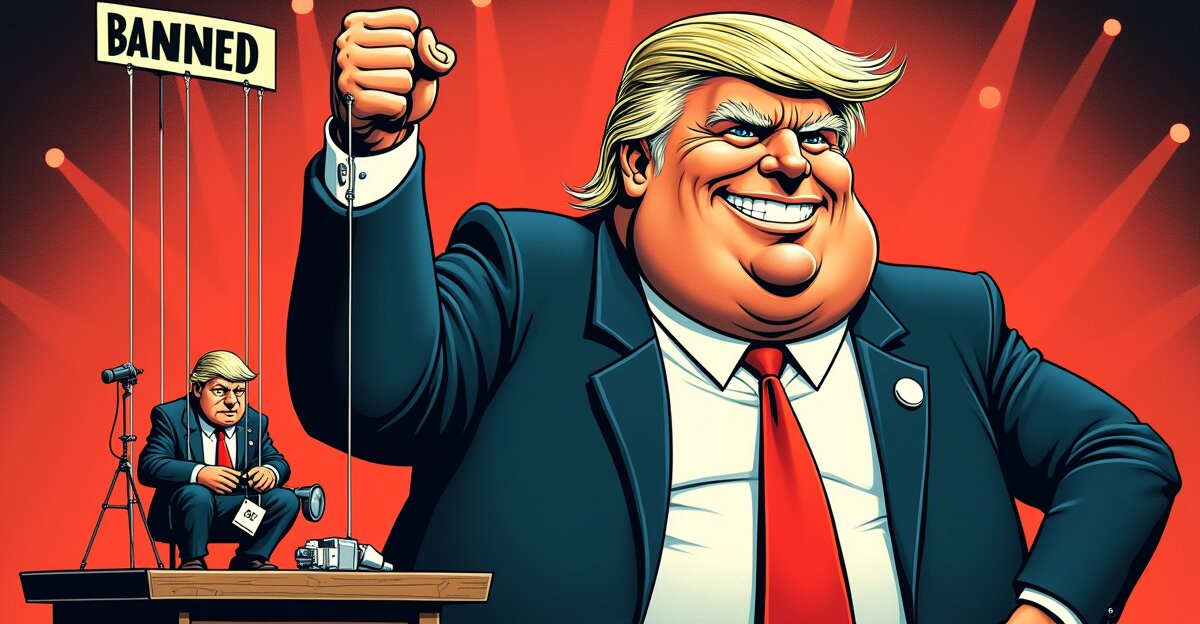
The U.S. government filed a federal court brief saying the First Amendment is a courtesy the president extends to reporters he likes.
"Access to the White House is a privilege, not a right."
— DOJ Senior Counsel Michael Velchik, in a court filing defending the media ban
On Friday, President Donald Trump did what presidents have always done. He got angry at a news report. On Friday, he also did something no president had done before: he banned three entire news organizations from the White House.
In a Truth Social post, Trump said he was stripping CNN, MS NOW, and Politico of their access "as a result of their constant 'reporting' [of] FAKE NEWS!" By Saturday, reporters from all three outlets arrived at the building where they had covered the presidency for years to find their press credentials confiscated by White House officials and their access revoked. On Monday, the White House issued a press release explaining that "no president is required to host a hostile operation on the grounds." On Tuesday, the Department of Justice told a federal court the action was "not retaliatory." And on Wednesday, the three banned news organizations appeared before a judge to ask him to undo what the government had decided was lawful.
It is worth pausing on the scale of it. This is the first time a White House has banned entire news organizations from the premises. Not one reporter. Not a network's evening crew. The institutions, with all their credentials, their correspondents, and their place in the press pool.
The government's legal theory, set out in a filing late Tuesday opposing the outlets' request for a temporary restraining order, has three parts. First, access to the White House is a "privilege, not a right." Second, the ban was "not retaliatory because the Government would have taken the same action anyway, notwithstanding Plaintiffs' speech criticizing the President." Third, and most striking, "the President has not revoked access to other outlets that have equally criticized the President."
That third claim deserves a moment. Other outlets, the government says, are criticizing the president just as hard and keeping their credentials. Which leaves the government's theory of what separates acceptable reporting from reporting that constitutes, in the president's own words, "a threat to our National Security" that "must be stopped."
The filing attached three letters, one per banned outlet, listing the offending stories. CNN's crime was reporting "top-secret" construction details on the East Wing bunker, part of Trump's $400 million ballroom. Politico's was reporting that Secret Service funds were being used to pay for security improvements at the planned ballroom. MS NOW's included coverage of the White House's investigation into leaks, and of a claim that the war in Iran had "significantly depleted" U.S. military munitions supplies. The letter to MS NOW, dated Tuesday, was three days after the White House had already revoked its journalists' access, and only one of its three examples even involved a reporter holding a White House hard pass.
Ryan Goodman, co-editor-in-chief of Just Security, looked at the munitions story and found its source: a document published in the Federal Register, the government's own public journal of official actions. The reporting the Justice Department calls a national security threat, Goodman noted, was sourced to a document the government itself had already published. The rest, he said, is "core First Amendment protected reporting."
The filing also took aim at the outlets' use of anonymous sources, a decades-old practice the president himself employs whenever the source serves him. The news crime, in the filing's view, is being accurate about things the administration does not want known.
The performance around the filing has been, to use the government's own framing, undisciplined.
On Tuesday, at the United Nations, where Trump was delivering a speech, CNN's Kaitlan Collins tried to ask him about the war in Iran. "I'm surprised CNN is here covering me," Trump said. "You shouldn't be here." "The United Nations allowed us in, sir," Collins replied. "You should not be here covering me," Trump said, then falsely claimed the network had said it would stop covering him.
Late Tuesday night, hours after the Justice Department filed its brief, Trump posted another attack on Collins on Truth Social: "All of the SLEAZEBAGS, like Third Rate 'Reporter,' Kaitlan Collins, of Fake News CNN, a truly unhappy person, said they weren't going to be covering me. Then why were they ranting and raving like Lunatics, in the Press Area, at the United Nations?"
Meanwhile, the vacuum left by the banned pool has been filled. Real America's Voice, the pro-Trump outlet, became the primary television crew traveling with the president to the General Assembly, tasked with providing the pool feed to media partners. Its first contribution from New York was footage from inside the presidential motorcade, a clip the White House would prefer the world not have seen. In the administration's ideal media, the only press that exists is the press that agrees.
The White House ban is one front in what MS NOW's lawyers call "an escalating war against the media by the Trump administration," which also includes an unusual review of broadcast licenses, the ejection of news organizations from the Oval Office and the Pentagon, and moves to slash funding for public broadcasters. The new rules for pool reporters who remain include a ban on follow-up questions. Several major TV networks have ditched pool coverage of the president in solidarity with CNN.
The case has landed on the desk of U.S. District Judge Timothy Kelly, who was nominated by Donald Trump in 2017. The detail matters because in 2018, Kelly ruled on almost exactly this situation.
That year, the White House revoked the credential of CNN correspondent Jim Acosta, a reporter who had asked questions Trump did not like. CNN sued. Kelly ordered the White House to temporarily restore Acosta's access, finding the government had not provided due process. At the time, the Trump administration argued in a court filing that "no journalist has a First Amendment right to enter the White House." The D.C. Circuit had already ruled against that premise: the White House may not arbitrarily deny journalists press credentials, and press access may not be revoked without due process.
The administration is now making the 2018 argument again, minus the individual reporter, plus three institutions.
Legal scholar Harry Litman framed the filing the way lawyers do. When an administration punishes the outlets that scrutinize it, he wrote, "it is dismantling a safeguard." "It's the difference between persuasion, which is fine, and coercion, which is a fundamental abuse of government power, the classic tactic of authoritarian government." Viewpoint discrimination is forbidden, he added, "because it uses the coercive power of the state to suppress speech that a free society depends on to keep government honest."
Joyce White Vance, the former U.S. attorney who is now a law professor and MS NOW legal analyst, was less polite. "The idea that fundamental rights are a 'privilege' granted at the whim of the king is dangerous," she said. "This is about the First Amendment, not White House access."
The public has an opinion about all of this, and it is not the one the White House wants.
An Economist/YouGov poll published Tuesday showed respondents Trump's original ban post. Thirty-two percent approved. Fifty-eight percent disapproved. Forty-nine percent strongly disapproved. When a government must explain to a judge why banning the press is not retaliation, and the country answers with a 58 percent disapproval, something is off.
MeidasTouch called the filing's arguments "deeply embarrassing and un-American," with a diagnosis the rest of the country has been quietly arriving at for months. "The Trump regime is afraid of the American people learning the realities of the failed war in Iran and Trump's disastrous presidency."
That fear is the tell in the whole case. The stories the government cites as national security threats are the stories about the war: munitions depleted by the fighting, a president who "underestimated the willingness of Iran to resume conflict," Secret Service money redirected to a ballroom while the country is at war. The national security the administration is trying to protect, it turns out, is the administration.
So the case now sits with a Trump-appointed judge, and the question the government has posed to him is whether three news organizations can be barred from a building for telling the American people what the American government is doing with American weapons.
The White House has a word for this. It is not "retaliation." It is not "punishment." It is "privilege." When a government describes the First Amendment as a privilege, it is not describing a legal theory. It is describing a government: one that has decided, in writing, that the press exists at its pleasure.
The question is no longer whether the judge will restore three press credentials. The question is why the administration thought it could file the paperwork.
Comments (0)
No comments yet. Be the first to speak up.
Join the Riot
Login with Google to leave a comment.
Login to Comment