
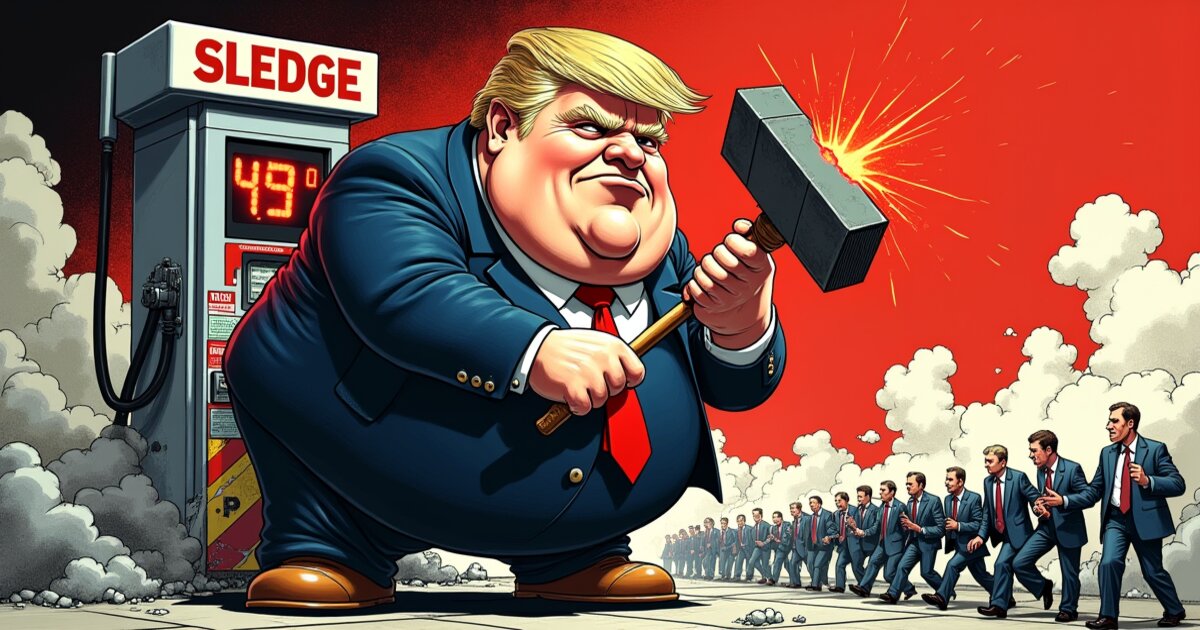
One number on a diesel pump is now worth more to the Republican Party than the president of the United States, and everyone in the room knows it.
"It's a referendum on our government. [Trump] is the head of the government."
— Jason Roe, Michigan-based Republican strategist, via Politico
The number is $6.52. That is the national average price of a gallon of diesel as of this week, up from $5.57 just one month ago and $6.23 seven days earlier. On the weekend, diesel crossed $6.50 for the first time on record, landing within pennies of the highest inflation-adjusted price since 2008. By any measure, it is an aberration: prices have surged 83 percent so far this year, which would be the steepest annual climb since AAA began tracking diesel in 2000. In Hawaii the average is already at $7. In California, it is flirting with $8.
Diesel is not a gas station item. It is the workhorse fuel that moves trucks, trains, tractors, and ships, which means it is the quiet tax on literally everything else that has a price. When it climbs, food climbs. When it climbs, freight climbs. When it climbs, the person who owns a pickup and a farm and a 4-H camp membership starts to feel the government is working against him.
Translation: the fuel that moves the entire American economy has stopped being cheap, and it stopped being cheap because of a war.
The supply side is a stack of disasters. The Iran war has choked off diesel exports from the Middle East, one of the world's most important producing regions. Reuters reports Middle East diesel exports have been cut roughly in half, with European stocks at record lows. Iran-backed Houthis destroyed the east-west pipeline in Saudi Arabia, the artery that was meant to bypass the Strait of Hormuz. Meanwhile Ukrainian drone strikes have knocked out refineries in Russia, the world's second-largest diesel exporter, and both Russia and China have layered on export restrictions. Paul Krugman put the math plainly: diesel is now selling for more than $200 a barrel, the equivalent of crude near $190, in a market where the normal spread is a fraction of that.
So the administration that started the war is now watching its own base pay the tab at the pump, every single day, in a number that resets to a new high.
And that is where the party started to crack. For a year, the Republican machine ran on a single premise: that Trump is the turnout machine, the unmatched motivator, the best messenger. In August, RNC spokesperson Natalie Baldassarre told Politico that if candidates "keep an arm's length from the president, they risk alienating their base [and] they risk 15 to 20 percent of their key Republican voters not turning out." She warned, in effect, that distancing from Trump was career suicide.
A month later, the same woman said the opposite. "No matter the topic, we encourage candidates to run the races they need to run to best represent the voters," she now says. "The president understands when candidates need to add nuance." The White House, for its part, still calls him "the unequivocal leader, best messenger, and unmatched motivator." The RNC is no longer saying that.
The ad numbers are the tell. Ad-tracking firm AdImpact found that only two battleground GOP candidates have aired a single campaign ad mentioning Trump since early August, out of hundreds of new ads in competitive Senate, House, and gubernatorial races. In Florida, Byron Donalds, a Republican congressman running for governor, quietly scrubbed the president's endorsement from his own campaign website after bragging about it not long before. The homepage used to ask supporters to "chip in to support Trump-Endorsed Byron Donalds." It no longer does.
The party that called him its turnout machine is now whispering that he is its kryptonite.
The defectors are specific, and they are all, conspicuously, men who recently defended the war. Mike Rogers, a Republican running for the Senate in Michigan, supported the invasion when it began, calling Iran "an imminent threat." On Monday he released an ad saying, "The war has to end and end quickly," and blamed the conflict for spiking food costs. His campaign staffer, Jackson Karki, wrote "very, very bleak" and added, "Thank you Donald Trump for ruining it for us and handing the country over to socialism." In Iowa, Ashley Hinson, who voted six times against House resolutions that would have ended the war, is now telling Iowans they "shouldn't have to foot the bill at the pump or the checkout line for the war in Iran."
The base is louder. A Trump supporter's video has gone viral in which he stares at his own truck and says, "This truck is gonna sit and rot now until this idiot president is out of office. I voted for him and I'm so sorry I voted for him." Then, after a pause: "I never thought I would say this. I miss Joe Biden." Nate Silver, who has watched these polls all cycle, says GOP polling "is just getting worse by the day in a way that isn't actually all that common in midterms."
So what does the president do? He reaches for a sledgehammer. On Tuesday he told reporters, "I've said let's not send out the diesel," and at the U.N. General Assembly he said, "We make a lot of diesel. I've called for (halting exports) within my people." Sen. Chuck Grassley posted that "high diesel prices ARE KILLING FARMERS INCOME" and called for an "embargo on diesel exports." Rep. Tim Burchett of Tennessee took the House floor, flanked by a billboard declaring diesel "out of control," to introduce a ban. Louisiana Gov. Jeff Landry called for a 90-day export freeze.
The energy world thinks this is the worst available answer. Bob McNally, a former Bush administration official, called an export ban "the king of the APEs," the industry term for authentic policy error, and warned, "If he bans exports, the coasts are screwed." Andy Lipow of Lipow Oil Associates said gasoline prices "could soar" and pleaded, "Do not ban diesel exports." Mike Sommers, CEO of the American Petroleum Institute, said a ban would "make the problem worse, not better." Even the White House contradicted the president, with an official telling CNN the administration is "not considering" any export restriction at this time. No new major refinery has been built in the United States since 1977, which is to say there is no idle capacity waiting to soak up the shock.
In other words, the president's fix for a problem he caused is to break the economy a little harder, on the hope that the number on the pump goes down before the number in the polls does.
Here is the thing the administration has not yet said out loud. The war is not a policy they can unilaterally end in time for the midterms, and the president knows it. Gregory Brew of Eurasia Group described the whole situation as "a high-stakes game of chicken with the Islamic Republic of Iran, and Iran's almost entire strategy is built around exerting pressure on the US through energy prices." Unless the administration is prepared to make a deal it has spent two years refusing, it has no good lever for the price of fuel. The only person who does have that lever is the man in Tehran.
That leaves the number. And the number, right now, is doing the politics that Democrats cannot do. It is telling the farmer, the trucker, and the red-state Republican, in a currency they understand, that the cost of their president's war is being charged to them personally, one fill-up at a time. The party has spent a year insisting the man is invincible, that he is the turnout machine, the best messenger, the one thing standing between them and the Democrats. The gas pump has a different opinion, and it is posting the receipt every day.
The question is not whether the Republicans will defect. The question is how many more days it takes before the number on the pump outweighs the name on the ballot.
Comments (0)
No comments yet. Be the first to speak up.
Join the Riot
Login with Google to leave a comment.
Login to Comment