
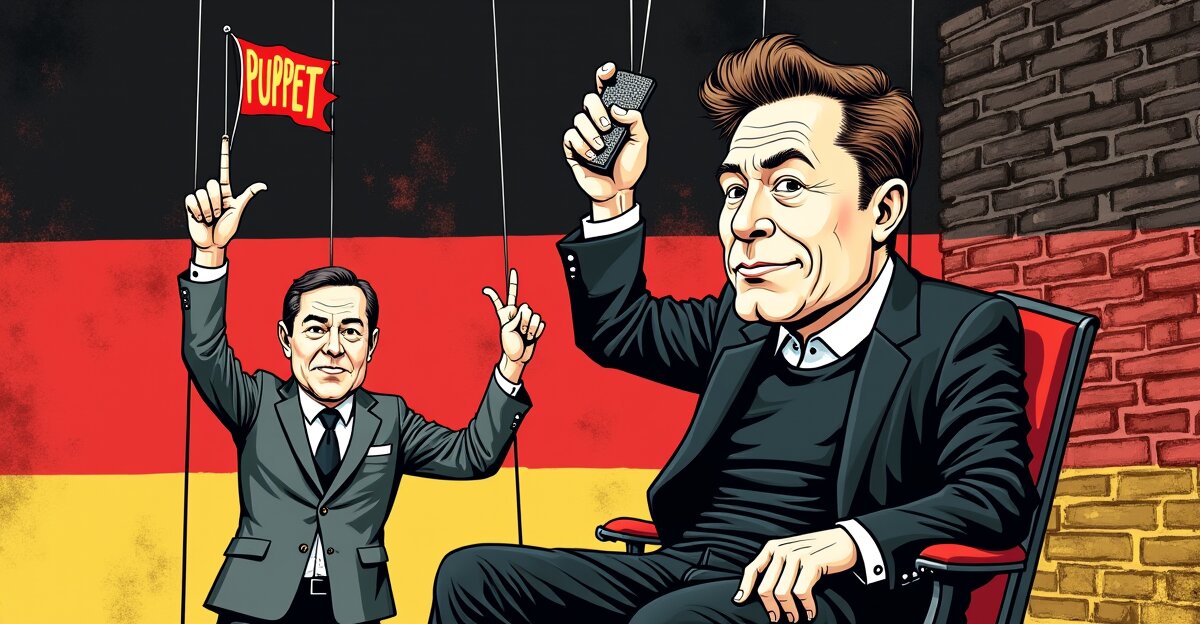
The world's richest man just celebrated the victory of a party that would abolish the right to asylum in the country where his greatest fortune was built.
"Well done!"
— Elon Musk, after the AfD won the Saxony-Anhalt state election on Sunday
The result, when it landed, was a clean one. The Alternative for Germany (AfD), the far-right xenophobic party that has spent years edging toward the center of European politics, won just over 44 percent of the vote in the state of Saxony-Anhalt. The Christian Democratic Union, Chancellor Friedrich Merz's own party, finished a distant second at 17.1 percent. That is not a tight race. That is a rout, and it happened in a German eastern state where, after Sunday's vote, the AfD's lead candidate Ulrich Siegmund could be positioned to become the first far-right leader to govern a German state since 1945.
But the number was never really the story. The story is who showed up to celebrate, and how fast.
Within hours of the exit polls turning, Siegmund posted to X, the platform Musk owns, thanking the world's richest man personally. He praised Musk for his "clear and highly important perspective on the political developments of our time, including here in Germany." Then he offered something that read less like gratitude and more like a recruitment pitch: if the AfD ends up leading the state government, the party "would very much welcome the opportunity for strong and constructive cooperation," and "Germany would once again be a place worth investing in."
That is the sentence to underline. Not the Nazi salutes at the rally. Not the pledge of "deportation from minute one." The sentence that matters is the one that quietly reframes a nationalist insurgency as a business case. Germany, in Siegmund's telling, is not a place with a past to reckon with. It is a market, and it is currently underperforming, and the cure is a new management team.
Musk did not wait to be thanked. After the win he wrote, in German, "Well done!" It is the same billionaire who has called the AfD "the only hope for Germany." And it is the same man whose companies depend on the exact regulatory and labor architecture that the AfD wants to strip away.
This is the seam that the rest of Europe is trying not to look at. The party's stated program, as The New York Times reported, includes cutting funding for public broadcasters, banning gay pride flags in schools, teaching more Russian, and abolishing the fundamental right to asylum. It pairs those moves with the kinds of tax breaks that sound like a pitch to capital. The AfD is not anti-business. It is anti-people, and it has learned to say so in the language of investment.
Translation: the far right in Europe is no longer an outsider movement railing against the system. It is positioning itself as the system's most efficient operator.
Siegmund's victory lap also had a telling gap. The New York Times noted that he declined to condemn supporters who chanted his surname at rallies "in the style of the Nazi salute, 'Sieg Heil.'" The silence is doing work. It tells the base one thing and tells the outside world another, and it relies on the fact that no one will make him choose between them.
The international reaction was immediate, and it split cleanly along a line you can almost see on a map. On the left, alarm. Kenneth Roth, the former executive director of Human Rights Watch, responded to the US President's post on the matter with a single cutting line: "Leave it to Trump to celebrate the victory of a far-right German party that shows sympathy for the Nazis, downplays the Holocaust, and flirts with Putin."
Because that is the other half of the story, the one the exit-poll screenshots were meant to bury. President Trump, Musk's political ally, posted to Truth Social a screenshot of the exit polls showing the AfD leading, back on Sunday afternoon, before the final tally was even in. The President of the United States ran a live highlight reel for a European party he has, repeatedly, described in terms of warm approval.
That is not an oversight. That is a campaign, and it is aimed not at Magdeburg but at the base of his own coalition, which has been watching European right-wingers turn out in force for years and wants to believe the same energy is waiting on this side of the Atlantic.
On the other side of the reaction, the European governments tried to find a tone that was firm but not hysterical. France's Europe minister, Benjamin Haddad, called the result "a serious moment" and offered the careful, ministerial line: "Nationalism and xenophobia will never be a solution. We must listen with humility to the anger, the concerns, the fears, and respond to them. We cannot forget our history."
It is the correct line, and it is also the one that arrives a full election cycle late.
The most honest reading, though, came from a Spanish commentator, Julen Bollain, who wrote that the far right is "turning discontent, economic insecurity, and disaffection into votes." He made the sharper point the polite officials would not: "AfD is doing something that should especially worry the left: transforming precarity, frustration, and disaffection into political identity and votes." He added the warning that lands like a door closing. "If we don't manage to give a collective response to the existing social discontent, someone always shows up ready to turn it into fear, hate, and scapegoats. And there they beat us, because they move like fish in water."
That is the whole thing in one breath. The AfD is not winning because Germans have suddenly become more hateful than their grandparents. It is winning because the institutions that were supposed to absorb economic anxiety have spent a decade hollowing themselves out, and something had to fill the hole. The far right is what poured in first.
David Adler, co-general coordinator of the Progressive International, put it bluntly: the election "sent a clear message, to Germany as to all of Europe, that the far-right rampage is not slowing down, but accelerating instead."
There is also a practical wrinkle that the celebrants on both sides of the Atlantic are trying to talk past. The Associated Press noted that to win an outright majority, the AfD needed 42 of the 83 seats in the state parliament, and it appeared on track for roughly 39. More importantly, other German parties have flatly refused to work with the AfD, which raises real doubt about whether the party can actually form a government at all. Siegmund may be the favorite. He may not be the premier.
That last fact is worth sitting with, because it is where the story gets genuinely strange. The party that celebrated a "decisive" win may not be able to govern a single state of 2.1 million people. The other parties, out of their own history and their own instincts, have drawn a line. The AfD wins the popular argument and loses the arithmetic of coalitions.
So what was the victory, then? It was not power, at least not yet. It was legitimacy. It was the moment the AfD stopped being described as an outlier with 20 percent and started being described as a force to be reckoned with, 44 percent and climbing, with a billionaire and a President both leaning in to help the story along.
Musk wants "constructive cooperation." Trump wants the screenshot to land. And a state that has, for eighty years, treated the question of what the Nazis did here as the unmovable floor of its politics has now elected the first generation of far-right leaders in that history to the door of government.
The question was never whether the AfD could win an eastern German state. It could. The question is what everyone just agreed, collectively and in real time, about what that victory is for.
It is for investment. That is the word Siegmund chose, and it is the word the others refused to contradict.
Comments (0)
No comments yet. Be the first to speak up.
Join the Riot
Login with Google to leave a comment.
Login to Comment