
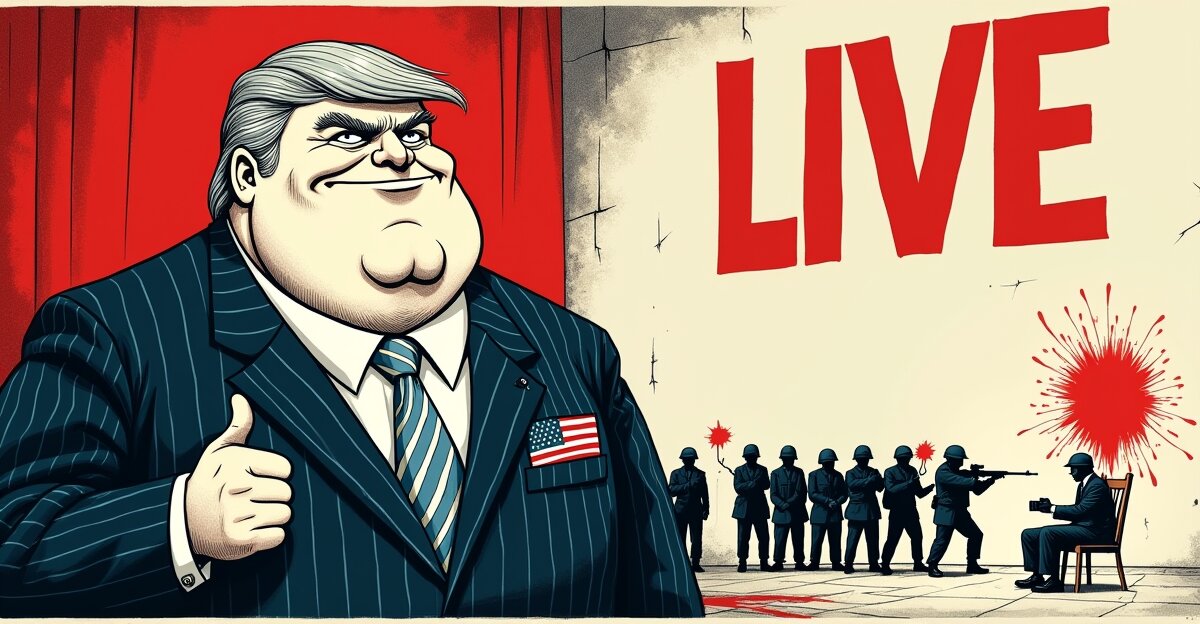
For the first time in nearly a century, America is preparing a public execution, and the Pentagon has promised that anyone can watch it happen on their screens.
"gonna get a firing squad of soldiers, and we'll make sure that people are able to watch it."
— Pete Hegseth, secretary of defense, speaking from the USS Abraham Lincoln
The Pentagon has scheduled the first military execution since 1961, and it has done the one thing that separates a spectacle from a sentence. It invited an audience.
On October 5, the department of defense announced that Nidal Malik Hasan, the former army psychiatrist who killed 13 unarmed soldiers at Fort Hood in 2009, will be shot by a firing squad on December 3, 2026, at 1 p.m. at Fort Hood, Texas: the same day of the week and the same time of day that he opened fire on a crowded medical building 17 years earlier. On Monday, the Pentagon confirmed that President Donald Trump had approved the method.
On Thursday, secretary of defense Pete Hegseth went a step further. In an interview with the conservative outlet Real America's Voice, conducted from the flight deck of the USS Abraham Lincoln, he said the execution would be livestreamed. He called the firing squad a "no-brainer." He said, "People need to understand that there's serious consequences for these types of things." And when asked whether Hasan had made any final requests, or reached out to Trump, he answered, "Don't care. We'll see him on Dec. 3rd."
The platform for the stream has not been decided. The timing, the location, the method, and the audience have.
Hasan is not a name most Americans know, but his crime is on the record. A Virginian who rose to the rank of major and became a military psychiatrist, he walked into the 11th Combat Surgery building at Fort Hood on November 5, 2009, and opened fire on the wounded and the doctors treating them, killing 13 people and wounding 32 while shouting "Allahu akbar." He was shot during the attack and paralyzed from the waist down. In 2013, a military court convicted him of premeditated murder and sentenced him to death, the first soldier condemned to die in more than 50 years.
He has occupied military death row alone since. In court, he apologized for "any mistakes" and said he believed he was protecting Muslims and the Taliban in Afghanistan. In private, he told a panel of military mental health professionals that he wished he had died during the attack, because death would have made him a martyr, and that even an execution would not stop it. He has represented himself in court for the last dozen-plus years.
What makes December 3 different is not the squad. It is the camera.
No execution has ever been livestreamed in the history of the United States. Deborah Denno, a Fordham University law professor who has studied American execution methods, said so plainly, and noted that the military's own rules would have to be bent to make it happen. Under Army Regulation 190-55, military executions are attended only by certain categories of people, including journalists and relatives, and those under 18 are excluded. The BBC asked the Pentagon whether those restrictions would be waived, and what, exactly, would keep a 12-year-old from pressing play.
The legal footing is, at best, unsettled. The appellate review of Hasan's conviction is not finished, John Mills, a lawyer who works with death row inmates, told the BBC, and a federal habeas petition would likely stay the execution. He called the plan to broadcast "unprecedented in the modern era" and "little more than attention-seeking by the Trump administration and is unlikely to occur, much less deliver any semblance of justice." The UN human rights office went further, telling AFP that a livestreamed execution would be "tantamount to a public execution and would breach the absolute prohibition of torture."
The international arithmetic is stark. Amnesty International counted more than 2,700 executions across 17 countries last year, but only two nations carried them out publicly: Iran, with 11, and Afghanistan, with six. If Fort Hood proceeds on schedule, the United States will be auditioning for that list.
Translation: every country on that list is a dictatorship, and the White House has just published a how-to.
The condemnation has been swift and nearly unanimous, spanning the religious, legal, and political worlds. Senator Chris Murphy, a Connecticut Democrat, told CNN the idea was "disgusting" and reminded him of the public executions carried out by the Islamic State. The US Conference of Catholic Bishops expressed "shock and great sorrow," with conference president Archbishop Paul Coakley calling the decision "a barbaric promotion of a culture of death and must be reconsidered." The Legal Defense Fund said the plan "demonstrates the federal government's zeal for brutality at any cost."
The timing of that last point is the ugliest part of the story. On October 1, one week before Hegseth made his announcement, the state of Tennessee attempted to execute Christa Pike, the only woman on its death row, by lethal injection. It failed. Two doses were administered. Pike survived, regained consciousness, and was taken to a hospital. On Wednesday, a federal judge ordered that the evidence from the attempt be preserved. Her lawyers called the ruling "just a first step."
Tennessee could not get one injection right. The Pentagon is booking camera crews.
And an audience will come, because the audience is the point.
A July Pew survey found that 66 percent of Americans support the death penalty for those convicted of murder, up six points in five years. Trump reversed President Biden's moratorium on federal executions when he returned to the White House; 13 federal executions were carried out during his first term. On Friday, before a Columbus Day crowd, Trump said that in the 1900s "we had really strong laws," that today "you can do almost anything. Nothing happens. But we're changing that." The firing squad is that sentence, made flesh and ballistics.
Even among the victims, the plan divides. Alonzo Lunsford, a former army sergeant who was shot seven times in the attack, told the BBC that a firing squad was "befitting" for what Hasan did, and that he plans to attend. "I want him to know he failed," Lunsford said. "I'm still here." He also said he wants Hasan to look him in the eyes before the trigger is pulled. Even so, Lunsford said he did not think everyone should be able to watch, out of concern for the message it would send to young people. He reserved the uncut stream for the families of the fallen and the survivors.
The people at the sharpest end of the spectacle have asked for the less theatrical version of it.
So here is where things stand. The date is set: December 3, 1 p.m. The method is set: a firing squad, last used by this country in the final months of World War II, to shoot a single deserter named Eddie Slovik. The audience is set: everyone with a screen. The only things standing between the two are a court that has not finished reading the case, and the fact that nobody has yet written down what the rules are for a live broadcast.
A firing squad is a slow, loud, error-prone method. The shooters are volunteers. The rounds are not all real. Everyone who has studied the method knows that when a state promises a public performance of death, it has promised a performance, and performances can go wrong in real time, in public, in front of millions. One state learned that lesson last week in a hospital bed in Tennessee.
The question was never whether Hasan's crimes deserved the harshest punishment the military has. The question is what a country does when it stops believing that the law needs to be credible and starts believing it needs to be watched. The Pentagon did not need the public watching to carry out an execution. It wanted the public watching. That is the difference between a sentence and a show, and in December, America will find out which one it has become.
Comments (0)
No comments yet. Be the first to speak up.
Join the Riot
Login with Google to leave a comment.
Login to Comment