
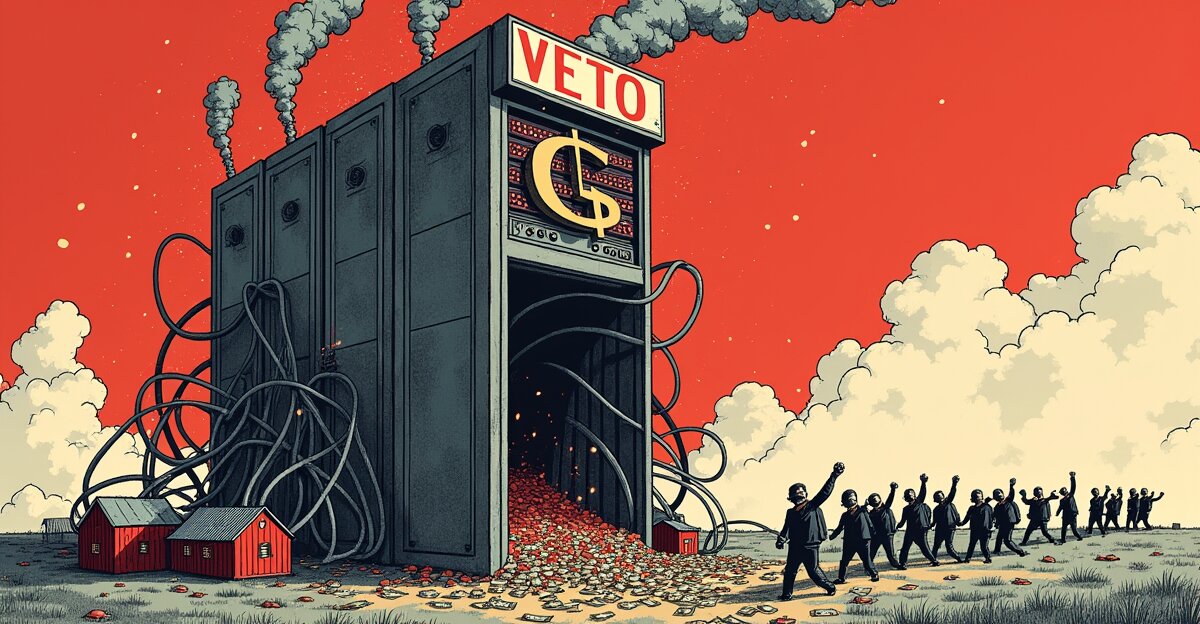
Indiana spent the last five years selling its power, its water, its farmland, and its patience to whoever was building the future. The future just sent the invoice.
"The people are speaking, and they're speaking in one voice in opposition to this infrastructure."
— Tatishe Nteta, political science professor, UMass Amherst
For a while, Indiana rolled out the red carpet for data centers the way it once rolled it out for the auto industry: cheap land, cheap power, cheap politics. In 2019 the legislature carved out a state sales tax break so a hyperscale facility would never have to pay sales tax on the electricity keeping its chips humming. Local governments added property tax breaks on the server equipment. A 2025 law stretched the break to quantum computing, a technology that exists in two states at once, apparently the one thing Hoosiers would never be asked to vote on.
The machines arrived. Now the state is finding out what they cost.
Translation: the state offered the future a tax-free room. The future moved in with half a million chips and the neighbors' power bills.
The numbers come from a survey by Bellwether Research for Free Press Indiana, fielded October 6-11 among 896 registered Indiana voters with a margin of error of plus or minus 3.4 points. The headline, out of the state Donald Trump painted as red as a barn door in both 2020 and 2024: the Hoosiers are done with the men, and they are done with the machines.
Trump: 54 percent disapprove of the way he is handling his job. 44 percent approve. Among independents, 69 percent disapprove, 61 percent of them strongly. And in national numbers released October 8, Pew has Trump polling worse than Joe Biden did in 2024.
Governor Mike Braun: 48 percent disapprove. 38 percent approve. Independents give him a 58 percent disapproval. A year ago, in the same Free Press Indiana survey, Braun sat at 24 percent favorable, before the machines ramped up to full hum.
Forty-seven percent say the state is headed in the wrong direction; 35 percent say it is on the right track. And in a congressional election held today, 45 percent would vote Democrat to 44 percent Republican in their district. In Indiana.
The machines are not hypothetical. There are 41 known data center projects across 25 Indiana counties. Meta broke ground in February on a $10 billion, one-gigawatt campus in Lebanon. Amazon's 1,200-acre New Carlisle site, Project Rainier, has been live since October 2025 with about 500,000 AI chips doing work for Anthropic. Amazon's $7 billion Project Rise got unanimous approval in Jasper County in June. CoreWeave has another $7 billion in the works in Hammond. Google's 390-megawatt Project Louie in Morgan County got its power plan approved by the state utility commission on October 7, filed under the state's new fast-track law for giant power customers. And in September, Indianapolis approved roughly $240 million in tax breaks for the Sabey Decatur Technology Park.
Here is the deal, in statute form: no state sales tax on data center electricity. A 2026 law, signed by Braun on March 12, lets a facility approved locally after June 30 keep the state break if it pays the local government up to 1 percent of the sales tax it does not pay on its power. Facilities that already hold a tax break certificate are carved out. The state's price for the future, in other words, is a sliver, and only for the future that arrives after the state has already committed.
A state-ordered study of what all these breaks actually cost the state, and what they are doing to power bills and water, is due to the legislature on November 1. That is two weeks before Election Day. Some people call that timing.
Translation: the state's audit of the data center deal is scheduled for two weeks before the election, which is how you describe an audit that is really a campaign ad.
The national backdrop is uglier. Data centers currently consume about 49 gigawatts of electricity. The projects planned or under construction add nearly 350 gigawatts, roughly a quarter of the entire country's current generating capacity. A UMass Amherst poll found that only 11 percent of Americans would support an AI data center in their own community, and 65 percent oppose. In November, voters in at least three dozen municipalities will weigh ballot measures that would ban or gate the facilities.
And the industry is fighting back with a playbook that reads like a zine satire of itself. Leading the Future, a tech-backed super PAC, funds both Republican and Democratic candidates who support AI. One investigation found the PAC linked to a news website that ran AI bots posing as journalists to solicit quotes for articles promoting industry talking points. Another found a dark-money group tied to it paying lifestyle influencers to hype AI.
The irony is sharpest in Indiana. Trump has called data center opponents "backwards and poor." Braun is the man who ran as a guy from the people, in the blue-collar shirt and the amber-tinted glasses and the gold star on the navy jacket. IBJ readers made the connection with appropriate sarcasm, between the man of the people and the taxpayer-funded helicopter pad at the statehouse. In September, Braun extended the state's gas tax suspension, a gesture toward the Hoosier at the pump. The machines, for their part, will never stand in any line.
One polling analyst told the Indianapolis Business Journal the blunt version of the math: most Hoosiers will tether Braun's performance to Trump's. When the boss's numbers sink, the regional manager's numbers sink with them. And the issue does not respect party lines, which is exactly what the state GOP does not want said out loud: 52 percent of Republicans or Republican-leaning voters in the Bellwether survey oppose new data center construction. Independents sit at 79 percent. Democrats at 85 percent. A 2024 Trump delegate from Ohio, a lifelong Republican, now calls his state a "tech dump" and calls the bipartisan opposition "one of the most beautiful things I've ever seen."
The candidates who spent a year touting data centers as an economic miracle are quietly backtracking. Anthony Elmo of Good Jobs First has the phrase: "The politicians are chasing the grassroots; they aren't leading on the issue." The places are starting to blink. Indianapolis passed a data center pause through 2027, with exemptions for projects already in the pipeline. Merrillville paused new approvals for a year. County commissioners denied the rezonings around Frankfort and Leesburg. After packed public meetings, developers in Hancock County and Valparaiso pulled their own proposals.
Translation: the only truly bipartisan issue in American politics is making sure the AI bill does not land on the homeowner.
One more number in the survey should make every Republican in the state uncomfortable. Asked whether the legislature should redraw congressional districts ahead of the 2028 elections, the move Trump pushed for in Indiana this year and failed to get, 56 percent said wait until after the 2030 census. In a state where redistricting used to be a sacred Republican weapon, a majority of the voters just called it a tool they did not ask to be waved at them.
The machines will keep humming no matter who wins on November 3. The chips do not read election results. The question the Hoosiers just answered, in a poll, before they answer it at the ballot, is narrower and more personal: who is this for. The state sold the future a tax-free room. The future moved in. The neighbors, it turns out, were never the customer.
Comments (0)
No comments yet. Be the first to speak up.
Join the Riot
Login with Google to leave a comment.
Login to Comment