
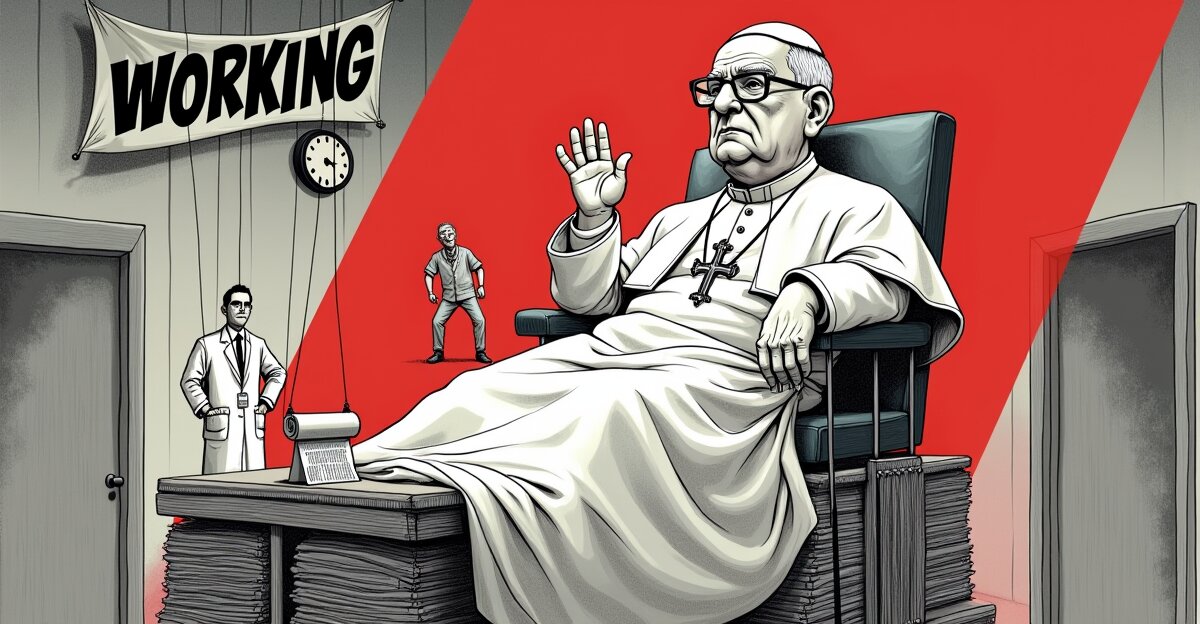
The world's oldest company is handling its 71-year-old chief executive's cancer the way any modern firm would: press bulletins, a schedule, and zero sick days.
"Recovery is proceeding as planned."
— Dr. Luigi Carbone and Dr. Stefano Margaritora, the Vatican's post-surgery bulletin on Pope Leo XIV
On Sunday, Pope Leo XIV stood before the noon crowd in St. Peter's Square, with the television cameras rolling, and told the world he had a nodule on his lung. "The doctors believe it is best to intervene, so, following their advice, I have decided to undergo surgery to have it removed," he said. He called the nodule "early stage" and "circumscribed." He asked for prayers for the pastoral visit he was planning to Peru. He did not use the word cancer, and he did not say what his own doctors already knew, because they had already taken tissue samples.
By Tuesday the word arrived. Surgeons at Rome's Gemelli Hospital removed the lower lobe of his right lung and confirmed adenocarcinoma, the most common type of lung cancer. The preoperative workup had been thorough: a robotic bronchoscopic biopsy that requires general anesthesia, a contrast CT, a PET scan. The Vatican's own physicians had suspected the cancer for days before the pope ever mentioned a nodule to the faithful.
Wednesday's bulletin was a recovery checklist: blood tests normal, chest X-ray normal, respiratory physiotherapy, walking in his room, "resumed his regular diet," which the doctors specified as breakfast and lunch. In the afternoon, Leo celebrated Mass with his secretaries in a special chapel the hospital built on the 10th floor, near his room. By Thursday, the bulletin added the one line that belongs in an employee handbook. The pope continued his daily activities independently. He was working from the hospital.
Translation: the Holy See found a way to report a missing lobe of the lung in the tone of a quarterly earnings call.
For two thousand years, the Vatican's doctrine on papal health fit in a single Italian saying: the pope is fine until he's dead. St. John XXIII was diagnosed with stomach cancer in 1962, and the diagnosis stayed hidden from the world until he died the following year. St. John Paul II's body performed Parkinson's disease for the cameras for more than a decade, and the Vatican confirmed it only after he died in 2005. Francis, the most forthcoming recent pope about his own ailments, still controlled the flow of information tightly in his dying months.
Leo, 71, the first American pope, broke the tradition on his own schedule, which is its own kind of revolution. A former editor-in-chief of the Vatican newspaper told the Associated Press that watching Leo announce his own medical news on camera "was truly a revolution," "like he was reading a medical bulletin himself." The transparency was real. A papal health crisis was now a scheduled event with a press room attached.
The transparency also had a release schedule. By Sunday's announcement, the biopsy was done, the scans were done, and the diagnosis was within reach. The faithful heard about the nodule first, and the cancer came later, delivered by the hospital instead of the pope. Openness, it turned out, is a product the Holy See can stage.
The pope's great act of candor came with a disclosure schedule of its own.
So the new workplace is established. A hospital room on the 10th floor of Gemelli, with a dedicated chapel, a physiotherapy regimen, and doctors on the record confirming that the patient is eating. The papacy is not on pause. The papacy has a hospital room, a chapel, and an IV stand, and it is open for business.
The stress test is the itinerary. On November 6, Leo departs for Uruguay, Argentina, and Peru: 31,000 kilometers, a dozen flights, two helicopter rides, and an ascent into the high Andes, in the country where he spent two decades as a missionary and where he holds citizenship. It is the longest trip of his 17-month papacy. Oncology surgeons generally advise patients not to fly for three weeks after this kind of surgery. By the hospital's estimate, the pope's recovery takes about a week more; a radiation oncologist in Rome told the Associated Press such operations typically call for 15 to 20 days.
Peru's president, Keiko Fujimori, offered the diplomatic version on Wednesday: "We understand that this recovery will take several weeks, longer than expected. We also understand that there could be some changes to the schedule of his visit." The Vatican has announced no changes, and nobody in Rome will be the first to announce them. The question is being settled in a lab: the lymph node results that will show whether the cancer is stage one or something beyond it.
The itinerary is the real story: a 71-year-old man who may not yet be allowed to board a plane, and a 31,000-kilometer trip already on the books.
A pope's health is a state secret for one reason: the institution cannot survive a vacuum. If the leader dies, there is a conclave, a succession, a machine spending its most sacred hours hunting for a new operator. The scarier scenario is not a sick pope but an uncertain one, which is why the machine's survival instinct for two millennia was to say nothing at all.
That instinct is now obsolete, and the new bulletin format matters more than its cheerful phrasing. There is now a schedule for disclosure. There are named doctors in the headlines. There is now, for the first time in modern memory, a weekly rhythm of updates that the rest of the world can calendar. The Church has adopted the conventions of a public company: quarterly optimism, careful staging, and a forward-looking statement about recovery.
What the bulletins have not yet settled is whether Leo's cancer is stage one or beyond it. Adenocarcinoma caught early is the most treatable version of lung cancer. The pope plays tennis weekly, swims, and has no known history of smoking. The numbers look survivable. The numbers do not change the institutional arithmetic: the Church is about to learn whether its continuity depends on one body, and how much the schedule bends when it does.
"The pope is fine until he's dead" is now a historical footnote. The replacement doctrine is better: recovery is proceeding as planned. The world's oldest company is running on one fewer lobe of lung, and the only thing still off the schedule is the stage.
Comments (0)
No comments yet. Be the first to speak up.
Join the Riot
Login with Google to leave a comment.
Login to Comment