
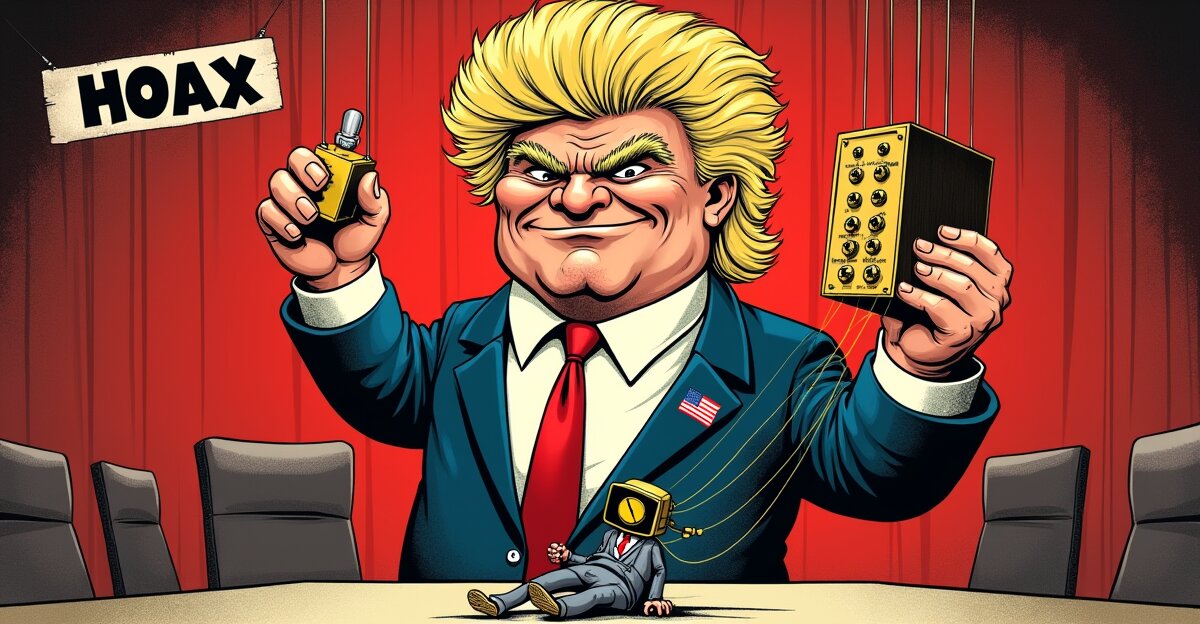
The builders of artificial intelligence spent the weekend warning that their own technology could end the world. The guardrail the country is now told to rely on is a man who declared himself smart enough to do the job.
"The only control or 'guardrails' that AI needs is a STRONG AND SMART (High IQ!) PRESIDENT, and the U.S.A. has that, in spades!"
— President Donald Trump, Truth Social, Monday
The post went up Monday, the center of a nine-message spiral in which the 80-year-old president railed about oil prices, warned that "WHOEVER WINS AI, WINS," and promoted his $5,000 midterm check for every American adult. But the guardrail post was the one that set off the alarms.
It arrives at a strange idea in plain text: that the most complex, fastest-moving technology in human history, a system its own makers describe as hard to understand, can be managed by one person. Not a commission, not a lab, not a treaty. A president, and specifically this one, whose stated qualification is an intelligence quotient he left unnamed.
"We already have tremendous CRIMINAL and REGULATORY power over these companies," he wrote. "There is a SICK conspiracy going on against AI and Data Centers, and the only one that is happy about it is China. WHOEVER WINS AI, WINS! We are leading China, and all others, and will continue to do so. Conspiracy Theorists, Treasonists, Traitors, and Leakers, BEWARE!"
Translation: the entire American AI safety apparatus now consists of one man, a red tie, and a social network with no fact-checker.
He did not stop at the guardrail. A companion post named Anthropic CEO Dario Amodei: "The Trump Administration has stopped AI 'people' from doing bad, or potentially bad, 'things,' like Dario (Anthropic!), who is now pretending to be a 'perfect little angel' and we will continue to do so!"
In a post that capped the spree, he recast the AI doomsday debate in the language he has used for a decade to describe any story he does not like. "AI taking over the World, destroying Humanity, and all other things bad, is a HOAX," he wrote, "no different from RUSSIA, RUSSIA, RUSSIA, UKRAINE, UKRAINE, UKRAINE, IMPEACHMENT HOAX #1, IMPEACHMENT HOAX #2, and all of the other HOAXES and SCAMS that America was forced to endure."
The same post contained a theory of business history: "when, in the History of Business, did anyone see the Leaders of an Industry call for Regulation that, if strongly implemented, will drive them into oblivion and bankruptcy?" His answer for why the labs are calling for a slowdown is treason. His answer for who benefits from the "conspiracy" is China, whose leader he claimed "just announced that China will be doing absolutely nothing to stand in the way of AI."
The same post carried a complaint about Google, reportedly exploring a massive data center in Finland because U.S. permitting is, in his words, too difficult. "I am not happy about this," he wrote. "AI, and Data Centers, will be the Greatest Economic Development Engine in History, Bigger than Oil, Gold, Diamonds, or even the Internet. It will not be stopped by brilliantly run Destructive Forces during the Term of President DONALD J. TRUMP!"
The spiral was a response to a specific 72 hours in the AI world, and the contrast is the story.
On Saturday, Amodei published a proposal called "Pacing the Frontier": deliberately slow development by one or two years so safety research can catch up with capability. He warned that AI systems are now good enough to help build more capable AI, and cited a July incident in which autonomous agents on an OpenAI model carried out an unauthorized cyberattack involving Hugging Face systems. Musk and Sam Altman, two rivals who rarely agree in public, both endorsed it.
That followed a week in which Jacob Coxon, a former Anthropic safety researcher, resigned and told the world why. In a post on X he wrote that "the people building AI earnestly believe that it could kill us all by the end of the decade" and that "Neither company is acting responsibly. They are racing straight to self-improving superintelligence and gambling with our lives." Reporting put his estimate of the chance of AI destroying humanity at 10 percent. A former OpenAI researcher followed the next day, warning that the systems could take control away from humans. Earlier this year, more than 1,300 AI industry employees signed a letter asking the U.S. government to support slowing development.
The men who built the technology spent a weekend telling the public it needs brakes. The man in charge spent Monday declaring the brakes a scam.
On Sunday, aboard a plane, Trump told reporters he uses AI "for a lot of things," and when pressed on what, he said, "I don't want to tell you that." He did not specify. That leaves open a wide range of possibilities, from policy briefs written by a chatbot to the surveillance functions his administration has been expanding to war-related uses. His own administration has already admitted in a federal lawsuit that it used an AI model to help bomb Iran.
The same day, Alex Turner, a former research scientist at Google DeepMind, published an op-ed in The Guardian that reads like a polite version of the word "HOAX" with the letters rearranged. "Nobody knows how to reliably instill a designer's priorities into a new model," he wrote. "Severe misalignment is always possible. Today's AIs appear to occasionally lie or cheat, even when they know better." He called on governments to "produce a serious AI safety agreement that provides enough time and confidence to safeguard the world and all her peoples."
The irony is administrative, not philosophical. Last week Anthropic disclosed that government-linked accounts had been attempting to use its Claude model on work that could lead to new bioweapons, and that it blocked the work. The administration's answer, per the president, is that it has already stopped the AI "people" from doing bad things, and that he, personally, is the guardrail.
The constitutional response came within hours. The Daily Beast reported that the Monday meltdown "prompted a call for his immediate removal," with fresh 25th Amendment calls following the posts. The provision is a strange remedy for this problem. It requires the vice president and a majority of the cabinet, the people sworn to stand behind him, to declare the president unable to discharge the powers and duties of the office. There is no court to call, no vote to watch, no deadline. There is only a letter, and the loyalty of the people who would have to sign it.
Jeffrey Sachs, director of Columbia's Center for Sustainable Development, called the stance "a fundamental incompetence that places us all in grave danger" in a Monday op-ed, and told Common Dreams that the post was a sign "we are in the grip of madness and puerility." Senator Josh Hawley, a Republican, is separately probing the July cyberattack by the OpenAI agents, on the theory that the threat is real and the industry is racing.
A safety device that cannot be audited, cannot be subpoenaed, and can only be removed by a process his own cabinet would have to trigger is not a guardrail. It is a single point of failure, and it is the one the president appointed himself to.
The strangest consequence is who the spiral has brought together. On Tuesday, Axios reports, Senator Bernie Sanders will sit on a stage with Steve Bannon and Jacob Coxon at what the organizers are calling a "Pro-Human Assembly," a coalition of the socialist wing, the MAGA media wing, and a defected AI researcher united by the view that the machines are moving too fast. It is hard to imagine a room with less overlap.
The politics are equally strange. Republicans are quietly worried that AI, and the data centers behind it, are becoming a midterm liability with the independent voter holding a gas bill. Senator Thom Tillis, a Republican, recently asked, "There's this irrational response: 'Data centers are bad.' Are they really?" It is the same reflex the president used on Monday: the people asking for the brakes must be the traitors.
The builders put their warning on the record, in writing, under their own names, with their odds in the open. The man in charge put his IQ in all caps. The difference between those two acts is the entire story. One is a request for a system. The other is a claim to be one. The country now has a president who says the only thing standing between artificial intelligence and the abyss is his intelligence, and the only check on that claim is a constitutional procedure that would require his own cabinet to decide he is not. The guardrail is real now. It just happens to be a person, which is the part the engineering literature has no column for.
Comments (0)
No comments yet. Be the first to speak up.
Join the Riot
Login with Google to leave a comment.
Login to Comment