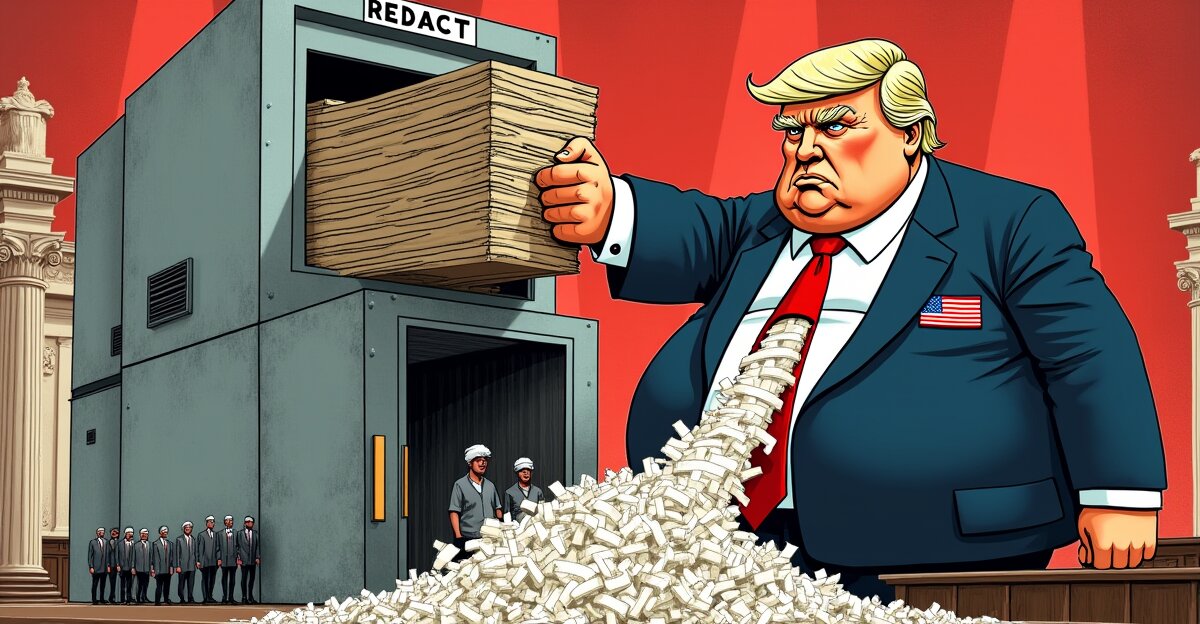
Twenty-five years after the worst attack on American soil, the families of the dead did the only thing left to them: they handed the president a list of files and asked him to open them. His answer was a travel schedule.
"I'm going to look at it when I get back. I know they asked me on Friday."
— President Donald Trump, at Shannon Airport in Ireland, Sept. 13, 2026, moments before boarding Air Force One
On the morning of the 25th anniversary of Sept. 11, the name reading at Ground Zero went, for a few seconds, off script. Terry Strada, the widow of Tom Strada, who was 41 when he died in the World Trade Center, stepped to the microphone as the national chair of 9/11 Families United and addressed the four former presidents and the sitting vice president seated before her.
"Administration after administration, including leaders in front of us here today, chose to protect the Saudis instead of standing with the 9/11 families," she said. "They withheld evidence. They vetoed JASTA. They broke promises, both public and private. It has been one betrayal after another."
She let the room sit with that. Then she delivered the sentence that will define the anniversary: "President Trump can still change that."
The president was not in the audience. He was at a separate ceremony at the Pentagon. What he was not doing was on stage, being asked by the widows and orphans of 2,977 people to stop, in his words, protecting one country's secrets over another country's dead. A nephew of victim Lisa Marie Terry finished his reading of names and turned to the crowd: "President Trump, you are our last hope. Release the unredacted files that implicate Saudi Arabia while what's left of the victims' families are still alive to see it."
Twenty-five years after a single morning broke the country in two, the central question of the anniversary was not how to remember the dead. It was who in the United States government helped them, and where the paperwork is.
The ask is narrow, and it is nothing new. Fifteen of the nineteen hijackers were Saudi nationals. The 9/11 Commission's 2004 report documented the San Diego chain of assistance: Omar al-Bayoumi, a Saudi national, helped the English-illiterate hijackers Nawaf al-Hazmi and Khalid al-Mihdhar find an apartment, co-signed their lease, helped them open a bank account, and introduced them to the al-Qa'ida recruiter Anwar al-Awlaki. Fahad al-Thumairy, an accredited Saudi diplomat and imam at the King Fahd Mosque in California, was in the room when it happened.
The commission stopped short of blaming the kingdom, and the records it left behind stayed in boxes. Over two decades, the boxes have been opened in drips, and each time the missing pieces are the same ones. In 2020, Attorney General William Barr invoked the state secrets doctrine to bury the FBI's 2012 report on the San Diego support network. In 2021, President Biden's declassification order forced out a 130-page FBI report identifying al-Bayoumi as a paid "cooptee" of the kingdom's intelligence service, routed through Prince Bandar bin Sultan. This week, the CIA released 71 presidential daily briefs, 1998 through 2001.
Brett Eagleson, president of 9/11 Justice, the coalition of families suing the kingdom, called the release a start, then itemized what was absent: no al-Bayoumi phone records, no FBI files on the "cooptee," no British intelligence on the imam's contacts. "Families have asked both past and current administrations to release the records that will help expose the full truth," he said.
The administration's "hundreds of pages" are a lot of pages. They are not the pages.
The legal fight that will decide whether any of it means anything has been running, on and off, for twenty years. The families' suit against the Kingdom of Saudi Arabia survived its biggest threat in August 2025, when Judge George B. Daniels denied the kingdom's bid to throw the case out. In his opinion, the imam's and the accountant's employment by Saudi Arabia "probably" tied their assistance to the hijackers to instructions from senior Saudi officials. That was legally sufficient to proceed to trial. No trial has happened yet.
The other defendants in the case, al-Qa'ida, the Taliban and Iran, have already been found in default. They never showed up. The kingdom keeps showing up, keeps paying lawyers, and keeps quoting the same sentence from the 2004 commission report: no evidence the Saudi government "as an institution" funded al-Qa'ida.
The men the United States holds at Guantánamo for the attacks have a tentative trial date in June 2028. Twenty-seven years after the planes, the closest Americans have come to a day in court over 9/11 is a future date on a federal docket.
Here is the part the White House would rather leave out. The files the families want are not an abstract justice project. They name a specific country, at a specific moment, in the middle of the most aggressive courtship of Saudi Arabia in American history.
Last November, Crown Prince Mohammed bin Salman received a White House state visit, his first in seven years, and the president, asked about the families' objections to the visit, responded: "As far as this gentleman is concerned, he's done a phenomenal job." The prince acknowledged the families and moved on. "I feel painful about families of 9/11 in America, but we have to focus on reality." The kingdom was named a Major Non-NATO ally, with billions in arms deals attached.
For the families, that is the whole arithmetic. Every new pillar of the relationship is an asset the White House now has to shield from the files. Declassifying records that could implicate a partner is not a paperwork exercise. It is a diplomatic event, and this administration has shown it knows how to stage diplomatic events.
The only piece of the Saudi brand actually leaving is the cheap one. LIV Golf, the PIF-backed tour, filed for bankruptcy in New Jersey on Sept. 8, after losing its Saudi investors. Strada said there is "some satisfaction" in it. "The Saudis were trying to improve their image. And it didn't work." Sportswashing, it turns out, is refundable. Arms deals are not.
So the anniversary ended the way the last 25 years have ended: with a deferral. Sunday, in a hurry to catch his plane, the president was handed the families' request and offered the line that will define the year. "I'm going to look at it when I get back. I know they asked me on Friday."
The White House statement that followed did the usual work. The president, it said, "is leading the most transparent administration in history, which is why he authorized the declassification and release of hundreds of pages of documents." A spokesperson added that his team is "working diligently to identify records that are responsive to these families' request." The Public Interest Declassification Board, which members of Congress wrote to in July on the families' behalf, is "actively engaged in interagency consultations to determine what equities, if any, may remain."
In 2016, the candidate called himself a "great declassification man." In 2022, he said, "Nobody has gotten to the bottom of 9/11," while defending his decision to host a Saudi-backed golf tournament at his own club. Now, on the anniversary, the man who holds the pen over every file in the government says he will look at it. When? When he gets back.
Translation: the most transparent administration in history has a file on Saudi Arabia, and the file is in transit, or in consultation, or being identified. It is not public.
The families say they are done being surprised. "It has been several lifetimes," Strada told The Guardian this week, and she added, with the flatness of a woman who has made a profession of waiting, that "the day of reckoning will come. We will have it."
The question is no longer what the files might contain. Everyone in Washington knows what the 2021 FBI report already says, and the families say the new material keeps getting stronger, including an alleged video of a kingdom agent casing the U.S. Capitol, which investigators believe was the intended target of Flight 93. The question is what it costs a president to open them. Twenty-five years, four administrations, a widow on a memorial stage, and the government's answer to the hardest question of the year was a sentence about a flight home.
The files are not missing. They are being kept, and the keeping is the policy.
Comments (0)
No comments yet. Be the first to speak up.
Join the Riot
Login with Google to leave a comment.
Login to Comment