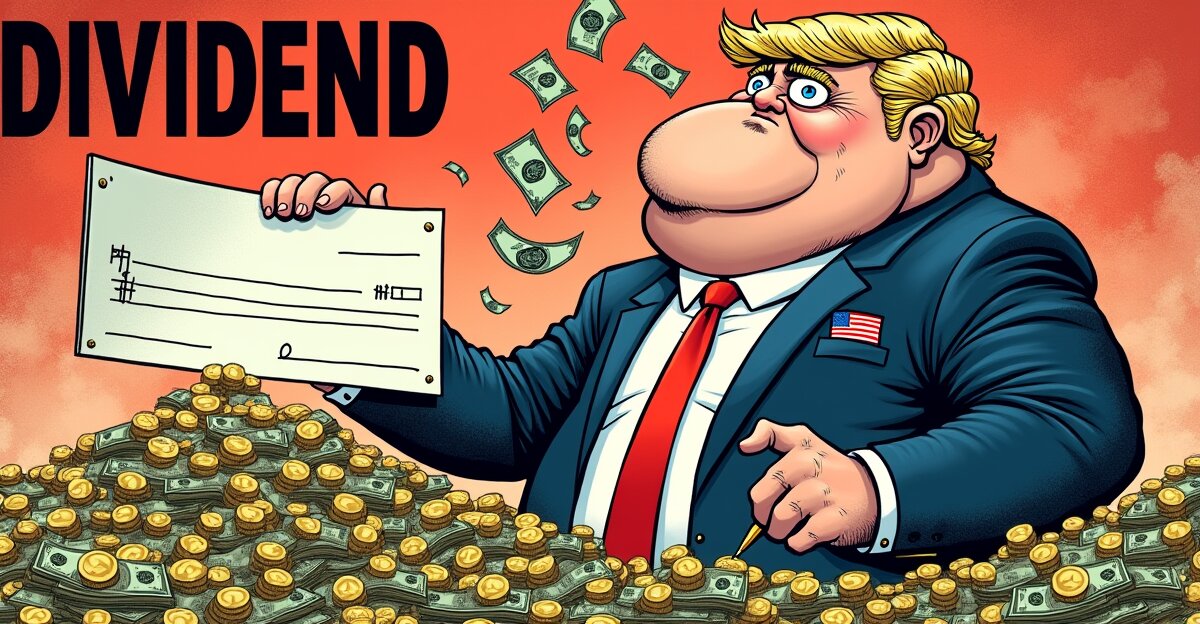
The cheapest way to keep a government, the president has decided, is to offer every adult a $5,000 check that only pays out if his party stays in power.
"Here is my promise: if the Republicans win the House of Representatives and the United States Senate, both of them... because of our tremendous strength and success economically, I will issue a dividend to every adult citizen in the United States of America for $5,000."
— President Donald Trump, Republican midterm convention, Dallas, September 9, 2026
That Wednesday, the president spoke for 106 minutes at the American Airlines Center and, for most of it, did the one thing this presidency has never been accused of being bad at: selling. At the Republican midterm convention, less than two months before the November 3 election, he announced what he is branding the "Trump dividends." If the Republican Party holds the House and the Senate, every adult citizen in the country gets $5,000. "It's very much like a successful company will do a cash distribution will do to its shareholders," he told the room, which was, by every account, not full. The only caveat he offered: the money must be spent inside the United States. "We don't want you going to Canada to spend the money," he said. "We don't want you going to China, to Germany."
The shareholder metaphor is doing real work in that speech. If the country is the company, the president is the chief executive, the voters are the stockholders, and the election is the annual meeting, then a dividend is not a policy. It is a retainer: the fee for staying in the room, paid to the people who vote on whether you keep your job.
The problem with the pitch is the balance sheet. There are roughly 270 million adults in the United States, so at $5,000 a head the payout comes to $1.35 trillion, and independent estimates from Reuters and PolitiFact land between $1.2 trillion and $1.35 trillion depending on who counts and who gets paid. The United States already runs an annual budget deficit of about $1.8 trillion, and the debt sits near $40 trillion. Translation: the dividend costs about as much as the government's annual shortfall, every year, forever.
Nobody in the administration has produced a funding plan. Vice President JD Vance, pressed on Fox News, called it "fundamentally a dividend for American workers" fundable by tariff revenue, which even by the administration's own accounting is a fraction of the bill. Economists are less generous: borrowing more than a trillion dollars for a single lump payment would add inflationary pressure and push rates higher, on top of a debt load already compounding. There is also a structural problem no speech solves. The dividend would have to be authorized by Congress, the very body it is designed to buy. The promise is written in a currency the president does not control.
The legal analysis is nearly as interesting as the economics, and considerably stranger. Bribing voters is illegal in this country, and there are federal statutes against it. The standard reading, from the experts Reuters and PolitiFact cited, is that a payment conditioned on a party's victory rather than on any individual's vote probably does not cross the line into vote-buying. The check is not payment for your ballot. It is payment for the party winning. That distinction is the entire legal architecture of the promise, and it is a thin one; the same experts described the scheme, in the genre's stock phrase, as "not far from a bribe."
The lineage goes back further than most people in that arena probably know. In the nineteenth century, party machines in New York and other cities handed cash, whiskey, and ballgame tickets to working-class voters on election day, and the parties called it enthusiasm. Tammany Hall ran on it. The new version has one innovation: the payment is promised in advance, on a public stage, by the sitting president, to a national audience. The receipt for it is a national election return.
The promise arrives with a track record, and it is a pattern. Last November, Trump promised on Truth Social that a tariff dividend check "of at least $2000 a person (not including high income people!) will be paid to everyone." This week, Fox News, reporting from the same city, noted that the $2,000 checks "have so far not materialized." In February of last year he embraced a plan, floated by Elon Musk, to send $5,000 checks out of savings the Department of Government Efficiency claimed it had found. DOGE, which was supposed to surface $2 trillion in cuts, shut down last year with roughly $110 billion in reported cuts. In December, he announced a $1,776 "warrior dividend" for service members that Politico traced to a housing stipend Congress had already approved.
The pattern is consistent enough to chart. A promise is made. Funding is never shown. The announcement is the product. Kendall Witmer, the DNC's rapid response director, called the offer "empty promises to Americans," noting that the only people reaping the benefits of Trump's economy are the president, his family, and his donors. This new check is different from the last ones in a single, load-bearing respect. The $2,000 check and the $1,776 check were policy with an election as a side effect. The $5,000 check is an election with policy as a side effect.
It comes with a budget, and the two are better read together. FEC filings, as reported by the New York Times and CNBC, show that in roughly ten days, three super PACs tied to Trump's MAGA Inc. have booked nearly $138 million in advertising across about 50 races. No Going Back PAC Inc., registered on September 1, has already spent $95 million; Safety and Affordability PAC Inc. has booked $27 million. Both are backed by MAGA Inc., and the two groups' paperwork was filed with the FEC six minutes apart by the same treasurer. No Going Back shares an address and phone number with MAGA Inc. MAGA Inc. itself has booked $9 million, all of it aimed at the Texas Senate race between Attorney General Ken Paxton and James Talarico.
In September, Trump claimed "like close to a billion dollars in the super PAC," and said he was "allocating probably $400 or $500 million." "We're going to spend a lot of money," he said, "because we don't want to lose our country." FEC records show MAGA Inc. holding $403.5 million in cash as of July 31. The ads do not pretend to be about the candidates. One spot ends: "He's fighting for you every day. Help him finish the job." When CNN's Kaitlan Collins aired it, her read was the cleanest: "You might be forgiven for thinking the president himself is on the ballot." She is describing the design. The $5,000 dividend and the $138 million in ads are the same transaction, viewed from two directions. One pays the voters. The other pays the machine that delivers them.
Democrats' own professionals are treating the promise seriously instead of laughing at it for one reason: the other side of the ledger. A New York Times/Siena poll released this week found Trump dragging down his own party, with even some Republicans losing faith in his economy as the midterms approach. The dividend is a response to a problem the polling identifies: an attempt to change what the election is about, from his record to the check, from pump prices to a number that lands in your account.
There is a psychological reason it may work, and it is the one his opponents should take most seriously. People do not price a $5,000 check the way they price a bond. They price it the way they price a lottery ticket: long odds, big payoff, and a seller who is the most famous man alive. The moment the promise is dismissed as impossible, professionals on both sides warn, the other side owns the message.
So the dividend is best understood for what it is. It is not, as of now, a policy, and it is not a bill. It is a signal delivered over 106 minutes in a Dallas arena: the party is the president, the check is the membership fee, and the country is the company. The question is not whether the $5,000 check will ever be cashed. The question is what it means that a sitting president, 48 days from an election, sitting on top of a $1.8 trillion deficit and a $40 trillion debt, believes the strongest card he holds is a promise he cannot keep, in a currency he does not control, to a public that is still waiting on a smaller check that never arrived. The $2,000 tariff dividend of last November is still stuck in the mail. The $5,000 one is now the party platform. The check was never the news. The check is the method.
Comments (0)
No comments yet. Be the first to speak up.
Join the Riot
Login with Google to leave a comment.
Login to Comment