
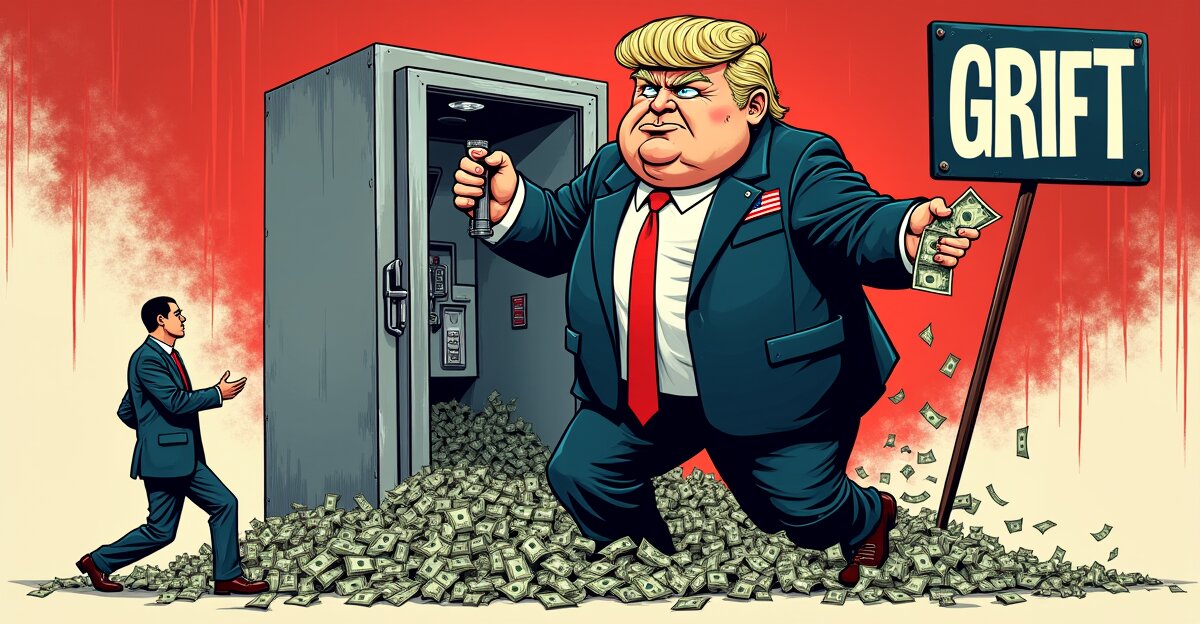
Washington spent months arguing over a crypto bill, but the real question was never about the industry: it was about the first sitting president in history who is about to own his own federally chartered bank.
"Donald Trump is now the first president in history to own and oversee his own bank. It may be the most brazen act of self-dealing our financial system has ever seen."
— Senator Elizabeth Warren, on the Senate floor, Monday night
The Digital Asset Market Clarity Act died in the Senate on Tuesday, 50 to 49, eleven votes short of the sixty needed to end debate. Every Democrat voted against the motion to advance it, and so did four Republicans: Senators Susan Collins of Maine, Josh Hawley of Missouri, Jerry Moran of Kansas, and Thom Tillis of North Carolina. The bill, which had been the chamber's first order of business since the August recess, is now stalled and likely will not return before the November midterms.
The vote landed the day after the 25th anniversary of September 11, in a week when the Capitol was otherwise full of remembrance. Warren, speaking for more than twelve minutes on the Senate floor, noted that the Senate's first bill back from recess was not about making life more affordable for American families. It was not about ending, in her words, "Trump's dangerous war in Iran." It was, she said, "a bill that would juice the value of President Trump's crypto empire, and reward the crypto billionaires who have facilitated his corruption."
The framing was the Democrats' entire case. The Clarity Act would have created a federal regulatory framework for the crypto market, and the fight was over the ethics provisions. After months of negotiation, the White House and Senate Republicans landed on what the Washington Post called their "last, best, and final offer": a compromise from Senators Ruben Gallego of Arizona and Tillis that would let state attorneys general sue federal officials who create or sponsor digital assets while in office.
Warren and her colleagues said the provision was a dead letter as applied to the man who mattered. Enforcement would be subject to a legal opinion that a Trump appointee could write into shutdown, they argued. A companion provision, which would have parked the president's crypto holdings in a supposedly "blind" trust, would not stop him from steering regulation to raise the value of his own positions. Warren offered a counter-bill of her own, the Ending Presidential Corruption in Banking Act, which she said is necessary to "terminate this corrupt bank charter."
Sen. Cynthia Lummis (R-Wy.), a sponsor of the bill, urged the chamber to "take the win," arguing that Trump had conceded "more than anyone in this town expected, twice."
Translation: a bill to regulate an industry whose only real subject was whether the president could keep cashing in.
Here is the part of the debate that went mostly unasked. The bank already exists. Last month, the Office of the Comptroller of the Currency, led by a Trump appointee, granted a federal bank charter to World Liberty Financial, the crypto investment fund founded by the president's sons and controlled largely by his family. The Trump family owns 38.25 percent of the venture. A fund backed by the United Arab Emirates' national security adviser and the president's brother owns 49 percent.
A federal national bank charter is not a formality. It allows the institution to operate nationwide, offer financial products to families and businesses, and, in Warren's phrasing, "enjoy the credibility that comes with the federal government's stamp of approval."
The money behind the institution is disclosed to the extent the president chooses to disclose it. In 2025, he reported roughly $1.4 billion in crypto-related income. His USD1 stablecoin generated $527 million in proceeds for him last year, according to his financial disclosures. An investigation by the anti-corruption group Accountable.US pegged his net worth at about $15.9 billion, with roughly $11.6 billion of it, or 73 percent, in "uncounted crypto assets." The Wall Street Journal reported that when the World Liberty Financial token launched last September, it added about $5 billion in cash to the family's fortune and had already surpassed the family's decades-old real estate portfolio as its most valuable asset.
The regulatory scenery was staged to match. In July 2025, the GENIUS Act, signed by the president, classified stablecoins as commodities rather than securities, subjecting them to looser oversight. The Securities and Exchange Commission, his agency, dropped its lawsuit against Coinbase. Trump Media, which owns Truth Social, bought $2 billion worth of Bitcoin.
And the president of the new bank is Zachary Witkoff, the son of the president's Middle East envoy, who, per Warren, "has never worked in a senior banking role." Under any prior administration, she argued, the application would have been "flatly denied."
The bank's early clientele, as Warren and others have reported, reads like a compliance department's worst nightmare. MGX, a UAE state-owned investment fund, put $2 billion into the crypto exchange Binance, paying in USD1 rather than dollars or dirhams, "cutting Trump into the deal." The president pardoned Binance's founder, who had pleaded guilty to failing to guard against money laundering. Warren called the timing "coincidental." Companies tied to World Liberty Financial have reportedly sold millions of dollars in tokens to outfits that did business with North Korea-sponsored hackers and sanctioned Russian money-laundering entities, and accepted $100 million from a businessman reportedly under investigation in the United Kingdom for money laundering.
With the federal charter, Warren warned, World Liberty could become "a new vehicle for billionaires, corporations, and foreign countries to bribe him."
The bank's founding customers are the people a normal bank would decline. The charter just gave them a lobby.
One detail of the ethics architecture deserves a moment. In this administration, federal appointees may not hold crypto. The rule does not apply to the president himself.
The bill's defeat was not purely a victory over grift, because the bill's sponsors were counting on more than principle. Crypto-aligned super PACs have spent nearly $190 million this cycle, Reuters reported. They did the same in 2024, piling into races against Democrats who resisted the industry's agenda, including Ohio's Sen. Sherrod Brown. The money has been tested more recently, too: in Illinois' House primaries, a candidate who defied crypto's spending won anyway, a fact Warren pressed on her colleagues.
The deciding flip came from Kirsten Gillibrand of New York, the chair of the Democratic Senatorial Campaign Committee and the crypto industry's most prominent friend in the chamber. Hours before the vote, she was privately urging her colleagues to advance the bill, according to Politico. An aide said she "would relish the chance to debate real ethics reforms on the floor." Then, at the end, she voted no. Her office did not immediately respond to a request for comment.
"We deserve to know why she tried to get her colleagues to rubber-stamp this corrupt crypto deal," said Ella Fanger of Demand Progress, "particularly at a time when she is claiming to oppose Trump's corruption."
Other Democrats framed the no as a line drawn for the midterms. "I cannot in good conscience vote for any legislation that codifies that behavior from public officials," said Sen. Elissa Slotkin of Michigan. Sen. Chris Murphy of Connecticut said the bill was being rammed through "based upon not the merits of the bill, but the threat that they will spend even more money in elections against people who vote against it." Gallego, who had negotiated the ethics language, said Republicans should have "worked more closely with Senate Democrats" instead of "twisting themselves into knots to appease President Trump."
Even the traditional banking industry opposed the bill, arguing it would let crypto start-ups raid deposits from small community lenders.
What the vote changed is mostly procedural. The charter stands. The bank is open for business, and a stalled bill does not repeal it. Scott Greytak of Transparency International US said the "need for responsible cryptocurrency regulation remains," and laid out the two failures Congress must fix before the bill comes back: stop the president from "profiting from the crypto industry while shaping and enforcing its rules," and let law enforcement "follow the money wherever it moves."
The irony is in the question that was never asked. The Senate was not asked whether the president may own a bank. He already can. It was asked whether it would add a layer of paper rules, with a switch built in, to make the arrangement look legitimate. The answer, for now, was no.
The bank is open. What the Senate decided on Tuesday was only whether the paperwork gets signed.
Comments (0)
No comments yet. Be the first to speak up.
Join the Riot
Login with Google to leave a comment.
Login to Comment