
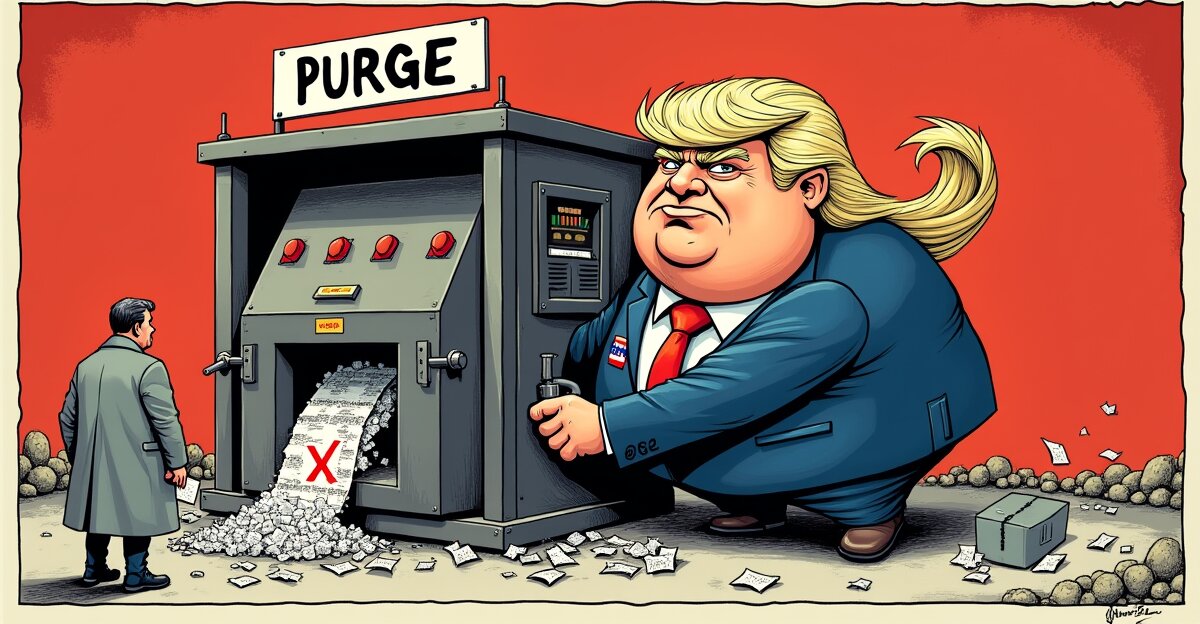
The Supreme Court has not found a single case of a noncitizen casting a ballot. It has found a database that has already mislabeled actual citizens as noncitizens, and a reason to let it keep running.
"The harm caused by burdening or disenfranchising even a few lawful voters outweighs the nonexistent harm that the Government experiences when it is prevented from taking an action that it likely lacks the authority to take."
— Justice Ketanji Brown Jackson, dissent, DHS v. League of Women Voters, September 25, 2026
The opinion was seven pages long. It carried no vote count, no majority author, and no date for the actual case it was staying behind. What it did contain, in a single clause, was the entire case for letting a federal database sort American voters into two buckets: "citizen" and "not citizen." The lower court's order, the unsigned majority said, "inhibits the Federal Government's efforts to assist state and local agencies in the proper administration of the midterm elections." That was enough. As of Friday, September 25, thirty-nine days before Election Day, the federal voter-purge machine is back online.
It had been offline for three months. On June 22, U.S. District Judge Sparkle Sooknanan in Washington ruled that the government's modified version of the Systematic Alien Verification for Entitlements system, known as SAVE, violates federal privacy law, the Social Security Act, and the federal laws governing administrative agencies. She used a phrase that rarely appears in a district court ruling. The government had "knowingly trampled on the privacy rights of American citizens in a manner that threatens the sacred right to vote." A divided panel of the D.C. Circuit later turned down the government's request to revive the tool. So the administration did what it does when the lower courts stop cooperating: it went to the Supreme Court.
To understand what the court unblocked, you first have to understand what SAVE was not. For decades it has been a quiet administrative instrument, a database the Department of Homeland Security runs to check whether immigrants qualify for public benefits. No one called it a voter-roll purger, because it was one. Then in March 2025, the president signed an executive order directing Homeland Security and the Social Security Administration to build systems that would let state and local governments verify voters' citizenship and immigration status. The agencies rewrote SAVE to do exactly that, with three changes that turned a benefits tool into an election tool.
The first change added records for U.S.-born citizens, a population that had been invisible inside a system built for noncitizens. The second gave users access to Social Security numbers. The third let them run many searches at once, in bulk, which is the difference between checking one person and processing an entire state's voter file. According to Homeland Security, election officials in 25 states, mostly Republican, have already run their rolls through. Judge Sooknanan watched what happened in June and wrote one line that describes the whole enterprise: "states have partnered with the federal government to access the database and are actively removing United States citizens from voter rolls based on inaccurate information."
That "inaccurate information" is the quiet center of the story, because the machine has a documented error rate, and the errors go in one direction. A ProPublica investigation this year found that the administration's rush to convert SAVE into a voter-verification tool made it prone to false positives, with actual citizens flagged as noncitizens in at least five states. Votebeat found that in Texas, the system flagged hundreds of people who had registered to vote through the state Department of Public Safety, the agency that requires proof of citizenship from everyone who registers. Election officials confirmed that at least some of them were, in fact, citizens who could vote. The machine was flagging people who had already proven the very thing the machine was checking for.
The test run was worse. When Texas officials ran their rolls through an earlier version of the database in 2019, 2,700 names came up as candidates for removal. Five hundred and seventy-eight of them were citizens. In the case now before the courts, one plaintiff had her voter registration revoked without her knowledge, and two others were forced to produce proof of citizenship just to stay on the rolls.
Translation: the most reliable thing this database does is point at people who are already on the right side of the line.
Here is the part that matters for November 3, and the answer is mostly nothing. Federal law, the 90-day quiet period, prohibits systematically unregistering voters in the final 90 days before an election, and the conservative majority accepted that as enough to "limit the potential impact" on this year's rolls. There will be no mass purge before the votes are cast.
But "mostly nothing" is not nothing. Election officials may use SAVE right now, on individual voters, for the next thirty-nine days and every day after. And the moment the election ends, the full machine, the bulk scans, the statewide sweeps, the entire apparatus the administration spent a year building, restarts at full power. There is a second thing the ruling does, and it requires no voter to be removed at all. It changes what happens when a voter gets flagged. A proof-of-citizenship demand. A letter in a ballot envelope explaining why your name appears on a list of suspected noncitizens. The Brennan Center has spent years documenting that confirmed noncitizen voting is vanishingly rare, a handful of cases in a sea of tens of millions of ballots. The machine is not fixing a documented problem. It is manufacturing a documented one.
Intimidation does not require removal. It requires doubt.
The victory is also worth measuring against everything else the administration has lost. Federal courts have dismissed 25 separate Department of Justice lawsuits seeking states' unredacted voter rolls, and the government has not prevailed in a single one. Two bills, the SAVE Act and the SAVE America Act, which would have required citizens to prove citizenship at the point of registration, died in Congress. Earlier this month, the Supreme Court itself blocked a Trump rule that would have let the Postal Service restrict the delivery of mail ballots for 2026. And yet the administration needed an emergency petition to the Supreme Court just to keep a tool a district judge had shut off. The solicitor general called Judge Sooknanan's ruling "an indefensible order." Homeland Security's general counsel, on X, in a post that reads like a victory lap over a subpoena: "Yes, you read that right. We had to file an emergency petition in the Supreme Court just so we could use government data to help states stop noncitizens from illegally voting."
Translation: the federal government lost every fight over the voter rolls in the lower courts, so it went to the one court that has never lost one.
The dissent, signed by Justices Jackson, Sotomayor, and Kagan, called Friday's decision "questionable interim ruling[] about two statutory provisions" the Supreme Court "has never before interpreted." That is the other thing about the opinion: it decided nothing. It did not rule that SAVE is legal. It did not rule that the government has the authority to run a national citizenship check on the country's voters. It paused a pause, and it did so with the merits case still sitting in the queue. Justice Jackson, in the line that should be framed, wrote that the majority "focuses only on the harms the Government will purportedly suffer absent a stay, disregarding the harms that the use of the modified database has caused, and will likely continue to cause, to lawful voters."
The League of Women Voters and the Electronic Privacy Information Center, the groups that built the case, said the fight "is not over," and they return to the D.C. Circuit the moment the Supreme Court's docket allows. The district court's ruling, the one about the sacred right to vote, is still on the books. What it is not, for the next 39 days and the purge season that follows, is the law of the land.
The question the court left unanswered is the one the evidence has already answered. The government has flagged citizens in Texas, in five states, in a 2019 test run, and in the case before it. It has produced, in return, no documented instance of a noncitizen voting. The machine works. Its error is documented, and the errors point one way only, at the voters.
The question was never whether this database threatens noncitizen voting. The question is why anyone was surprised when the list started filling up with the right people.
Comments (0)
No comments yet. Be the first to speak up.
Join the Riot
Login with Google to leave a comment.
Login to Comment