
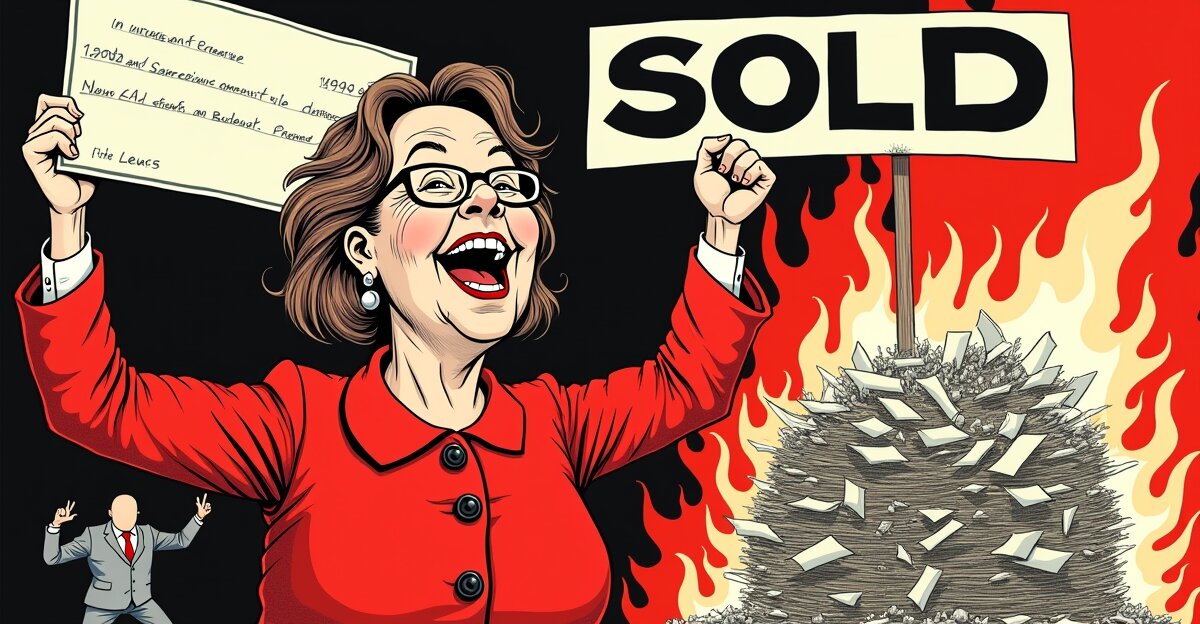
The senator told a defense contractor she could deliver. The contractor paid, and the contracts followed. An FBI file on the exchange spent five years getting built, and died when the man who runs the FBI came back to power.
"This is corruption of the highest order."
— Troy Jackson, Democrat, running against Susan Collins for the U.S. Senate
In the final weeks of 2019, a top fundraiser for Sen. Susan Collins walked into a perilous meeting at a Corner Bakery in Washington. For the first time in two decades, the Maine Republican was in real danger of losing her Senate seat, dragged down by Trump's dismal approval ratings and behind her likely Democratic challenger in fundraising. Scott Reed, who runs her super PAC, the 1820 PAC, met that day with three executives of Hawaiian defense contractor Navatek. He asked for a $500,000 donation.
Government contractors are banned from political donations, and offering money for an official action, or accepting it, is criminal bribery. But the company had a proposal: cut a big check, CEO Martin Kao told Reed, and Navatek wanted Collins to guarantee tens of millions of dollars in federal funding, funneled through a shell company.
After the meeting, Kao sent $150,000 to the super PAC using the shell. Two months later, he told Navatek executives that Collins had "committed to getting the company $32 million in naval contracts," per an internal company email reviewed by ProPublica.
How Navatek worked is its own genre of American history. Under Kao, the company went from a sleepy Hawaiian engineering firm to a machine that paid its way into the Pentagon's budget. The playbook: find small states with complementary universities, get access to their senators, and bankroll them. Kao told congressional staffers, "I'm not red or blue, I'm green."
Navatek would concoct a research project with a university in a target state, Kao would make a large initial donation, and well-connected lobbyists would sell the pitch, word for word, into the Senate's budget reports. In 2019, page 185 of a 307-page Senate Appropriations Committee report set aside $21.5 million for "hybrid composite structures research for enhanced mobility" and an "autonomous ship systems" test bed. Navatek's name does not appear on the page. Every project was one the company had requested.
The research went nowhere. A company slideshow put it this way: "We thrive in the valley of death," the gap where research languishes without becoming a product. In Maine, the company 3D-printed a prototype boat with the University of Maine's giant printer. The Navy had no plans to use it.
"The boats weren't delivered to the Navy," one former employee recalled. "The Navy didn't even want them."
The research produced nothing the military wanted. That was the point.
The paper trail is the part that should bother you. In 2018, Kao and his wife gave to Collins right before she placed $8 million for Navatek into the defense budget. "I spoke with Sen. Collins office regarding the $8M," a naval official wrote in a February 2019 email. "The interested company is Navatek." In 2019, according to the indictment, he sent her roughly $33,000 through illegal straw donors, his own relatives. Ahead of an August 2019 publicity event at Navatek's Maine headquarters, he orchestrated over $40,000 in family donations, telling Collins's team to reallocate the excess over the cap to his father. An FBI agent flagged the move in a presentation to prosecutors: against election law.
Amy Abbott, the campaign's finance director, emailed Kao: "This is perfect. We are so grateful for ALL the Kao support!"
Then came the check: $150,000 to the 1820 PAC from a new LLC called the Society of Young Women Scientist and Engineers, with no "s" on "Scientist." The money came from Navatek's account, not Kao's, in violation of the contractor ban. A good-government nonprofit noticed the filing in early 2020; a Hawaii journalist found Kao's wife's name on the paperwork within days.
Seven days after the super PAC cashed the check, one of Reed's subordinates emailed a Navatek lobbyist asking for Kao's phone number: "Senator Collins would like to call Martin to thank him."
Kao's scheme ended the way all schemes end: with a new crime. He defrauded the pandemic-era Paycheck Protection Program, inflating Navatek's payroll to amass loans of $13 million. Navatek's founder reported him, and on September 30, 2020, agents in windbreakers raided the Honolulu office and arrested Kao.
He pleaded guilty in the fall of 2022 and worked as a line cook at a Cheesecake Factory while awaiting sentencing. Then he sat across from the FBI agents who had brought him down, Michelle Ball and Kevin Gounaud of the bureau's elite public corruption unit CR-15, and started talking. Over at least three days, he laid out how the machine worked. "It takes two to tangle," he told them. "I was fooled and foolish enough to believe that the power elected officials wielded, and were actively willing to sell to anyone wealthy enough to pay, was.... 'smart business.'"
For his final meeting in September 2024, he handed the FBI a 50-page document: dozens of lobbyists, staffers, and members of Congress, with email addresses and phone numbers, a road map for subpoenas. He had been sentenced to 87 months, with no leniency for his cooperation.
This is where the story stops being about a senator and becomes about a government. By the end of 2024, the agents believed they had enough to pursue a sweeping bribery investigation that could ensnare top lawmakers of both parties. Ball, before she was fired, had won approval for a new case centered on South Carolina, one of the states Navatek was eyeing for expansion. The FBI had questions about a steak dinner Kao shared with Sen. Lindsey Graham.
Then Trump returned to the White House.
Kash Patel, the new FBI director, set about purging CR-15 agent by agent. Ball, who had led the 2018 investigation into the Russian agent convicted of infiltrating the NRA, was fired in October 2025, a one-page letter saying she had "weaponized" the Justice Department. Gounaud, a 20-year veteran, was pushed out in early 2026. The career attorney on Kao's case quit; dozens of agents and prosecutors left. The Justice Department's Public Integrity Section collapsed in February 2025, after staff were ordered to drop a case against a Trump ally and leadership quit en masse.
The FBI told ProPublica that it investigated claims against Collins "years ago" and "ultimately found nothing implicating Senator Collins or the Senator Collins' campaign." Asked about the 2024 investigation, the spokesperson did not respond.
The file didn't die for lack of evidence. It died from a change in administration.
Collins's response has been a counterpunch. Her deputy chief of staff, Annie Clark, "vigorously" denied the bribery and pay-to-play claims, calling Kao's account "outlandish," and wrote that the matter had been resolved in 2021. ProPublica's follow-up found some of those claims incorrect and misleading: the dead investigation was built on claims Kao made to the FBI in 2022 and 2024. FBI records acknowledged that "several emails and other documents corroborate statements Kao made to the FBI." People familiar with the investigation said the agents considered him credible.
Collins has a simple explanation for why the first meeting with her required a donation. "We charge people for the privilege of a meeting." Asked about Kao, the senator who, according to his account, told him "you've seen me deliver": "He's a liar."
In Maine, the Democrats are counting votes: Collins is the only Republican seeking reelection in a state Kamala Harris won in 2024, and recent polls show a toss-up with Jackson leading. Jackson calls the conduct "corruption of the highest order" and says the jig is up. Devon Murphy-Anderson, the Maine Democratic Party chair, put the purged probe in its place: "It appears, instead, that she betrayed us again, and was bailed out of trouble by the president of the United States."
Republican leaders stood by Collins. Senate Majority Leader John Thune called the reporting a "political hit job." And just last week, as Collins returned to Maine for the first time since the reporting, the Democrats asked new questions: Reed's firm, which runs the pro-Collins super PAC, paid Collins's former lobbyist husband at least $1,000 last year while working for clients who had donated to Collins or had business before her committee. How much has never been disclosed; Senate financial disclosure rules only require reporting that the payment was more than $1,000.
The FBI spent five years building a file on how the Senate appropriations committee works. Then the man who controls the FBI decided the file was a mistake. The file is gone. The senator is not. She is on the ballot November 3, in a state Kamala Harris won, and the only thing scarier than an open corruption investigation is a closed one you can read.
Comments (0)
No comments yet. Be the first to speak up.
Join the Riot
Login with Google to leave a comment.
Login to Comment