Twelve Western democracies woke up on Tuesday and decided the money was going to stop flowing, and now the old empires are circling to remind everyone who still answers to Washington.
"The British government agrees that there is ethnic cleansing of Palestinians in areas of the West Bank, perpetrated by settler terrorists. All too often the Israeli government has turned a blind eye to this and worse, members of it have made statements and taken actions to support the forced displacement of Palestinians."
— Ed Miliband, British Foreign Secretary, in the House of Commons, September 8, 2026
The phrase "ethnic cleansing" is a trigger word in London politics, a word that usually appears on protest placards and in the mouths of backbench radicals, not at the dispatch box of the Foreign Office. On Tuesday morning, the British government used it, in print, on the record, in the strongest condemnation of its own closest intelligence partner that this country has ever issued.
The move was announced by Foreign Secretary Ed Miliband, who told MPs that the UK now takes the official position that Israel's occupation of the West Bank is unlawful in its entirety. That is a real step. The UK had long called the settlements illegal; it had not called the occupation itself unlawful, and Miliband conceded as much in the chamber, saying the country "should have acted earlier" and that it "has taken the new prime minister to come in and recognize the gravity of the situation." In other words, the previous government had been sitting on this.
The sanctions that followed are the part that matters. An import ban on goods from settlements. A comprehensive regime targeting firms that provide construction, infrastructure, financing, or real estate services for settlement expansion. A ban on advertising illegal settlement property in the UK. Personal sanctions on individuals accused of promoting settler violence. And a new bar on arms licenses and other exports that "materially contribute to the occupation." Miliband expects the enabling legislation in place within nine months.
Translation: for the first time, the money is supposed to feel it. Settlements run on business, and the whole architecture of this package is aimed at the invoices.
The UK did not do this alone. Twelve countries issued a joint statement warning that Israel's actions in the West Bank are killing the two-state solution: Canada, France, Denmark, Finland, Iceland, Ireland, Norway, Poland, Portugal, Spain, and Sweden, with the UK leading. France and Canada, in particular, will ban the import of settlement goods. French Foreign Minister Jean-Noël Barrot put it plainly: "France cannot, through its trade, support a situation that threatens the security of both Israelis and Palestinians."
This was built, per Politico, on a summer of quiet diplomacy that culminated in a visit to Downing Street by French President Emmanuel Macron last week. The coordinated timing is not accidental. These are the two countries with the largest historic Jewish populations in Europe, the countries that have spent the entire Gaza war being told their stance is soft. Now the soft countries are the ones writing the sanctions.
The whole thing landed two weeks before the UN General Assembly, and ahead of the first in-person meeting between new British Prime Minister Andy Burnham and Donald Trump. Miliband said the UK will use the assembly to "shine the clearest and harshest spotlight" on what is happening in the West Bank. Whatever is said at that table in New York, London has already said its piece.
Israel did not wait.
Foreign Minister Gideon Saar responded within hours, calling Miliband's remarks "outrageous lies" and accusing the British government of "systematically working against the state of Israel." The retaliations were specific and petty in the way that is meant to be a message: close the UK consulate in Jerusalem; bar 11 British MPs from entering Israel, including Jeremy Corbyn, Diane Abbott, and Zara Sultana; and, most pointedly, eject the UK from the US-led Gaza coordination mission.
It is worth pausing on that last one. A mid-sized Western government, and its access to the very war room it has spent years helping to run is simply revoked over a trade ban. That is not diplomacy. That is leverage being shown, and the implication is that anyone else in the twelve-country group who keeps going down this road can expect their own file opened up.
The pressure from the other side of the Atlantic arrived the same day. US Ambassador to Israel Mike Huckabee, fresh off a weekend in which he had condemned the British government for "Jew hate" despite the fact that the man who announced the sanctions is Jewish, told the BBC the ban would be a "discrimination against the Jewish people." He suggested individual US states, specifically Florida, might take trade action against the UK.
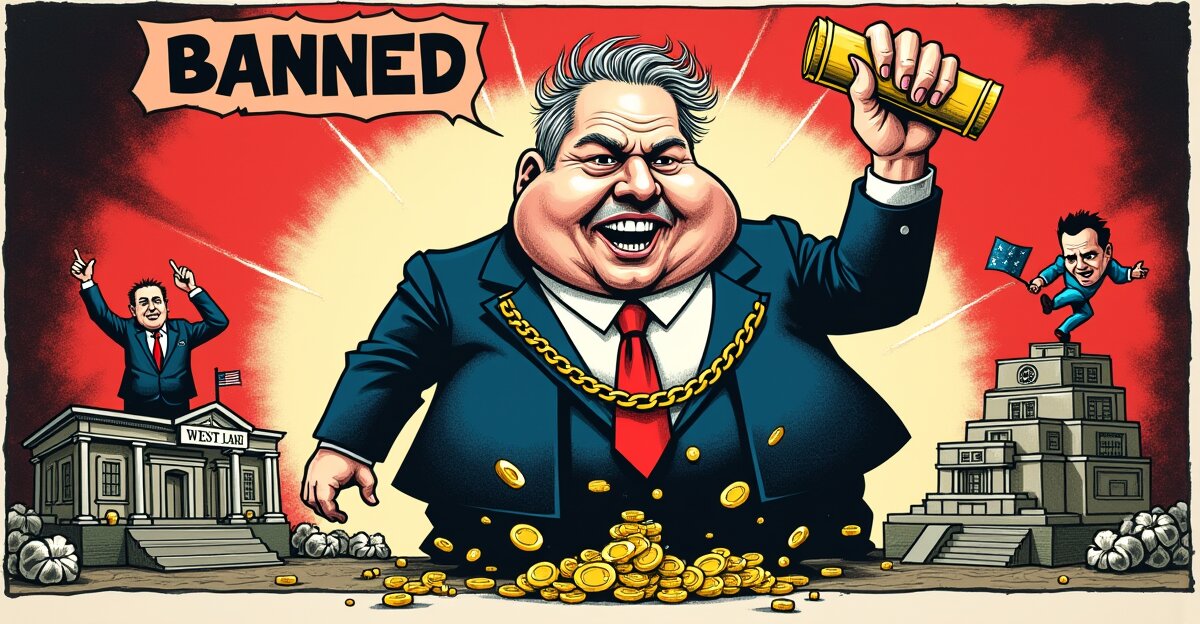
That last line is the one to hold onto. In January, Trump threatened 10 percent tariffs on eight countries, the UK included, for refusing to back his demand for military force to take control of Greenland. The playbook is already written. The UK sanctions are a test of whether the fat-man administration will enforce its new "no discrimination against Israel" trade doctrine against an ally, or whether the old alliance gets the pass it has always gotten.
Domestically, the story got stranger. Miliband leaned on his own Jewishness, calling himself a "proud British Jew" with relatives who found safety in Israel after the Holocaust, and said there was "absolutely no contradiction" between supporting Israel and supporting Palestine. On the floor of the Commons, even a Conservative crossed over. Edward Leigh, the longest-serving Conservative Friend of Israel, said he "absolutely and fully support" the sanctions, because they were "about standing up for freedom, for morality and justice."
Meanwhile, the shadow foreign secretary, Tom Tugendhat, warned the economies of Palestine and Israel are "too interconnected" for the ban to work and that it risks "harming innocents." That is the standard argument, and it is also, quietly, an argument that the status quo is fine as long as nobody's grocery bills go up.
Miliband stopped short of calling what is happening in Gaza a genocide, saying the UK would wait for the international courts, which is the most legally correct and emotionally inadequate position a government can take. The line on Rwanda, Srebrenica, and the Yazidi people doing the heavy lifting for a decision that the government would rather not make.
The real reason this happened now is on a map, not in a press conference. Israel's plan to build out the E1 settlement area east of Jerusalem, roughly 1,200 new homes that the UK condemned last month, would slice the West Bank in two, severing the north from the south and ending, functionally, any prospect of a contiguous Palestinian state. Everything else in Tuesday's announcement is downstream of that one construction project. Sanctions on milk and perfume are symbolic; E1 is the knife.
So here is the tension that has defined this whole war, restated. The country that spent eighty years being told to keep its head down, to not rock the boat, to let the special relationship do the work, finally put a number on the invoices. And the first response was not an argument about the land, or the courts, or the two-state solution. It was: you will be discriminated against, and we will close your consulate, and we will tell the Americans to hit you with tariffs.
The question is not whether the sanctions will stop the bulldozers in E1. They almost certainly won't, not by themselves. The question is whether twelve Western governments have, for the first time, agreed that the money was never neutral, and whether the old order has enough left in it to make them all walk it back by New York.
Comments (0)
No comments yet. Be the first to speak up.
Join the Riot
Login with Google to leave a comment.
Login to Comment