
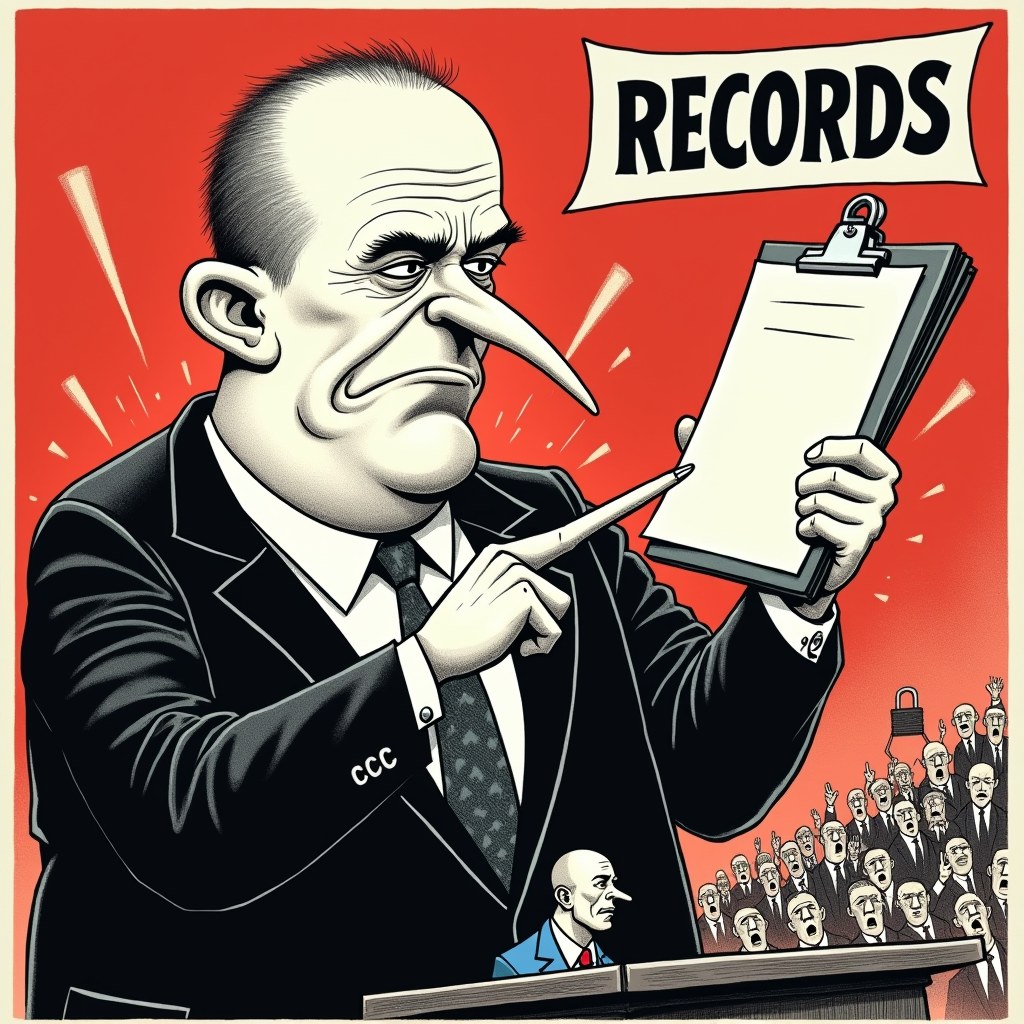
The administration's favorite weapon is a demand for medical records, and the weapon just found a target with a sealed door behind it.
"Talafreako needs to release the medical records (if they exist at all)."
— Stephen Miller, White House deputy chief of staff, Sunday, on X
On a Sunday, with the Texas Senate election a month away, Stephen Miller did what Stephen Miller does. He pointed at a political opponent and demanded proof of his body.
Miller, 41, the White House deputy chief of staff, posted that Democratic Senate nominee James Talarico "needs to release the medical records (if they exist at all)," with that closing parenthetical hanging there like a man filing a complaint about a possibly nonexistent person. It was the latest installment in a multiday assault on Talarico's illness, which had pulled him off the campaign trail after a flu diagnosis.
Except the post landed in a field that was no longer empty. The moment Miller demanded the charts of a 37-year-old with the flu, a wave of commenters reached past him and pointed at the office above.
The sequence is worth reconstructing. Talarico, a Texas state representative running for the open Senate seat, announced on Sept. 30 that he was sick. He called in virtually to an event with the U.S. Hispanic Business Council, visibly unwell, saying he'd been "shaking too many hands on the campaign trail" and warning that "if I was passing on this illness to somebody and got someone's grandmother or someone's baby sick, I couldn't live with myself." The night before, he'd gone to urgent care in Dallas.
His last in-person appearance before that had been a Sept. 28 fundraiser in New York with Robert De Niro. After that: nothing. And in the nothing, the campaign war filled in.
Ken Paxton, the Trump-endorsed Republican nominee, demanded "proof of life." His campaign launched a "Tala-Freak-Out Tip Line" for sightings of the missing Democrat and pushed missing-person posters of him. Spokesperson Madison Cercy declared that "Low-T Jimmy appears to be having a full-blown mental Tala-freak-out on the national stage," and that if Talarico was "too fragile to face Texans, he has no business asking for their vote." MAGA accounts went further, claiming he'd been committed to a psychiatric facility. His spokesman JT Ennis called it "a lie designed to promote a pathetic conspiracy theory."
Then the president. At a San Antonio rally, Trump worked in a running bit that Talarico is a vegan who gets sick after eating meat for show. Talarico is not a vegan. On Truth Social he wrote, "TalaFREAKo has been missing for 12 days!" and, "12 days is a long time to rid yourself of the so-called flu bug. What's going on?" The day before he'd tagged Talarico "MISSING IN ACTION" and asked, "Where is he? What is wrong with him? Bad rumors are coming out."
Translation: a flu is a terrible thing to waste on a 37-year-old, and a very useful thing to waste on a senator.
The boring facts make the assault work. Talarico has Type I diabetes, diagnosed during his 2018 run for the Texas House, the year he went into diabetic ketoacidosis after walking the length of his district for a string of town halls and slept for 36 hours. This year his campaign ran television ads for a bill he championed capping the monthly out-of-pocket cost of insulin in Texas. The CDC notes that people with diabetes face higher risk of serious flu complications and tend to stay sick longer than other patients.
He resurfaced Friday at the Austin City Limits festival without announcement, greeting voters in Zilker Park, and told The New York Times he'd been "home sick in bed" with "a nasty case of the flu." "Everybody should get the flu shot," he added, before walking into a crowd. His campaign posted video with a note: "Hate to disappoint the conspiracy theorists, but James is still alive and meeting with voters at ACL today."
Buried in all of it is a detail the tip line can't find. Talarico has accepted four debate invitations. Paxton has accepted none, despite his campaign telling the world in July that "of course we're going to debate." The missing man is not hiding from cameras. The man hiding is the one with the tip line.
Miller's Sunday demand was the punchline to that week of theater, and the theater bounced.
Under the post, the loudest replies came from the base Miller exists to serve, flipping the demand on its source. "Just like your boss has released his!" wrote one. Another: "So does Trump.... the real in-depth ones." A third: "No, he really doesn't. How many members of congress release their medical records every time they're sick? Has Trump released his yet from the shooting in PA?" A fourth: "Maybe when Trump release his. The American ppl deserve to know why his hands are rotting from the inside out." One more dragged the retired Senate leader into the pile: "Let's see Trump's medical records and McConnell's. Why are you relentlessly attacking Talarico? It's weird."
Miller did not reply. The White House did not answer the demand, which is to say it did what it has always done.
Because here is the part the tip line can't find. The 80-year-old president of the United States has not released his medical records since a bullet grazed his ear at a rally in Butler, Pennsylvania, in July 2024. No chart from the hospital that treated him. No exam since. No documentation of any kind, beyond the standing White House non-answer that the president is in excellent health.
The visible evidence has accumulated anyway, all year. The bruised hands that will not stop appearing in photographs. The perpetually swollen ankles. The neck rash peeking out of a collar. The slurred sentences, the public naps, the sleepless nights of posting. In August, a clinical and forensic psychologist named Dr. John Paul Garrison, who studies body language, flagged what he described as a repeated spasm in Trump's right arm and offered a shortlist that read like a punch line: "This could be neurodegenerative disease. We could be talking Alzheimer's, we could be talking Lewy body dementia, you could be talking something like Parkinson's disease," or, he added, post-stroke damage. Asked about it, the White House did not respond.
The asymmetry is not an accident. In this administration, the medical-records demand is a campaign weapon, and like all campaign weapons, it is pointed only at opponents. The machinery that wants a 37-year-old diabetic to prove he is alive does not want a single line of his boss's chart, which is the one document that would end every story being told about the president's hands, his legs, his arm, his sleep. A transparency demand in this government is a demand for someone else's body.
Miller, the man who built a career on saying the quiet part out loud, found that out with his own post. He asked for the records of a man with the flu, and the base, which knows exactly what records are for, asked for the only set that matters.
The charts exist. They always have. Every visit, every scan, every spasm is written down somewhere on a locked shelf in Washington. The question was never whether the records exist. The question is who gets to open the file, and the answer has always been no one.
Comments (0)
No comments yet. Be the first to speak up.
Join the Riot
Login with Google to leave a comment.
Login to Comment