
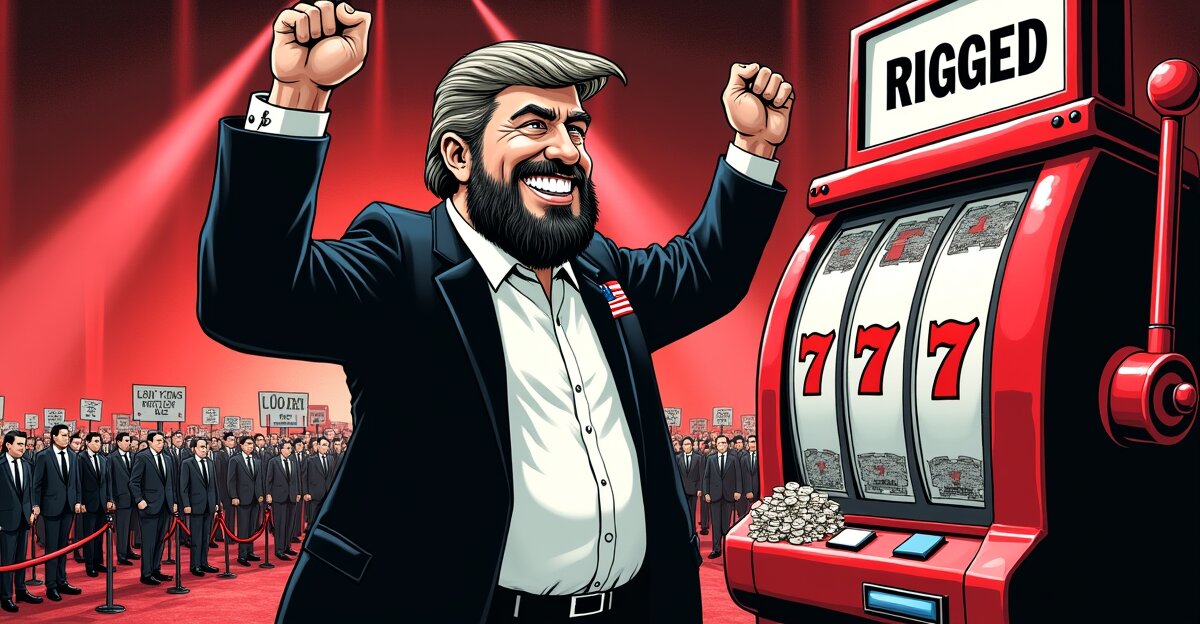
By November, every House race will carry a price on a betting machine, and the richest family in American politics holds a stake in the house.
"Any conversation about what's going on with prediction markets in the U.S. right now needs a big disclaimer: Donald Trump Jr. is a huge investor in Polymarket."
— Kate Knibbs, senior writer at Wired, on The Intercept Briefing
One month before the midterms, the two biggest names in a category that barely existed four years ago have already built "midterm hubs" on their home pages. Kalshi and Polymarket, the platforms Americans use to bet on everything from the Super Bowl to the next Supreme Court appointment, have turned November's elections into a product. In 2024, Americans wagered $3.2 billion on a single presidential contest, according to Fortune, and one French trader walked away $80 million richer for calling Donald Trump. This cycle, the betting spreads across the House and Senate, and Pew Research reports trading volume on prediction markets "has soared in recent months."
The machine has also stopped being a side bet and become the news feed. Polymarket has a content partnership with Dow Jones and now distributes through Substack. Kalshi has deals with CNN, CNBC, and Fox. On CNBC's Squawk Box, "the Kalshi odds" are read out the way a stock ticker used to be. In under two years, a barely regulated class of betting platforms has been handed the role of probability anchor for the decade's most consequential elections.
A betting slip now does the work that a false flag used to.
Nobody has yet decided what this thing is. The platforms insist they are financial exchanges, federally regulated commodity-trading venues, cousins of the corn futures market, except the corn is "who wins the governor's race." Dozens of states disagree. They say it is gambling, that the states own the tax and the laws, and that in Texas, where gambling is nearly illegal, it is flatly illegal. The result is a pile of more than 50 lawsuits across the circuit courts, and on October 7 the fight crested at the Supreme Court. State attorneys general from 39 states and Washington, D.C. filed a joint brief in support of New Jersey, which is asking the court to overturn an appellate ruling that found federal commodity law supersedes state gambling law. The brief's verdict: the case "has splintered the circuits and lower courts with no resolution on the horizon. Only this Court can provide the much needed answer."
The White House, for its part, has already picked a side. PBS NewsHour reports the Trump administration is backing Kalshi and Polymarket against the states that are moving to ban or regulate them. The industry's response to the states has been money and lawyers. A week after Texas lawmakers held hearings on whether prediction markets constitute gambling, the founders of Kalshi dropped $200,000 into a new Texas-focused political action committee, according to the New York Times. OpenSecrets has tracked a $3 million effort from a group called the Coalition for Prediction Markets. Politico describes Kalshi's legal shop as a "murderers' row," much of it recruited out of the Biden administration.
Now the part that turns a regulatory squabble into a conflict of interest.
Donald Trump Jr.'s venture capital firm, 1789 Capital, just became the lead investor in Polymarket's latest fundraising round. He is a paid adviser to Polymarket and, per the Financial Times, to Kalshi as well. His father's media company, Trump Media, floated its own prediction market, walked it back a notch, and settled for a partnership with crypto.com instead. And the president himself has spent the term publicly siding with the industry against the states.
Translation: the president's son is the casino's lead investor, and the president's government is the casino's bodyguard.
The companies, for their part, insist the insiders can't play. A Kalshi spokesperson told WIRED that in elections "we have a broad list of people that are not allowed to be in the markets, where if you're a donor, a staffer, a family member of staffers, and many more, you're not allowed in the markets." Fine, on paper. The question is what a rule means when the house's biggest shareholder is sitting at the dinner table of the administration that decides who gets to make the rules.
On the ground, election officials are preparing for a war.
In Delaware County, Pennsylvania, a poll worker at a training session asked whether the crew could "just want to make a minor bet on what turnout will be, that'll keep things interesting." The county's answer was to rewrite the oath. Some 2,500 election employees in the county have signed "an affirmation that the workers have no direct or indirect interests in any bets, wagers, or prediction markets." Dean Logan, county clerk of Los Angeles, tells WIRED the prediction markets "fed a lot of the volatility in the aftermath of the June election," including threats and aggression from "people who had a stake in the outcome" at "a level that we haven't seen in prior elections." The Wisconsin Elections Commission now warns voters they cannot bet on an election's outcome and then vote in that same election. A Kalshi employee, on X, called the warning "active voter suppression."
The odds themselves are not the problem, officials say. The problem is the public's relationship to them. In a poll commissioned by the Partnership for Large Election Jurisdictions, 75 percent of likely voters could not correctly say what prediction market odds represent, and 35 percent believed the numbers were counted votes or official projections from state officials. Last month, in the Wisconsin gubernatorial primary, both Kalshi and Polymarket priced progressive candidate Francesca Hong as the likely winner until the actual votes came in. And in some House districts the entire market is worth a few thousand dollars, which means, in the words of Texas election attorney Andrew Cates, "anybody could place a big bet on a race and skew at least the perception of the odds."
The manipulation risk is no longer hypothetical. The Justice Department has charged a U.S. soldier with profiting on prediction market bets using classified information. A Google employee has been prosecuted for insider trading on the platforms. Kalshi tells WIRED it has flagged manipulation and insider-trading cases to the CFTC, including a Senate candidate who claimed he bet on himself on purpose. In June's California primary, affiliate marketers paid by both platforms posted content questioning the outcome of the Los Angeles mayoral race; after the backlash, the influencers removed the paid tags. The companies say their rules prohibit election-denial content. The companies' rules, it turns out, are enforced by the companies.
And the CFTC, the federal agency that oversees the markets, says it has no plans for midterm-specific surveillance. It is "extensively monitoring election markets, just like all other markets."
Meanwhile, at the top of the food chain, the absurdity keeps compounding. A startup called Verifact Markets is letting users bet on facts: where the coronavirus came from, whether the moon landing was staged. The markets, its backers say, will be settled not by the votes but by a "proprietary, AI-flavored system" that adjudicates the truth. Knibbs, who covered the launch, summarized the moment: "I think we just had our Pets.com moment for the prediction market space." The bubble is frothy enough that LeBron James has a deal with Polymarket and Sydney Sweeney is advertising a rival app. And the addiction medicine is catching up. An Associated Press investigation of treatment providers found the same damage as sportsbooks, in the words of Dr. Cynthia Grant of Birches Health: "There may be real differences in how these products are defined or regulated, but in the therapy room, we are often seeing the same cycle of anticipation, action and reaction play out again and again."
There is no inventing a healthy alcohol, as Knibbs puts it. The machine is not broken in the way a machine can be fixed. It is working. It is just not working for the people it is supposed to serve.
The states' brief asks the Supreme Court to decide one question: do the states get to regulate this casino, or does the federal label win? Whoever answers it will be answering with the midterms already in motion, in polling places across a country where every race now has a ticker, a whale, and a price. The question was never whether the markets would become a signal for who wins. The question was who owns the machines. Right now, the answer is the same name on the casino's ledger and in the government that blocks the states from touching it.
Comments (0)
No comments yet. Be the first to speak up.
Join the Riot
Login with Google to leave a comment.
Login to Comment