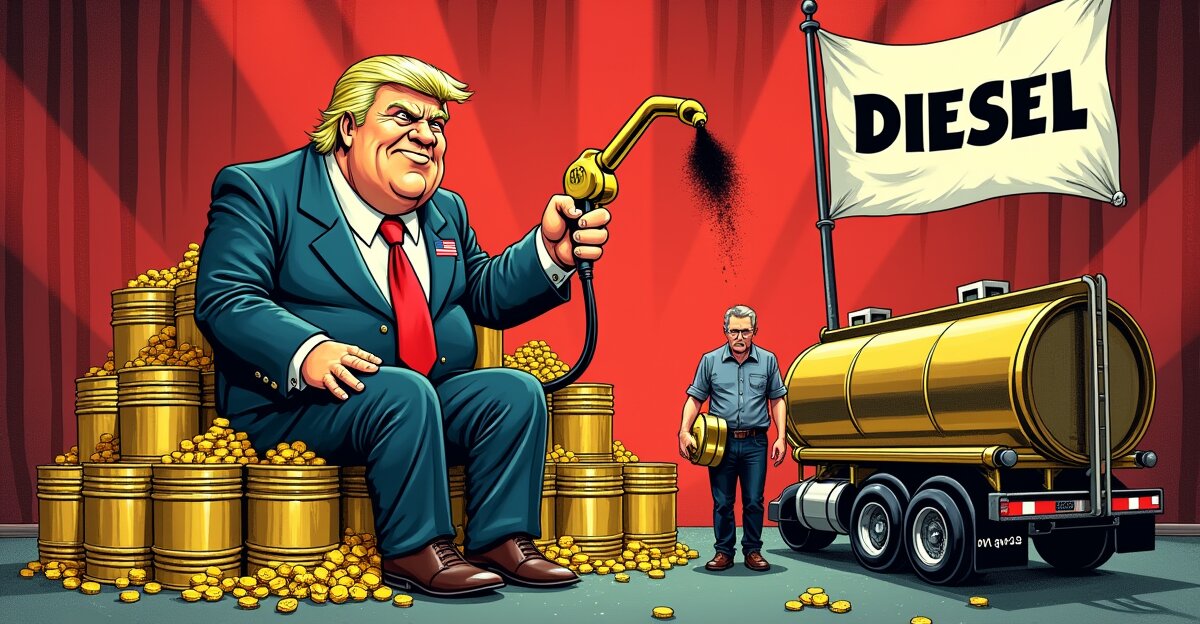
Three weeks after signing a law to choke off Russia's war money, the White House handed Moscow a six-month sanctions holiday, a guaranteed market for its diesel, and, by Zelenskyy's word, a smokescreen.
"I believe our team is simply being used as a smokescreen. And that is certainly not fair. It is certainly not how partners should treat each other."
— Volodymyr Zelenskyy, President of Ukraine, reacting to the Russian diesel deal
On Friday afternoon, President Donald Trump took a phone call from Vladimir Putin. The call, by the president's own account, was supposed to be about a suspected case of pneumonic plague in Russia. Instead, Trump announced that Russia would "immediately" begin shipping diesel to American markets: more than 300,000 tons right away, another 500,000 tons in November, a million tons "immediately thereafter," and three million more "within a short period," depending, he wrote on Truth Social, on the condition of the refineries Ukraine has been striking.
The United States has not imported a barrel of Russian oil or gas since 2022, when the Biden administration banned the imports in response to the invasion. Hours after the announcement, the Treasury's Office of Foreign Assets Control issued a temporary general license suspending sanctions on Russian diesel until April 7, 2027, the first such license to run longer than the standard 30-day window since the Ukraine war began in February 2022.
The timing is doing a lot of work in this story.
Just weeks earlier, Trump had signed the Lindsey O. Graham Sanctioning Russia and Iran Act, one of the most sweeping Russia sanctions laws Congress has passed in this war. It is named for the late Senator Lindsey Graham, a Trump ally and Russia hawk. It authorizes tariffs of up to 100 percent on the top five importers of Russian oil and gas, targets the shadow fleet of tankers that has carried Russian crude, and bans new U.S. investment in Russia. This week, lawmakers had been urging the administration to use the law to help Ukraine.
Then, on a Friday in October, the administration licensed the very product the law was built to price out of the market.
Scott Lincicome, a vice president at the libertarian Cato Institute, asked the only question that mattered: "Can America tariff America?"
The stated reason is the price at the pump. The Iran war, which began in February, has sent global energy prices soaring, and diesel has taken the worst of it. The national average sits at $6.28 a gallon, down from a record $6.52 set on September 22. Brent crude has been trading above $103 a barrel; before the war it traded around $73. In a country where diesel moves trucks, tractors, and the cost of almost everything, it has become the most political number in the economy.
The math of the deal does not hold. U.S. diesel consumption runs about 3.8 million barrels a day. The first tranche is roughly 2.25 million barrels, a little less than a single day's worth. Tim Armitage, an investment strategist at Quilter Cheviot, told the BBC that the numbers "won't make a material difference to pump prices in the US," and called the announcement "a slightly desperate move by President Trump to try to lower inflation ahead of the midterms." The election is three weeks away.
Translation: whatever this deal is, it is not a supply solution.
So what is it? Consider who benefits. Russia banned its own diesel exports in July, after Ukrainian drone strikes on refineries knocked domestic output down by roughly 30 percent, according to the International Energy Agency. Moscow was sitting on summer-grade diesel it needed to offload before switching to heavier winter blends. This deal hands the Kremlin a guaranteed buyer, a six-month sanctions holiday, and a market for the very product Ukraine's strikes were supposed to keep from reaching the open market. Clayton Seigle, an energy strategist at the Center for Strategic and International Studies, called it "a great benefit to Russia and to Putin."
Consider also what the deal is not. Nobody has said who is paying for the diesel. Nobody has said how it is paid for. The Treasury has not said whether the license covers American buyers or just "the global market." Russian presidential aide Yuri Ushakov declined to say whether the United States offered anything in return. The White House did not answer questions about the deal's terms. In full public form, the deal exists only in a Truth Social post.
There is also the question of what the other side of the table said. The president announced the deal while his envoy Steve Witkoff and son-in-law Jared Kushner were in Miami, meeting with Ukrainian officials to discuss a proposal to end the Russia-Ukraine war. In the same stretch, Ukraine had defended its strikes on Russian refineries, and Trump had blamed those strikes for the fuel crisis. Volodymyr Zelenskyy responded by saying Russia would repay the diesel "with further terror and perfidy," and that the deal was "an investment in a war that must be ended, not prolonged."
"Any easing of sanctions against Russia without a clear and lasting de-escalation agreement with Russia is an obvious weakness," Zelenskyy wrote.
Trump, leaving for a campaign rally in Syracuse, offered a different summary. "I want to thank President Putin. To be honest with you, we have massive amounts of oil coming into our country, and it's diesel, which is what we want. So, thank you." He did not answer shouted questions about Zelenskyy's criticism.
The backlash crossed party lines, which is worth noting. Senators Chuck Schumer, Jeanne Shaheen, and Elizabeth Warren called the announcement a betrayal of Ukraine, the European allies, and U.S. national security, and wrote: "Enough is enough. The President must end his war with Iran instead of funding Russia's war machine." Senator Richard Blumenthal, a co-sponsor of the sanctions law, said the deal was "directly contrary to Congress's intent" and called it "an insult to Lindsey Graham's memory." Even Representative Michael McCaul, a Texas Republican and one of Congress's more consistent Russia hawks, warned that lifting the sanctions "will only fund the Kremlin's war machine."
Jeremy Siegel, the Wharton finance professor, put it most plainly: "It looks like Trump cut a deal with the devil."
The irony here is not subtle. In September 2025, Trump had scolded world leaders for buying Russian oil. "They're funding the war against themselves. Who the hell ever heard of that one?" he asked the United Nations General Assembly. Less than a year ago, his own Treasury Department had sanctioned multiple Russian oil companies for "Russia's lack of serious commitment to a peace process." Now the president of the United States is thanking Vladimir Putin, by name, for "massive amounts of oil."
In the same week as the diesel deal, he floated suspending the federal gas tax, opened up tax-free "red dye" diesel for highway use, and pressed G7 nations to release 100 million barrels from strategic reserves. Every move points at the same number: diesel at $6.28, and the election three weeks out.
Zelenskyy's word for the whole affair was smokescreen, and the mechanics are easy to follow. If Russian diesel is flowing to markets again, then the strikes that were choking Russia's refineries no longer serve the American interest. The deal converts a U.S. war aim into a bargaining chip, and it lets the president pose as the man who solved the pump problem while quietly rearranging which side of the war Washington is on.
The question is not whether the president can buy diesel from Russia. Congress passed a law bearing a Russia hawk's name, and the administration issued a license that quietly undoes it. The question is what a president does with a war when it becomes a line item on a gas station sign.
Comments (0)
No comments yet. Be the first to speak up.
Join the Riot
Login with Google to leave a comment.
Login to Comment