An American cabinet secretary bragged on national television that a foreign country is "forced to work" for the United States, then spent the next hour denying he was describing theft.
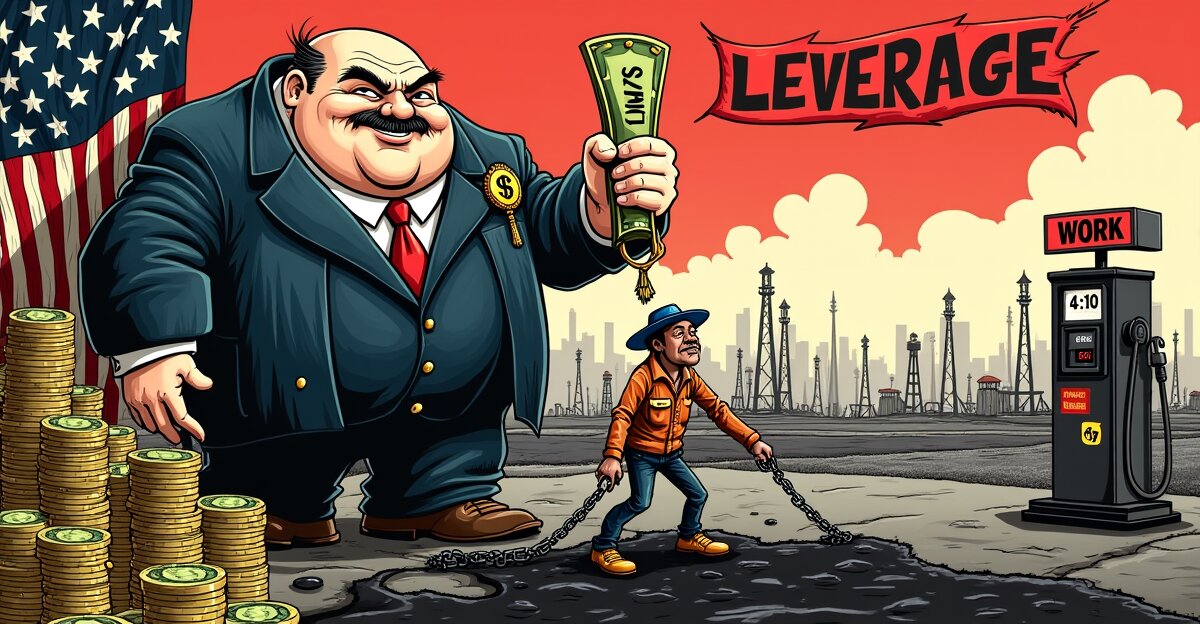
"We have a lot of leverage over Venezuela. We control the sale of oil outside of their country. So right now, they are forced to work in partnership with us."
Energy Secretary Chris Wright, ABC News "This Week," September 6, 2026
It is difficult to find a cleaner description of empire. Not the old kind, with the flag and the garrison and the open ledger. This one arrives on a Sunday morning interview, in the measured, reassuring tone of a man explaining a business arrangement. The United States, Secretary Wright explained, has "a lot of leverage" over Venezuela. It "control[s] the sale of oil outside of their country." And so the country, he said, is "forced to work in partnership with us."
Then, roughly an hour later, a different question forced a different framing. When pressed on whether the administration was taking Venezuelan oil by force, Wright's answer was that it was not "stealing" anything. The logic, as rendered by one account, was almost charming in its circularity: if the oil is in Venezuela, and Venezuela controls it, then what is happening "isn't stealing." A seizure is a partnership. A partnership is consensual. The consent is implied by the fact that the seizer holds the only exit off the boat.
The words came out in a specific order, and the order matters. On "This Week," Wright spent the first half of his segment defending the war with Iran as "a challenge" and "a conflict zone" rather than a war, insisting the American blockade of Iranian oil would "either change their regime, or it'll change their regime's policies." Gas prices, he said, would come down. "Trust the market, certainly don't trust my predictions." He promised that Venezuelan oil exports were "up 50 percent," total national production "up 25 percent," and that "billions of dollars of new investment has been announced."
It was when the host turned to the Venezuela deal that the machinery of the sentence revealed itself. The United States, Wright said, "transform[s] that region from a region of conflict to a region of commerce." He said the momentum was "very, very positive for the hemisp," then, catching himself, reissued the thought: "for the Western Hemisphere."
That is the tell. He did not mean commerce in the sense a Venezuelan meant it, or a worker in the region, or a family paying for heating oil in winter. He meant commerce in the sense a balance sheet uses it: a flow of extractable value, redirected.
Translation: the same administration that just bombed a foreign government into obedience is now describing that obedience as a win-win, and asking you to believe the win part is not a lie.
To understand why the phrase "forced to work" landed so hard, you have to understand what it sits on top of. On January 3, 2026, American forces conducted a military operation in Caracas that killed dozens, including civilian residents of a bombed apartment complex, and captured President Nicolás Maduro and his wife Cilia Flores. They were flown to New York, arraigned in federal court, and charged on drug trafficking counts to which both pleaded not guilty. Venezuela's UN Charter sovereignty was set aside as a matter of convenience. The United States did not ask Caracas to open its oil fields. The United States took a sitting president off the ground at 3 a.m. and told the country what to do next.
What came next is the part that is easier to ignore. The Trump administration announced that it had "secured majority US control of more than 65 billion barrels of proven oil reserves in Venezuela," a number that, on the president's own arithmetic, would more than double the strategic reserves held by the United States itself. A new law in the Venezuelan legislature, passed by the government in place, handed control of production and sale to private companies. Sanctions were lifted. The administration began to collect the proceeds.
How much has been collected, and where has it gone, is not a question the administration has answered. The Financial Times calculated that the administration had collected more than $13 billion in proceeds from Venezuelan oil sales, without public oversight. The Council on Foreign Relations, relying on tanker-tracking data from Bloomberg, estimated that in the first four months of American control, roughly one hundred million barrels worth an estimated $8 billion had flowed through a process that was, in the organization's words, marked by "no transparency and minimal oversight." The administration has not disclosed how much Venezuelan oil it has sold, how much revenue it has collected, or how it has used the funds.
There is a mechanism for it, at least on paper. An executive order created "Foreign Government Deposit Funds," Venezuelan money held in U.S. Treasury custody, with the secretary of state issuing instructions for disbursement. A State Department witness told Congress that roughly $3 billion had been authorized for Venezuela, and could not say how much remained in the accounts. A KPMG audit was promised, with no date. The written agreements with the traders, buyers, and banks running the operation were never made public, though two of the companies in the loop, Vitol and Trafigura, each have documented histories of bribery schemes tied to oil sales.
The money is not, in other words, unaccounted for the way a lost wallet is unaccounted for. It is accounted for by a process that is not accountable. There is a difference, and the difference is the entire story.
Here is where the two interviews braid together, and the contradiction becomes the point rather than a footnote. On the morning show, Wright described a country that is "forced to work in partnership with us." On the network's follow-up that same day, when the theft question actually landed, the administration's answer was that no theft was occurring, because Venezuela is, in the framing, the one in control. Both statements can only be true if "control" is a word that changes shape depending on who you ask it to describe.
This is not a slip. It is a template. The same sentence structure showed up in the war with Iran, where the administration calls an active, escalating, month-long shooting conflict "a conflict zone" and the deployment of 50,000 troops "a challenge," while the service members it is sending into the Strait of Hormuz are, as of the weekend, 18 dead and nearly 800 wounded. The word war, in the mouths of the cabinet, has been retired in favor of the word situation, and the situation, by design, does not require an ending.
So here is the question the Sunday interview will not answer, because answering it would require a ledger. If the United States is not stealing Venezuelan oil, whose is it, exactly? If Venezuela "controls" the oil and is "working in partnership," why does the partnership require that every dollar of it move through an American account before the Venezuelan government may see it, under terms the Venezuelan government did not negotiate and the American government has not published? If the region is being transformed "from a region of conflict to a region of commerce," what does commerce look like from the side that is being forced to work for it?
The answer the administration has settled on is that the question is unanswerable, because the framework inside which it could be answered is one in which the United States is not a participant but a rule-maker. You cannot audit the referee. You cannot subpoena the landlord. You can only ask, with some embarrassment, to see the lease.
The lease has not been shown to anyone.
The question is not whether the United States took Venezuela's oil. The question is what the country thinks it calls a thing when it takes it, and whether "forced to work" is the honest name, or just the honest one said on a Sunday, before the cameras stopped rolling.
venezuela, oil, trump, empire
Comments (0)
No comments yet. Be the first to speak up.
Join the Riot
Login with Google to leave a comment.
Login to Comment