
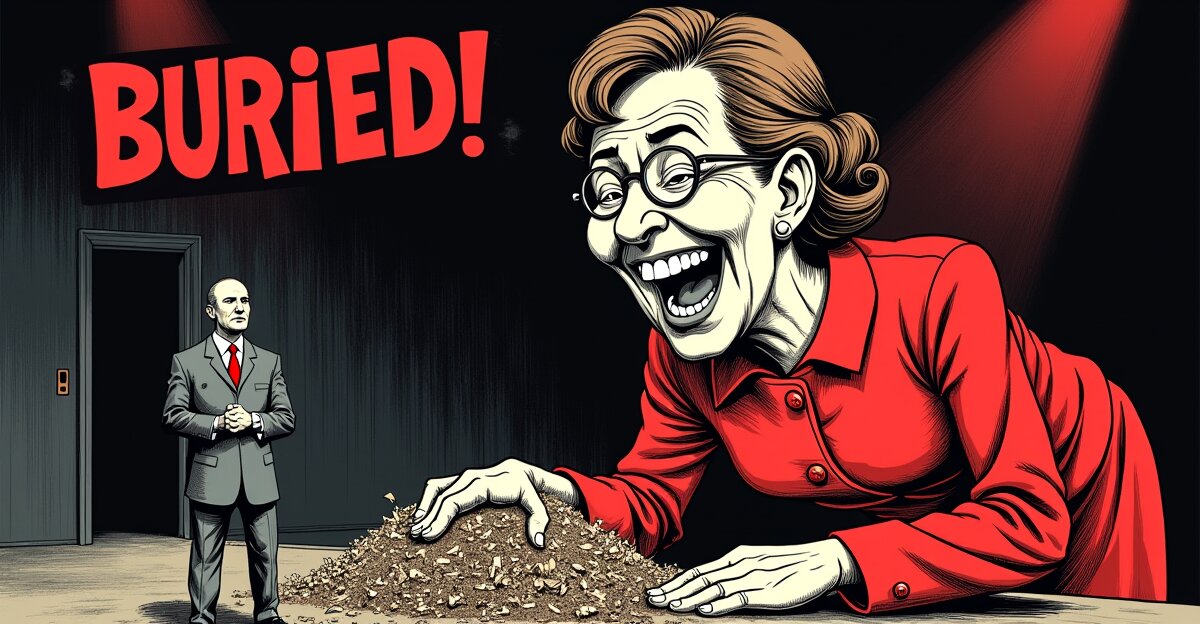
The FBI had a 50-page map to corruption in Congress. Then the administration purged everyone who could read it, weeks before the senator it implored went back on the ballot.
"I was fooled and foolish enough to believe that the power elected officials wielded, and [were] actively willing to sell to anyone wealthy enough to pay, was 'smart business.'"
— Martin Kao, letter to the U.S. District Court in Hawaii
In the final weeks of 2019, the top fundraiser for Sen. Susan Collins sat down across from three executives of a Hawaii defense contractor called Navatek, because the two-time Republican from Maine was losing her seat, dragged down by Trump's dismal approval ratings. The fix turned out to be simple. He asked for $500,000 for her 2020 reelection. Navatek's CEO, Martin Kao, had a counteroffer: if Collins would guarantee tens of millions in new federal funding, the money would flow through a shell company, and the senator would know where it came from.
Government contractors are banned from political contributions, and a donation offered for official acts is criminal bribery. Kao later told FBI agents that everyone involved understood the payments were exactly that. Neither side seemed to mind. Weeks after the coffee, $150,000 arrived at the 1820 PAC, Collins' super PAC, from an LLC with a typo in its name: "the Society of Young Women Scientist and Engineers." Seven days after the check cleared, a super PAC staffer asked a Navatek lobbyist for Kao's number. "Senator Collins would like to call Martin to thank him."
The rest of the machine had a name inside the company: "the method."
The old model was dead. The late Sen. Daniel Inouye, the "King of Pork," had steered hundreds of millions in federal dollars to Hawaiian favorites by name, and Navatek, a sleepy engineering firm under founder Steven Loui, had been one of his beneficiaries. When Inouye died in 2012, the company found its replacement in the annual defense budget, a document so vast and so secret that a determined appropriator could plant a project for one contractor without leaving a fingerprint. The playbook: partner with a university in a member's state, pitch the research to staff, make a large initial donation, and let well-connected lobbyists do the rest.
For Collins, the method looked like this: an $8 million boat hull research project, written into the Pentagon budget and pushed to the Navy by her office. "I spoke with Sen. Collins office regarding the $8M," a naval official wrote in a 2019 email. "The interested company is Navatek." Such awards are supposed to be competitive. They were not. A year later, $21.5 million for "hybrid composite structures research" and "electric propulsion for military craft" appeared in a Senate report, language former employees said Navatek had composed word for word.
The deliverables were mostly PowerPoint. The crown jewel, unveiled at the University of Maine with a Guinness World Records rep on hand, was the world's largest 3D-printed boat, christened by Collins and the Maine delegation. The Navy never ordered one, never wanted one. "The boats weren't delivered to the Navy," one former employee told ProPublica. "The Navy didn't even want them." Navatek's revenue climbed from $10 million a year to almost $40 million, and Kao's private life climbed with it: a $4.5 million Honolulu beach house with a waterfall pool, a company renamed after himself, and a joke about his future takeover of Lockheed Martin.
It took a shell company typo to end the run.
In early 2020, the Campaign Legal Center spotted the LLC in the 1820 PAC's public filings and complained to the FEC. A Hawaii journalist found Kao's wife's name in the shell company's paperwork. The super PAC's lawyer, Cleta Mitchell, who would later help Trump try to overturn the 2020 election, suggested a fix: make the shell look real by handing out STEM scholarships, "particularly, perhaps in Maine, where the bad press was." Kao's email summary of the plan was terser: "just a pack of bitches getting free $."
The end came anyway, for fraud rather than bribes. Kao defrauded the federal Paycheck Protection Program with $13 million in inflated payroll loans, and Navatek's own founder reported him to the feds. Agents raided the company's Honolulu offices in September 2020. He pleaded guilty in 2022, and while awaiting sentencing worked as a line cook at a Cheesecake Factory.
What happened next is the part the FBI never got to finish. Facing nearly a decade in prison, Kao did what a rational felon does: he talked. Over three days in a U.S. attorney's office in Honolulu, and in follow-up interviews that ran into late 2024, he handed agents a 50-page document naming dozens of lobbyists, congressional staffers, and members of Congress, complete with email addresses and phone numbers. A road map. He said he and his associates had donated nearly $900,000 to dozens of politicians to build operations in six states running on more than $40 million a year in government money. He said the company's research "was of no real value" and that Collins was its most important patron, the office that steered the contracts while the campaign collected the checks, sometimes within 24 hours of a defense bill passing the Senate.
By the end of 2024, two agents in the FBI's elite anti-corruption unit, Michelle Ball and Kevin Gounaud, believed they had enough to open a sweeping bribery investigation into members of Congress. One thread of it involved a steak dinner in South Carolina that Kao had shared with Sen. Lindsey Graham.
Then Trump came back, and the probe died the way probes in this administration die now: quietly, with paperwork.
The Justice Department was stacked with the president's personal lawyers, and the purge gutted the institutions that could have carried the case. In February 2025, the department's Public Integrity Section, the career attorneys who build public corruption prosecutions, collapsed when leadership was ordered to drop the case against New York City Mayor Eric Adams. Unit leadership resigned in protest. Trump appointees ordered the remaining prosecutors to stop opening new corruption cases, months after Kao's confession. At the FBI, Director Kash Patel dismantled CR-15, the unit dedicated to corrupt elected officials, agent by agent. Gounaud was pushed out in early 2026. Ball, whose prior work included investigating Trump's effort to overturn the 2020 election, was fired in October 2025 in a one-page letter accusing her of "weaponizing" the Justice Department. She is suing. The career attorney assigned to Kao's case had already quit.
The FBI's public position is that the agency investigated the claims against Collins years ago "and ultimately found nothing implicating Senator Collins or Senator Collins' campaign. Any suggestion otherwise is totally false." The spokesperson did not answer questions about the 2024 investigation built on Kao's cooperation.
ProPublica reporter Avi Asher-Schapiro put it plainly: the Trump administration "took a wrecking ball to the FBI teams and DOJ lawyers specializing in these cases," and "as far as we know, the FBI abandoned a witness who might have been able to expose a generational corruption scandal."
The timing of the collapse is not lost on anyone in Maine.
Collins is running for a sixth term this November in a race that could decide control of the Senate. Her opponent, Troy Jackson, called the ProPublica report "corruption of the highest order." "We deserve answers about every contract and every conversation that Collins and her team facilitated on the backs of taxpayers," he said. "The jig is up." Collins' office, through deputy chief of staff Annie Clark, "vigorously" denied the allegations as "outlandish" and said the matter was "resolved in 2021," when her campaign disgorged the money Kao had sent "without our knowledge."
Here is the detail that makes the denial hard to swallow. The two people at the center of the 2019 scheme are running her 2026 campaign. Amy Abbott, who met Kao in the 2019 room and later emailed him "We are so grateful for ALL the Kao support!," is the finance director for her reelection. Scott Reed, the man who asked for $500,000 at the bakery, again chairs her super PAC.
Kao, for his part, went quiet. Invited to meet a ProPublica reporter at a federal prison camp in South Dakota, he declined twice when the guards called him on the intercom. His letter to the sentencing judge is the best summary of the arrangement: a small company, a powerful committee, a budget that can write a company's name into a 307-page report, and an FBI ready to read the paper trail, right up until the paper trail's owner became president.
Kao's 50-page map to Congress still exists, sitting in files inside a building the administration now controls, waiting on an FBI that no longer does this work. Washington has always been for sale. The receipt is the new thing. So is the fact that the people in charge made sure no one else would ever see it.
Comments (0)
No comments yet. Be the first to speak up.
Join the Riot
Login with Google to leave a comment.
Login to Comment