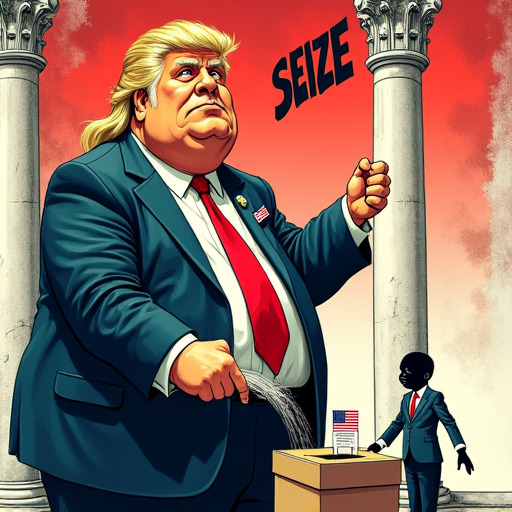
Four days before Brazil votes, the country's own intelligence agency has confirmed what Democratic lawmakers have been warning about since the summer: the United States is running an interference campaign against a Western Hemisphere election, and the White House's only answer is a one-line reassurance.
"The Trump-Rubio interventions, with the collaboration of the Bolsonaro clan, have made the Flávio campaign into another US regime change operation."
— Mark Weisbrot, co-director of the Center for Economic and Policy Research, in the Los Angeles Times
On Sunday, 158.7 million registered Brazilians vote in the first round of their presidential election, and by every measure it is a statistical tie. Datafolha's latest poll, fielded September 15 to 17, puts incumbent President Luiz Inácio Lula da Silva at 46 percent against 44 for Senator Flávio Bolsonaro in a projected runoff; Quaest has it the other way, Flávio 42 to Lula 40. A runoff, if needed, comes October 25.
The setup should be a story about Brazil: a labor leader seeking a third term against the eldest son of Jair Bolsonaro, serving 27 years and 3 months under house arrest for the 2022 coup plot. Instead, for six months it has been a story about Washington. And this week, four days from the vote, Brazil's own intelligence service put that claim in writing.
Reuters reported Wednesday that Abin, Brazil's intelligence agency, "confirmed the existence of interference from the United States as well as Russia" in the October 4 election. The document, titled "Threats to the 2026 electoral process," went out in late August, in confidence, to the presidency, the Superior Electoral Court, and the Justice Ministry. Folha de S.Paulo columnist Mônica Bergamo broke it; Metrópoles and CNN Brasil followed on September 19.
The report does not accuse the United States of tampering with voting machines. That is its careful language, and it is also its quiet horror. What Abin describes is a "selective intensification and reconfiguration" of American pressure on Brazil, "gradual, combined and adaptive," and rated at what Brazilian outlets translate as a "critical" level of threat to the election. It names Secretary of State Marco Rubio as central to the pressure, and draws on Trump administration documents from November 2025 through May 2026, including a draft White House declaration asking Brazil not to restrict "political dissidents" at the polls.
The most damning thing about the report is not what it accuses Washington of. It is how methodically it catalogs the method. Pressure that arrives gradually, combined, and adaptively is pressure engineered to be deniable.
The timeline reads like a trade war with an electoral objective. In July 2025, as Jair Bolsonaro's trial advanced, Rubio announced visa restrictions on the presiding judge, Justice Alexandre de Moraes, and his allies. On July 30, the Treasury sanctioned Moraes under the Global Magnitsky Act. The same day, Trump stacked a 40 percent tariff on top of an existing 10 percent duty on Brazilian goods, for a combined 50 percent, explaining the move as Brazil's "persecution of former President of Brazil Jair Bolsonaro."
On the prosecution itself, Trump has been emphatic: Bolsonaro, in his words, is "not guilty of anything," and the trial is a "witch hunt." For a president who spent years insisting that investigations into his own 2020 election subversion were political persecution, a foreign court convicting a foreign president of a coup is not a domestic matter. It is a casus belli for a 50 percent tariff.
The instruments have rotated since. The tariffs were struck down in February 2026 when the US Supreme Court ruled 6 to 3 that the emergency powers law behind them did not authorize them. In May 2026, Rubio designated the PCC and Comando Vermelho gangs as foreign terrorist organizations. In September, Trump's annual drug memorandum said Brazil had "failed to confront" them. Over the summer, per the Washington Post, Brazil denied visas to two senior State Department officials "whom the Trump administration planned to dispatch on a mission to cast doubt on the fairness and integrity of the country's electoral system." By month's end, Brasília was still withholding approval of Trump's ambassador pick.
Translation: the tariffs were illegal, the court said so, and the administration simply moved to the next instrument on the shelf.
Then there is the Oval Office. On May 26, Flávio Bolsonaro flew to Washington, met with Trump, Rubio, and Vice President JD Vance, and Trump posted the photo. Reuters reported the meeting was sought amid a "campaign crisis" for Flávio's bid. The senators' warning letter this week, from Jeanne Shaheen, Peter Welch, and Tim Kaine, described that meeting as one "undertaken while attempting to mitigate a domestic political scandal" and said it "underscores the administration's willingness to insert itself in the election."
The letter accused the administration of a "campaign of interference and destabilization in Brazil" across Trump's second term, with actions that "point toward an effort to interfere with, and potentially undermine, Brazil's general election in October." More than 30 House Democrats followed with a demand that Rubio confirm by October 1 "whether the administration will commit to respecting Brazil's electoral process and to recognizing its certified outcome." The deadline they chose is four days before the election, which means the deadline is the vote itself.
The letter made a historical reference the administration has spent a term trying to scrub from the region's memory: "Particularly given the tragic history of US involvement in the 1964 military coup against Brazil's democratically elected government," the lawmakers wrote, "the United States has a responsibility to support the democratic institutions that so many Brazilians, across generations, struggled to build."
In 1964, the United States helped overthrow a democratically elected government and then spent decades lecturing the hemisphere on democratic transition. The 2026 version has dropped the coup and kept everything else, which is arguably worse. The goal is not to install a dictator. It is to install a friend of the sitting president, using a tariff schedule, a sanctions list, a visa bureau, and a network of paid social accounts instead of a junta.
The digital layer is the newest part of the operation and the least acknowledged. Court filings by the coalitions backing Lula and third-party candidate Renan Santos accuse Flávio's campaign of benefiting from paid US advertising and mass messaging: US-based right-wing profiles and influencers running "paid partnership" posts on X, some citing Polymarket betting odds to claim Flávio was the favorite and distort Brazilian polling. That, the filings argue, is prohibited foreign financing; they seek disqualification if confirmed.
The infrastructure behind that layer has a paper trail. Fernando Cerimedo, the Argentine political consultant known in far-right circles as the "king of bots," was arrested at a Bolivian airport in August, days after gunmen shot his girlfriend, the lawyer Nadia Beller, outside a hotel. In the 2022 coup case, Brazilian police evidence showed Army Col. Ângelo Denicoli, sentenced to 17 years, passed Cerimedo the fabricated reports claiming Brazil's voting machines failed, which Eduardo Bolsonaro amplified. And on the commercial side, Cerimedo's business partner is Brad Parscale, the digital strategist behind the Trump campaigns of 2016 and 2020, whose tools now run across Latin America.
In the end, it is a product line: the same data machinery that built two American election victories, exported as a foreign interference package with a Brazilian zip code.
At the UN General Assembly on September 22, Lula said he intended to tell Trump to stay out of the election. He has called the White House draft declaration "arquivo morto," a dead file. The State Department, for its part, offered a one-line reassurance in August: the United States "respects the Brazilian people and candidates chosen in free and fair elections." Weisbrot put the legal question flatly: the intervention is "even clearly illegal under the Charter of the Organization of American States, to which the United States is a signatory."
Political scientist Octavio Amorim Neto offered the local read: "It was not just a trade maneuver," he said. "Bolsonarism explicitly applauded [Trump's economic attack], while Brazil's traditional right did not vigorously defend national sovereignty, saying that everything was Lula's fault." The sanctions were never meant to change Brazilian law. They were meant to make Brazilians flinch.
On October 4, the machines turn on. Abin's report does not question the machines. It questions everything around them: the money, the messages, the visas, the tariffs, the draft declaration, and the Oval Office photograph. That is the pattern the report describes, and it is the pattern the October vote will test.
In 1964, the coup came first and the explanations came later. This time the explanation is arriving first: a confirmation, four days before the vote, in a confidential report to the electoral court of a country whose voters have not yet cast a single ballot. The only thing missing from the file is the outcome. And in this administration, the outcome has always been the part that comes first.
Comments (0)
No comments yet. Be the first to speak up.
Join the Riot
Login with Google to leave a comment.
Login to Comment