
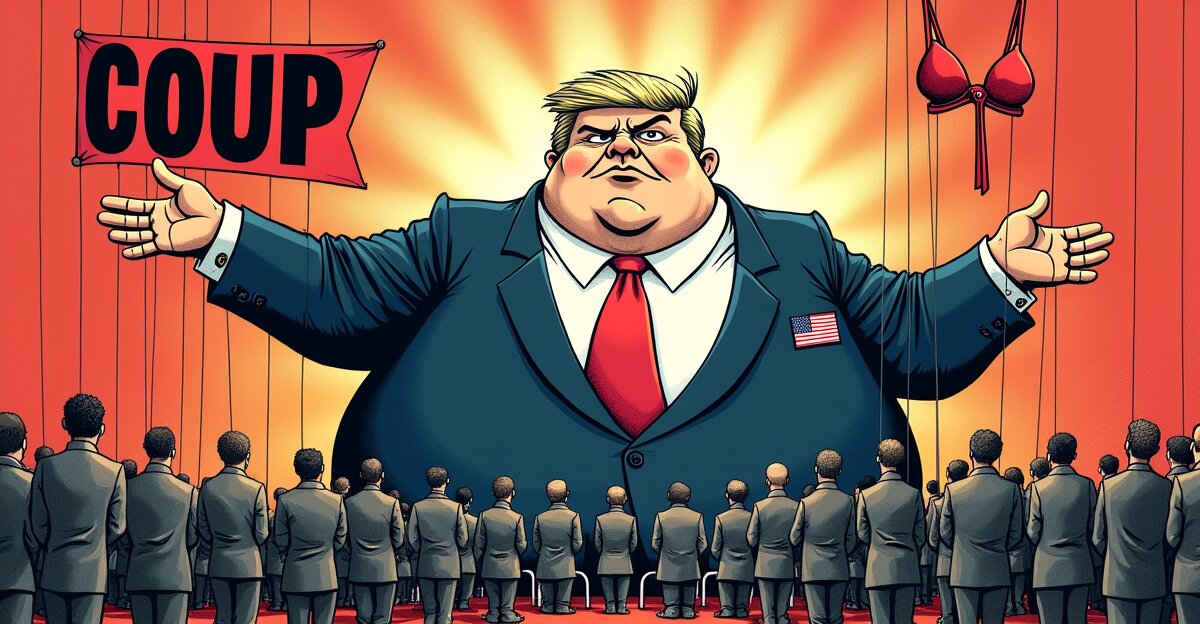
The board of the most valuable company on Earth reversed itself in twenty-four hours, and the only thing that changed in the meantime was what the president posted on Truth Social.
"I've been speaking to the board directly and indirectly, and I felt very strongly about it."
— Donald Trump, after Nvidia's board unanimously reinstated Jensen Huang, via CNBC
Before the market opened on Monday, the board of directors of Nvidia issued a statement that quietly rewrote a rule of American corporate governance. The unanimous vote to restore Jensen Huang as chief executive came, the statement said, "after the Board received input from senior levels of the United States government, and based on that input, the Board is confident that Mr. Huang's reinstatement poses no national security risk." For the first time in modern memory, a Fortune 10 board formally cited the federal government as the basis for a national security judgment about its own CEO. The government doing the reassuring had, just days earlier, publicly declined to say whether the woman at the center of the scandal was actually a spy.
Hours later, the source of that input held court on Truth Social. President Donald Trump posted an AI-generated image of the bloodied, newly reinstated CEO waving a red bra in the air, a picture riffing on the 2024 assassination attempt on the president himself. Huang, in Trump's retelling, had been shot over his sins, and like the president, had gotten back up.
Twelve days. The board took his resignation on a Wednesday. It put him back on a Monday.
To understand the reversal, start on October 29, when The New York Times reported, citing people briefed on U.S. intelligence surveillance, that officials had concluded Alice Huang, a Chinese national and former executive of Megaspeed, a Singaporean data center firm, was a Chinese intelligence asset passing information to Beijing. Electronic surveillance of her, the Times reported, revealed her close relationship with Jensen Huang, whose identity was revealed through the unmasking process. He never received a defensive briefing.
The details kept arriving. The Wall Street Journal found that Jensen Huang had been introduced to Alice Huang by her husband, Kang Wei, a Chinese businessman Huang had known for a decade. The husband, the Journal reported, had for two years spoken openly of their closeness. On November 6, The Times reported that a memo was circulating among top U.S. officials describing Alice Huang as a spy for China's Ministry of State Security. The Financial Times reported the next day that the government believed the relationship was romantic.
President Trump, the Times reported, was briefed on the intelligence in October 2025, and again in May 2026, when Secretary of State Marco Rubio delivered the briefing aboard Air Force One. The president was "not particularly moved." At a Halloween party at Mar-a-Lago, Trump said he wanted Huang to stay on his science advisory council and described him as "very above board." The Times also reported that Nvidia had donated at least $20 million to the fund building the White House ballroom. The number circulating in Washington is $25 million.
Translation: the government that spent a year watching a CEO's love life through a wire became the character witness at the CEO's job interview.
The fall started on November 8, when Huang sent a note to "my colleagues at Nvidia" admitting marital infidelity, and the board, after urging by general counsel Tim Teter, opened an investigation. On November 11, the Times reported, citing five Nvidia employees, that Huang had also had a relationship with Kimberly Powell, an Nvidia vice president who reported directly to him, a pairing Nvidia's code of conduct directly forbids. That afternoon, the board accepted his resignation as president, chief executive, and director, effective immediately.
The announcement came out the next morning, and Colette Kress took over as interim CEO. By November 20, the company's market value had shed about $2.7 trillion from its October 6 peak. Trump, asked about the resignation on a television interview, said "Sad." He then offered a successor: "There is only one man to take his place, Tim Cook of Apple. A Legend replaces a Legend!"
Also on November 12, Attorney General Todd Blanche said the Justice Department had reached "no conclusions" about whether Alice Huang was a spy. CNN reported that the intelligence collected so far did not prove she had acted as one. The Department of Justice's position, in other words, was: we do not know, and we will not say.
By midweek, the fight for Huang's job was on. The Financial Times reported that Huang's allies were assembling a "war room" of Silicon Valley executives to lobby for his return, with a stop at the White House. An open letter urging the board to reinstate him drew more than 178,000 signatures in four days. The encouragement calls reportedly included Elon Musk, Sam Altman, and Larry Fink, and, per the Times, Donald Trump, who urged Huang to "fight for his job."
On the November 17 earnings call, board chair Harvey Jones said the board "does not intend to reinstate" Huang and had retained Heidrick & Struggles to search for a permanent replacement. Semafor reported that evening that three directors were already pushing for a return. On November 20, Trump said he "would love to see Jensen be given a second chance. You know we're a country of second chances," and added that he "would like to see Jensen make a big apology and go back."
Sunday, the president demanded his reinstatement on Truth Social. Before the market opened Monday, the board voted unanimously to restore Huang as CEO and president. Harvey Jones called him "the right person to lead NVIDIA."
A board that says no on one Monday says yes the next, and the only variable that changed in between is the president's feed.
Trump called the vote "the correct and proper decision." He called Huang "a Great Patriot and National Treasure." He said the country "needs Jensen's leadership at NVIDIA," and that Attorney General Blanche "has confirmed that the U.S. Government does not possess evidence that he has engaged in any unlawful conduct." A week after his office said the Department of Justice had reached "no conclusions," the attorney general could now confirm the absence of evidence. The investigation, for what it is worth, continues.
Trump told CNBC he had "convinced them." White House communications director Steven Cheung said the president was "totally involved" and that "we have to protect our geniuses." Treasury Secretary Scott Bessent, who a few days earlier had demanded a "dramatic shake-up" over Nvidia's "culture of non-compliance," spent Sunday calling Huang an "outside" candidate.
Nvidia's stock jumped nearly 30 percent on Monday, its biggest one-day gain in more than two decades. The bra came after. In the president's posted version of events, a plot to assassinate his ally's career had backfired, and both men walked away bloodied and victorious. The 25th Amendment calls that followed were not an accident of timing. On Saturday night, the president had posted a Trump and Putin handshake captioned "My Friend," and on Sunday, former U.S. attorney Joyce Vance called it evidence that "something is badly wrong with the president of the United States." By Monday, the bra made it hard to tell which absurdity was the newest one.
The institutional machinery is now grinding. Huang has agreed to a transcribed interview on December 1 before three House committees, chaired by Brian Mast, John Moolenaar, and Rick Crawford, all Republicans. Nvidia's general counsel is set to appear on December 2, and Huang has also agreed to testify before the Senate Banking Committee. California Attorney General Rob Bonta has served Nvidia an investigative subpoena, asking whether advanced chips or confidential information reached China and whether the company misled investors. The board says its probe into "possible foreign intelligence efforts targeting" the company will "proceed to conclusion."
Commerce has its own paper trail. Axios reported that Trump approved action against suspected diversions of Nvidia chips to China at least three times this year, in May, in August, and on November 5, and that Commerce officials resisted each time. Last week, the House Foreign Affairs Committee released licensing records showing the Commerce Department approved sales of more than 800,000 advanced AI chips to Chinese companies this year, including 75,000 for Alibaba and shipments to firms on the Pentagon's list of Chinese military companies. The Times reported that Megaspeed's Malaysian subsidiary kept receiving export-controlled Nvidia technology, more than $800 million of it, for eight months after the company was put on the no-sell list.
The question isn't whether anyone in Washington understood what just happened. The question is why anyone thought the board of the world's most valuable company was the institution that would say no.
Comments (0)
No comments yet. Be the first to speak up.
Join the Riot
Login with Google to leave a comment.
Login to Comment