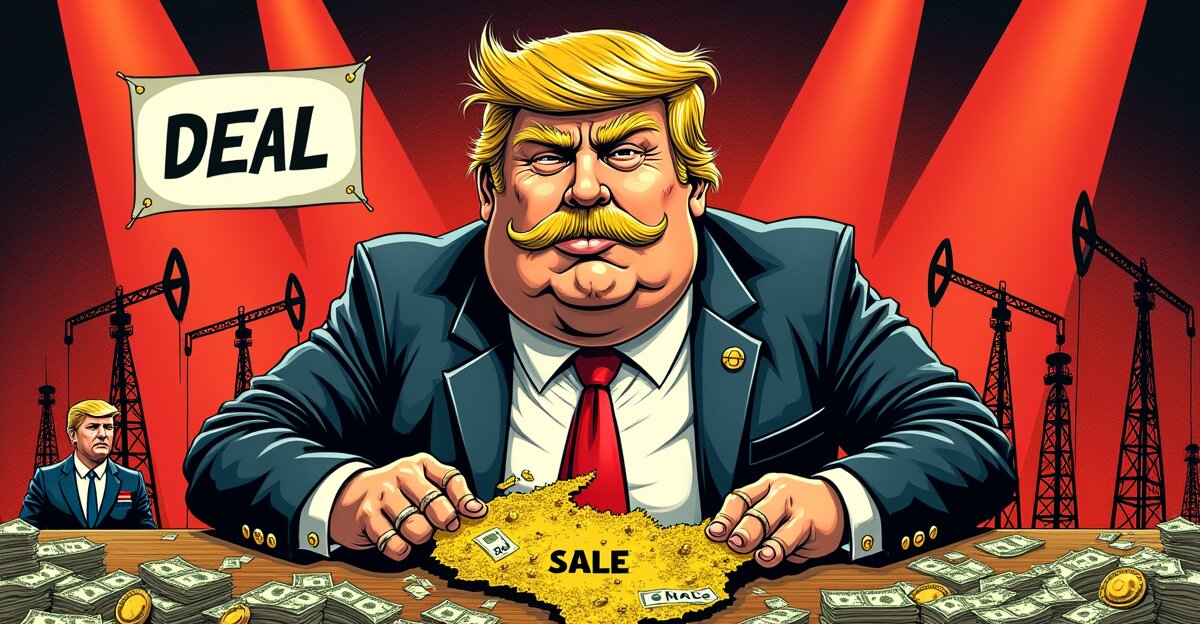
A president who kidnapped a foreign head of state now holds, on paper, a hundred-year claim to a fifth of his victim's oil. He calls it the biggest deal in world history. The gas prices say otherwise.
"If the U.S. scheme in Venezuela sounds colonial, that's because it is. This is the Trump administration trying to increase U.S. revenue from Venezuelan oil production. It's extremely unusual. It's probably unprecedented in the history of the international oil industry."
— Gregory Brew, senior energy analyst, Eurasia Group
When the U.S. military dragged Nicolás Maduro out of his palace in a middle-of-the-night raid in January, the administration called it justice. It was, more precisely, the opening move in a transaction. Eight months later, that transaction has a price tag and a term sheet: 65 billion barrels of Venezuelan proven reserves, a 100-year concession, and a 35% equity stake for the Department of Defense in the company of a man who made his first fortune as a Chávez era contractor.
Trump posted about it on Friday night, in the all-caps register reserved for the truly seismic. "THE BIGGEST OIL DEAL IN WORLD HISTORY," he wrote. The White House followed on Monday with a fact sheet, the first real detail of what was, until then, a slogan.
Here is what the fact sheet actually says. Venezuela's interim leader, Delcy Rodríguez, has granted 100-year concessions for 17 oil fields to a privately held firm, North American Blue Energy Partners, or NABEP. In exchange, NABEP handed the Pentagon's "Office of Strategic Capital" a 35% equity stake in its corporate parent, and the State Department a guaranteed right to buy 20% of all future output at production cost. The U.S. government gets veto power over every board appointment, and a majority of the board must be American citizens. The whole arrangement is governed by U.S. law and subject to U.S. courts.
Read that again. The Pentagon does not own 35% of a foreign oil company. It is not in the business of being a minority shareholder in a Caribbean energy firm. This is the Department of War taking an equity position in a barrel, and it is, by every measure, a new instrument of statecraft. The closest thing anyone can point to is the British government's old stake in a young BP, back when it was still the Anglo-Persian Oil Company.
Translation: nobody is selling Venezuela oil. The United States is installing itself in the room where it happens, with a golden share and a seat at the table for the next century.
The numbers in the White House document are the kind that move markets and startle economists. Trump says the deal "MORE THAN DOUBLES American Oil Reserves," lifting the nation's proven holdings from roughly 46 billion barrels to well over 110. Rodríguez's government projects $100 billion in new private investment and $209 billion in taxes flowing back to Caracas over a quarter century.
Except the same White House that is so certain about those figures has no answer for a simpler question: who is paying, and when does it show up at the pump? The administration says the new Venezuelan crude will refill the Strategic Petroleum Reserve, which the Iran war has drained to 286 million barrels, its lowest level since 1982. Energy analysts call this a virtual impossibility. The extra-heavy sour grades that dominate Venezuelan crude do not fit the salt cavern storage that makes up the SPR. "We don't put heavy sour crude into the SPR," one told Fortune. "So the idea of refilling the SPR from Venezuela doesn't work."
The average American is paying $4.08 a gallon this week, up from $3.19 a year ago. The deal is not going to change the price of gasoline for Labor Day weekend, or for November. Amy Myers Jaffe at New York University put it plainly. Trump, asked about a timeline, offered: "If it was two years, you know, that's a short period of time."
Then there is the man. Alejandro Betancourt, 46, runs NABEP, and he is the most uncomfortable detail in the entire document. He built his original fortune as one of the so-called "bolichicos," the Chávez era contractors who won multi-billion dollar power contracts, critics say, without bidding. His accounts have been under investigation in Switzerland for years, and he was twice arrested in Britain in 2025 on extradition requests from Switzerland and Spain over money laundering allegations. He has been formally charged with no crime.
According to U.S. media, the Trump administration intervened this year in the Swiss probe and pressured the British government to lift the travel curbs on him. Now he is, in the words of the Financial Times, the man who would be Trump's viceroy in Venezuela, the face of a deal signed on the strength of a friendship with both Rodríguez's government and the president's inner circle. Brew, who has been tracking it, has a shorthand for the arrangement. "Colonial cronyism."
A deal that hands a 35% stake and a century of governance rights to a firm run by a man under foreign corruption scrutiny is not a policy. It is a favor, written in the language of energy security.
The story on the ground in Caracas is not cheering. At a market in eastern Caracas, a man named Douglas Borjas told AP what many Venezuelans are thinking. "I think they're doing it to cling to power," he said, of his own leaders. "It's like, 'I'm giving you a vast amount of petroleum as long as you leave me alone here in power.' The Venezuelan people deserve better."
Ricardo Hausmann, the Harvard economist and former planning minister, called it a "shameful deal" that Rodríguez, who holds no legitimate constitutional authority, has no power to make. Sen. Tim Kaine labeled it "corruption at epic scale." Sen. Chris Van Hollen said Trump "put our service members at risk to get Venezuelan oil for his billionaire buddies."
Rodríguez, for her part, insists sovereignty is intact, and says she wants Venezuela to be an "energy powerhouse." She wants to be the partner that outlasts the next American administration and the next Venezuelan one, because the deal is only as durable as both of them.
There is a thread here that runs deeper than one deal, and the president has laid it out himself. In January, threatening what came, he told The Atlantic that if Rodríguez "doesn't do what's right, she is going to pay a very big price, probably bigger than Maduro." In April, of Iran, he posted: "With a little more time, we can easily OPEN THE HORMUZ STRAIT, TAKE THE OIL, & MAKE A FORTUNE." In 2011, before he was a president at all, he said of Libya and Iraq, "I would take the oil."
The Venezuela deal is not an aberration. It is a proof of concept. The spoils belong to the victor, he told a Las Vegas crowd, and he is now writing the rulebook: remove the head of state, install a compliant one, and let the Department of War take its cut.
The question is not whether this deal is corrupt. The question is why a government that raided a palace to get a contract would ever be surprised that the world, and its own courts, are watching very closely.
Comments (0)
No comments yet. Be the first to speak up.
Join the Riot
Login with Google to leave a comment.
Login to Comment