
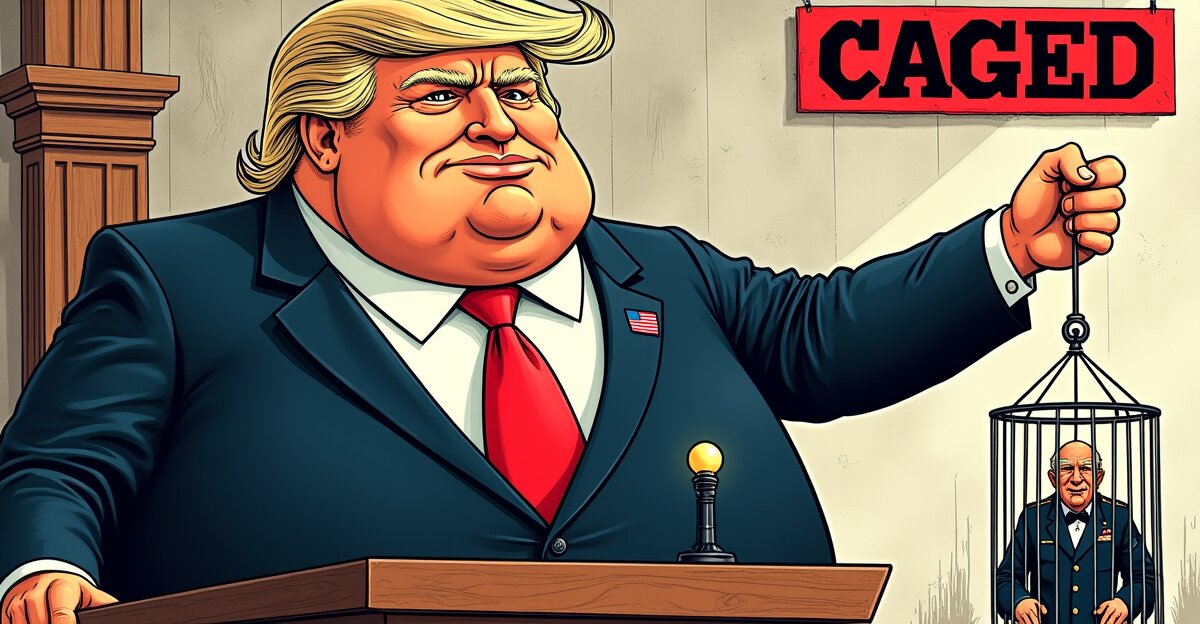
A decorated Air Force major has spent 100 days in solitary confinement for the least dangerous thing a soldier can do: speaking.
"Who I am is immaterial. In the grand scheme of things, I'm just a nobody. What matters far more than who I am is what I have to say and the price I'm willing to pay to say it."
— Major Jason Watson, on the steps of the U.S. Capitol, July 1, 2026
Watson is 40 years old. He is a graduate of the Air Force Academy, a logistics officer with 17 years of service, most of it spent overseas, and by every account a career soldier who never planned to become a cause. On July 1, he did the thing no field manual quite covers. He put on his uniform, walked up the steps of the Capitol with Rep. Al Green (D-Texas) escorting him, stood alone holding a sign that read "impeach, convict, remove," and called for the removal of President Donald Trump and Vice President JD Vance.
He gave his reasons out loud: U.S. military involvement in Venezuela, Cuba, and Iran. Then the Capitol Police led him down the steps in custody.
The Air Force did not so much charge him for the protest as for the talking that followed it.
In August, the service referred Watson to a general court-martial on three articles of the Uniform Code of Military Justice: Article 88, contempt toward officials; Article 92, dereliction of duty; and Article 133, conduct unbecoming an officer. The evidence is a three-part chronology: a June interview with the Substack newsletter Defenders of Our Republic, the July 1 protest, and an August 17 interview with Erin Burnett on CNN, in which Watson said, "Not only is [Trump] a failure as president, he is flagrantly violating the Constitution, breaking the law, engaged in rampant corruption, and is killing Americans."
He closed with a sentence the government would later play on a courtroom screen: "I believe we can defeat this government if we just take a stand."
Watson's attorney, Christopher Mutimer, says his client is the first major in the history of the military to be charged under Article 88. Military defense lawyer Cody Harnish, who has tracked such prosecutions, counts only three modern cases against service members of any rank. The article, as the defense has noted, exists to police personal abuse of superiors, not the advocacy of lawful process, of which impeachment is the most lawful of all.
Translation: the case is not about what Watson did to the military. It is about what the military cannot stand, which is a service member talking back.
Watson has been in pretrial confinement since that CNN interview. His cell is in Calvert County, Md., and the conditions, as described by his lawyers and his senior defense counsel, Air Force Maj. Heather Bruha, are solitary in the way the United Nations means it: 20 to 22 hours a day alone, lights on around the clock, a room cold enough that he sleeps in thermal underwear, and at least one guard who recommended jumping jacks to keep his body warm.
The defense counted 18 strip searches. He has been denied yard and shower time on multiple occasions and has lost weight and muscle mass from the inactivity. His calls with counsel are restricted. Bruha told the court, "We have an officer, a major, held in confinement for speech. He does not need to be there. It's not necessary, it's not reasonable, it's not required." She added: "He has never felt more alone there."
There is a structural detail that makes the whole thing worse. Watson is stationed at Joint Base Anacostia-Bolling in Washington, and the base has no confinement facility of its own. The government is renting a cell in a civilian Maryland jail, on a taxpayer contract, to hold a man for his words. By the Nelson Mandela Rules, which define solitary by solitude rather than square footage, he has been in solitary for almost 100 days.
On Tuesday, the two sides spent nearly three hours before a military judge over his confinement status, submitting 39 exhibits, 36 of them from the defense. The government's central exhibit was a play button. Trial counsel Lt. Col. Chris Dunn played Watson's full CNN interview for the court, and the judge stopped the video mid-sentence at "I believe we can defeat this government if we just take a stand." Dunn called the words "serious misconduct" and warned of their "coercive nature," as if a confined man's sentences might set off other airmen. The defense produced not a shred of evidence that a single airman had followed Watson's example.
The defense's rebuttal reads like a catalog of absurdities. The order Watson allegedly disobeyed by giving the Burnett interview had expired weeks before he sat down for it. The government's own witnesses testified he is not a flight risk. The military never once argued he is dangerous to anyone. Dunn told the court Watson had received "no fewer than three warnings" about continuing his calls for impeachment. And when Watson offered to resign from the Air Force rather than face a court-martial, the government declined the offer within a day. It did not want him gone. It wanted him quiet.
The hearing also surfaced a possible transfer to the Naval Consolidated Brig in Chesapeake, Va., farther from his lawyers, with three months left until trial. The judge has not ruled. The government asked for 48 hours to read the defense's documents about the conditions of his confinement. The trial is set for February 2027.
The government's own witnesses say he is not a flight risk. The cage stands anyway.
Watson is not a one-off target. He is a test case in a pattern that now has a shape. The administration has exploited ambiguities in immigration law to try to deport noncitizens for protesting and writing op-eds. It has invented a domestic terror organization, antifa, out of thin air, to prosecute protesters and, in one case, a person for reading radical literature. It has revived the Espionage Act to harass journalists and sources. And now it has found a new front: the UCMJ.
The comparison that should worry even hawks in the bar is this one. Mutimer told NPR that soldiers charged with sexual assault and other violent crimes are not held in pretrial solitary. The man in the cell has, by the government's own evidence, committed no violence, leaked nothing, and been convicted of nothing. He has a microphone and a signature on a protest sign.
This is selective enforcement at best and lawless retaliation at worst.
A cage is not a protective measure when no one is being protected. No base is safer because a logistics major sits in a room with the lights on. It is a price tag, a number the administration wants every officer in the chain of command to memorize: this is what it costs to stand on the Capitol steps in uniform and say the word the commander in chief has decided is seditious.
Watson told reporters that day that what matters is the price he is willing to pay to say it. The government has now done the arithmetic for everyone. The verdict in a court with no jury, for the crime of speaking, is 100 days in the light, and counting.
Comments (0)
No comments yet. Be the first to speak up.
Join the Riot
Login with Google to leave a comment.
Login to Comment