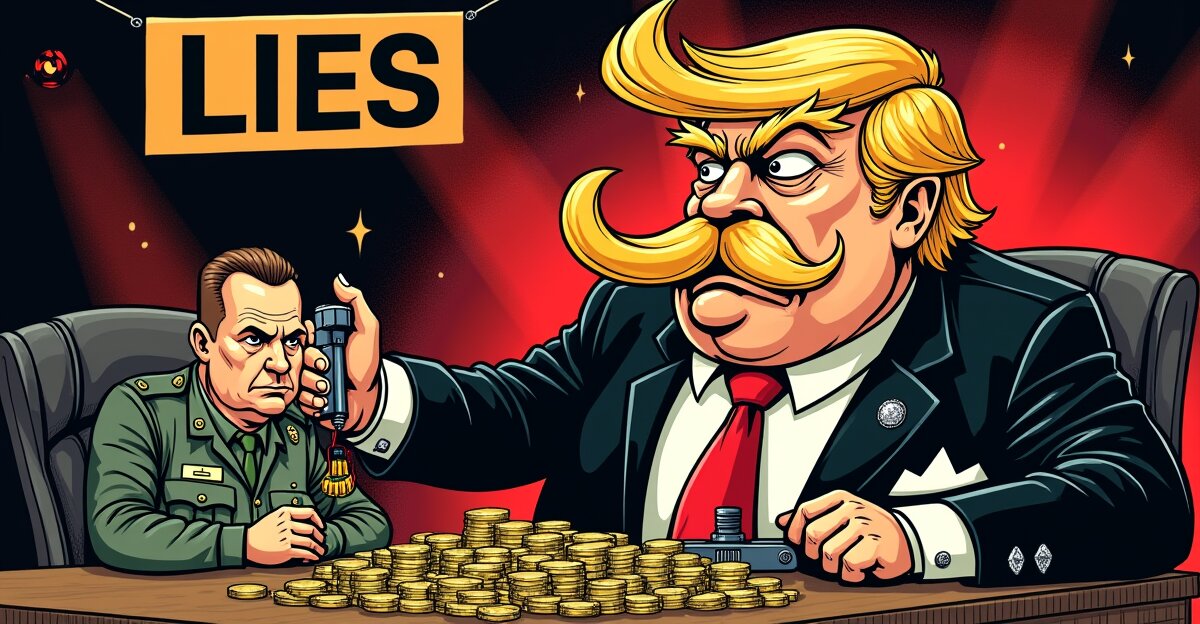
A Pentagon that cannot confirm its own stockpiles has started running lie detectors on its own officers to find out who told the truth.
"The 'leakers' of these treasonous statements are being hunted down. Long-term jail sentences will be sought!"
— Donald Trump, on Truth Social, in a post warning off anyone who reports what the war is actually costing
The United States has spent two centuries building an elaborate myth about how its military works: a meritocratic institution of professional generals who answer to the facts, not the mood of the White House. That myth was quietly put on trial last month, in a way the American public has only just begun to grasp. According to The New York Times, federal investigators ran polygraph tests on roughly fifty members of the Joint Staff, the body of senior officers and civilians who coordinate American military operations around the globe. They were asked, one by one, whether they had passed classified information to journalists. The information in question was not the location of a weapons cache or a covert operation. It was the simple, inconvenient fact that the war in Iran had drained America's stockpiles of long-range precision missiles and Patriot interceptors.
The tests, conducted in August after a wave of reporting detailed the shortages, were not, by any account, a routine leak investigation. Former military officials told the Times that mass polygraph testing on this scale was unprecedented among the highest ranks of the US military. This was not the FBI quietly tailing a single suspected source. It was a line of officers, many of them working with US Central Command, the very command running the war, being marched into a room and hooked to a machine to measure their heart rates and their breathing. The machinery of the modern military, built to project power abroad, had turned inward, hunting for a truth its leadership wanted kept in the basement.
The story, in other words, is not just about a leak. It is about a government that has made the reporting of bad news into an act of sedition.
Trump's reaction to the coverage of the munitions crisis was immediate and unhinged. On Truth Social, he declared that "The US has massive amounts of 'munitions,' especially of certain types," and that "large amounts are being manufactured and shipped to the US as needed." Then came the threat. He did not explain which reports he was referring to. He did not cite a single document, a single stockpile count, a single factory. He simply pointed at the press and demanded "long-term jail sentences."
Translation: when the numbers stop matching the speech, the fix is not to recheck the numbers. It is to find the messenger.
The gap between the president's words and the reality he was denying was not small. Reporting indicated the military had used "nearly all" of its long-range precision missiles, a shortfall that, according to sources, contributed to the decision to call off a planned strike on Iran on August 2 that would have been, by one account, "the biggest attack since World War Two." That a president would be told by his own defense secretary that the war was running out of ammunition, and would then turn around and threaten the officers who confirmed it, is the kind of sequence that used to be the stuff of political satire. It is no longer.
At the center of it stands Pete Hegseth, the defense secretary, who has presided over one of the most radical purges of the senior military in a generation. The Times reported that Hegseth had surrounded himself with loyalists and removed more than eighty generals and admirals during his tenure. Officials told the paper that the resulting atmosphere was one of distrust, bred in part by the man whose job is to command the people now under suspicion.
This is the detail that should trouble anyone who thinks this is merely a leak investigation gone too far. A polygraph is a crude instrument. It measures stress, not truth, and its results are inadmissible in American courts for precisely this reason. The American Polygraph Association itself puts the tool's accuracy at somewhere between eighty and ninety percent, a number that means, in plain English, that it is regularly wrong. To run a hundred people through such a device and treat it as a tribunal is not an investigation. It is a performance, a way of making an institution visible from the inside out, so that every officer who has not yet spoken now has to weigh, in the privacy of his own head, whether the machine is coming for him next.
According to people with knowledge of the tests, that was the point. The government's investigators were not only hunting for the source of a particular leak. They were building a deterrent, a standing threat aimed at everyone else still deciding whether to call a reporter.
Sean Parnell, a Pentagon spokesman, declined to confirm or deny the specifics. The department "does not comment on internal personnel or investigative matters," he said, but it "takes all leaks of classified national security information extremely seriously and investigates accordingly."
It is a sentence that would be perfectly ordinary in most contexts. A government protecting genuine secrets is not a scandal. What makes this one different is the shape of the secret. The information officers risked prison to tell the world was not a strategy, a capability, a target. It was a balance sheet. The war, the one Trump's own administration had sold as a swift and overwhelming exercise in American dominance, was running out of things. The stockpiles that are supposed to be the quiet foundation of a superpower's credibility had been burned through, and the men closest to the numbers were the ones being forced to sit under a lamp and hold still while a machine listened for the wobble in their voice.
The military does not have enough missiles for a return to "all-out war," sources said. That is not a classified secret in any meaningful sense. It is the kind of fact a country needs to know before it commits its children to another round of escalation. The question the polygraph is really designed to answer is not who leaked it. It is whether anyone at all is still allowed to say it.
The deeper story is about what happens to an institution the moment its leadership stops distinguishing between a secret and a mistake. A nation can afford classified information about its enemies. It cannot survive on a system in which the truth about its own failures is treated as treason. When the president's first instinct toward bad news is a threat of prison, and the defense department's answer is to wire up its senior officers to a device that is, by its own profession's admission, wrong a tenth of the time, the institution has stopped being a machine that produces facts. It has become a machine that produces obedience.
And in the end, that is the only thing a polygraph has ever really been good at, regardless of what it claims to detect.
Comments (0)
No comments yet. Be the first to speak up.
Join the Riot
Login with Google to leave a comment.
Login to Comment