
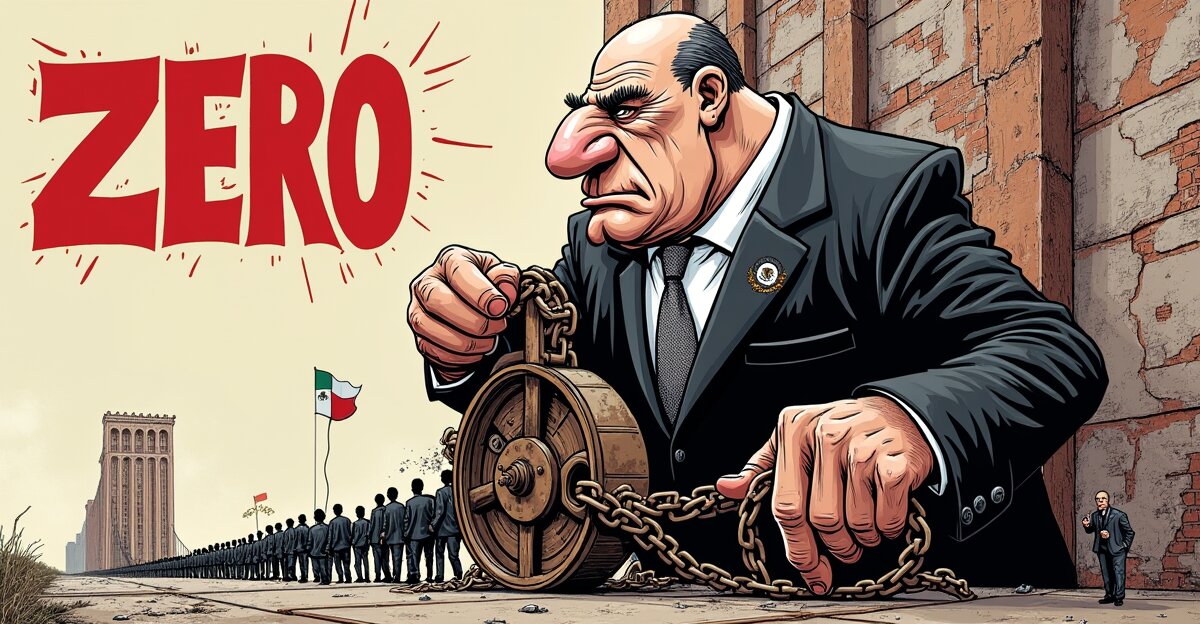
The man Mexican officials privately fear most about the future of their country is now the second most powerful person in the White House.
"There has been nothing to alert us that anything is changing."
— Claudia Sheinbaum, President of Mexico, asked about Stephen Miller's promotion to White House chief of staff
The most consequential personnel move of President Donald Trump's second term came without a press conference or a briefing. Three days after Democrats won a midterm sweep that handed them both chambers of Congress, the president replaced chief of staff Susie Wiles with Stephen Miller, the firebrand policy architect of the administration's deportation machine. Miller was elevated from deputy chief of staff to the second most powerful job in the government on November 6.
For the United States, it was a shuffle. For Mexico, it was a threat assessment.
A Politico report published November 12 found that alarm over the promotion had spread across Mexico, among "government officials, business leaders, and other power players." Those officials, Politico reported, fear he will "push Trump to authorize direct US military action on Mexican soil." John Feeley, a former senior US diplomat who keeps up contacts with Mexican officials, put it the way diplomats put it when they are being blunt: "no one is pleased, to say the least."
A personnel change inside one government became a foreign policy event in the neighboring country. That is not paranoia. It is a pattern, and the pattern is worth understanding.
Start with the number, because the number is where this story actually lives.
The New York Times reported on November 13 that Miller has been calling US Ambassador to Mexico Ronald Johnson almost every day to "rail" about the number of unauthorized border crossings. The goal he has set, Mexican officials told the paper, is zero. With a border nearly 2,000 miles long, those officials said zero is "simply not possible."
The irony is not that the demand is aggressive. It is that the demand is unnecessary. By the government's own data, unauthorized crossings fell in 2025 to their lowest level since 1970. The White House has spent two years crowing about "the most secure border in American history." And yet the calls continued, and, the Times reported, they ramped up in recent months after a slight uptick in the numbers.
Translation: zero was never a goal. It is a tripwire. A target that cannot be met means every day of the next administration is a failure, and every failure justifies something bigger.
The tripwire is already armed.
On November 12, Trump posted on Truth Social that "huge CARAVANS beginning their illegal march through Mexico" were heading north, that many of the migrants were people various countries did not want, and that Mexico would be punished if it did not stop them. "MEXICO MUST STOP THEM, NOW, and if they do not do so, the Tariffs on Mexico will be IMMEDIATELY DOUBLED."
The timing was not lost on anyone. The post landed four days after the Democratic landslide, and Trump suggested the caravan surge was a response to the election. Mexico's president pushed back on the premise. Claudia Sheinbaum said that since Trump returned to the White House in January 2025, no migrant caravan has reached the US border, and that the caravan reported to be forming in the south of the country is not, for now, moving toward the border. Asked whether Mexico would break up caravans by force, she said she would use persuasion, not force.
Note the geography. The caravan Trump threatened tariffs over was in Chiapas, roughly 1,300 miles from the border. A tariff ultimatum aimed at a country's interior is not border policy. It is a leverage play, and a country only needs leverage over a neighbor it has already forced into compliance if it intends to demand more.
Mexico takes this seriously in a way very few countries on earth do, and the reason is arithmetic, not emotion.
America has put boots on Mexican soil before. The Mexican-American War, and Pershing's Punitive Expedition of 1916-17, when a US army marched into northern Mexico hunting a single man and stayed long enough to make a point. New York Times reporters Maggie Haberman and Jonathan Swan documented that Miller, even before his promotion, had demanded military strikes on Mexican soil against suspected drug cartels. Leo Zuckermann, the columnist who wrote the searing response in the Mexican newspaper Excelsior after the promotion, put it most plainly: "The new chief of staff is a racist who does not look favorably upon our country... At any moment, he could revive plans to attack Mexico and convince Trump of their necessity."
In the same op-ed, his predecessor Wiles was described as "a skilled, disciplined, and pragmatic political operative." The contrast was the point.
Bloomberg reported on November 14 that Mexican trade negotiators expect Miller's promotion to prolong trade talks and raise the risk of confrontation between the two sides. Politico's Playbook described the installation as the arrival of a "wartime consigliere." The only neighboring country with an actual memory of American armies is watching US personnel moves, and when that happens, personnel moves are policy.
The White House response to all of it was what the White House response is always: a claim about the border, because the border is the only number that matters, and that number is now the most secure in American history. Spokeswoman Lauren Bis told the Times that "on day one, President Trump took action to secure our border." Ambassador Johnson posted on X that through "Mission Mexico" the two countries are "disrupting criminal networks, preventing dangerous crossings, and saving lives," and that the border "will remain secure and closed."
None of that is false. That is exactly what makes it meaningless. You do not need a war to keep a border closed. You only need one when the person in charge stops being satisfied by closed.
Sheinbaum, asked about the promotion at a press conference, delivered the line that should be framed: "There has been nothing to alert us that anything is changing."
That is what a president of a country that has been invaded twice by its neighbor says to keep markets calm and her people from panicking. The officials in her government do not believe her. The business leaders do not believe her. The trade negotiators are already re-planning around a White House that, in their reading, changed its mind about them overnight, along with the name on the door.
Mexico's calculation is the oldest one on this border: a neighbor that built the most secure border in its history, hit the lowest crossing numbers since 1970, and still is not satisfied is not looking for a better number. It is looking for a better excuse.
The question was never whether Mexico is on edge. The question is what happens the first day the number is not zero, and the man on the phone decides that is the answer.
Comments (0)
No comments yet. Be the first to speak up.
Join the Riot
Login with Google to leave a comment.
Login to Comment