
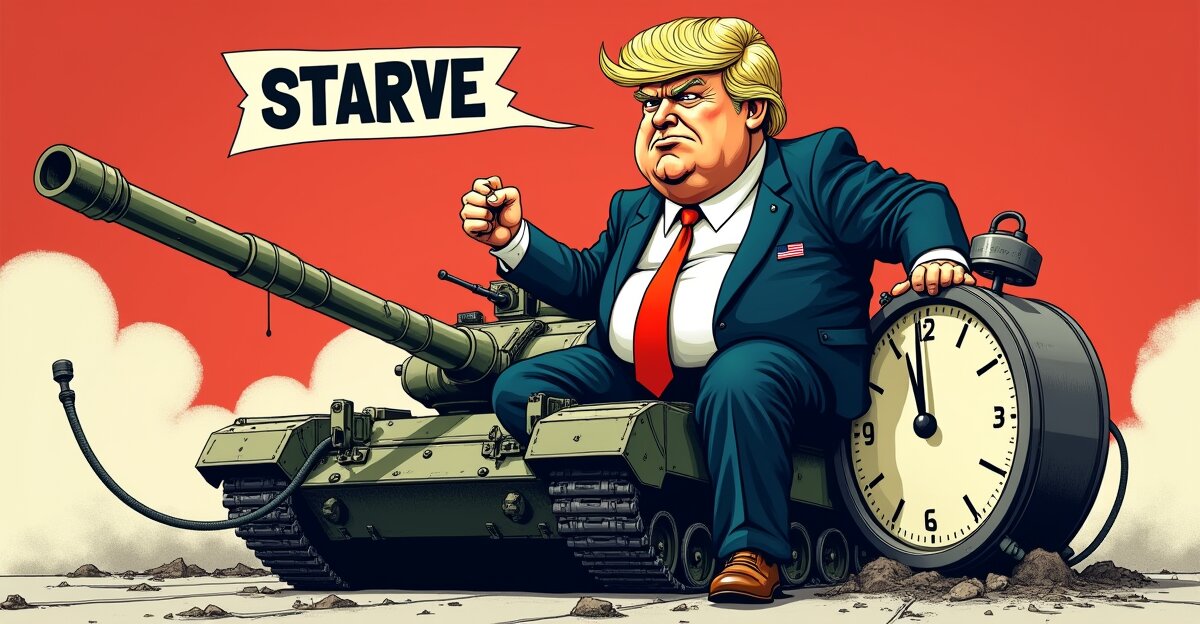
Eight months into a war the president called a little excursion, the new Democratic Congress gets to decide whether it dies on December 11, or whether the entire federal government goes down with it.
"What's the fastest way to end this war? To stop funding it, to stop giving it the fuel it needs to keep going."
— Sen. Chris Van Hollen (D-MD), in a statement urging Democrats to defund the Iran war before government funding lapses on December 11
Eight days ago, Americans went to the polls and did something they have only done once before in this century: they voted against a president's war, and won. The "blue tsunami" gave Democrats control of both chambers, the biggest blue wave in fifty years, and by every admission on either side of the aisle, the war on Iran was the referendum. President Trump and Vice President JD Vance both conceded the conflict was one of the top issues in the election. What the votes did not answer is what happens next. That question now has a date on it: December 11, the day the current federal funding runs out.
The arithmetic of the confrontation is simple. The war needs money to continue. The money arrives through appropriations. The appropriations require 60 votes in the Senate. The Democrats, with their new majority, can block that threshold all day long. So the incoming leaders are not planning to pass a war powers resolution, the sort of symbolic measure the White House would simply ignore. They are planning to do what Congress did in 1973: cut the money, and make the president choose between his war and a government shutdown.
The war that needs defunding has not exactly announced itself. It began on February 28 with Operation Epic Fury, the largest long-range precision fires campaign in Army history, and it has run roughly nine months since. In that time, per the Pentagon's own figures, at least 21 American service members have been killed and at least 865 wounded, with most of the deaths occurring after the mid-June ceasefire agreement that the administration has insisted marks the end of the war. The Pentagon has not attributed those post-ceasefire deaths to the war. It has not provided regular casualty updates. The Intercept calls the handling a cover-up.
The war has also spent more than its share of hardware. Iranian missiles and drones have struck more than 15 American bases across the Middle East, damaging or destroying hundreds of buildings in Kuwait, Bahrain, Qatar, the UAE, Saudi Arabia, Iraq, Oman, and Jordan. In July, three soldiers were killed at Muwaffaq Salti Air Base in Jordan while doing nothing at all. In early October, the Pentagon pulled 12 B-1 bombers out of RAF Fairford in England after a suspected Iranian plot to hit the base with multiple drones, a move so unusual that British Prime Minister Andy Burnham had to explain it to his own public. Air Force personnel logged more than 1,200 "alarm reds" in 38 days. The Fifth Fleet headquarters in Bahrain, hit at the war's opening, may cost more than $400 million to rebuild.
A war declared over in June is killing more of its soldiers than it was before. That is not a typo. That is the war.
Then there is the other body count, the one Americans pay for in their own garages. The Congressional Budget Office estimated in September that the Department of Defense has incurred roughly $38 billion in war costs. Other estimates, assuming a broader range of costs and a higher munitions burn rate, put Operation Epic Fury at more than $100 billion. The Pentagon budget for next year, already sitting in Congress, contains $70 billion for the Iran war.
The costs Americans see on their receipts are the part the administration cannot explain away. Regular gas averaged $2.98 a gallon on February 27. It was $4.27 on October 22, and it sat above $4 for a record 158 days this year. The Brown University Iran War Energy Cost Tracker puts the extra fuel spending by American households at more than $141 billion since the war began. Mark Zandi, the chief economist at Moody's, calculates the war has cost the average American household almost $2,000 and "absorbed about half the average American household's income gain." Translation: the war is being paid for in two currencies, one in bullets and one at the pump, and both accounts are in the red.
The human ledger is shorter and harder to ignore. On the Capitol steps, 168 pairs of shoes now stand in a memorial to the people killed when a U.S. strike hit an Iranian school on March 18. Over 150 of them were children. In April, after Trump threatened that "a whole civilization will die tonight," Amnesty International warned his rhetoric may constitute a threat of genocide under the Genocide Convention. In September, at the United Nations, he told the assembly he had "a big decision to make" and threatened to "annihilate" Iran.
And yet the polling says the American public has already tried this war and rejected it. In a Reuters/Ipsos poll released this week, 71 percent of Americans want the new Congress to pass legislation to end the war. That includes 51 percent of Republicans. Only 25 percent of Republicans want the new majority to focus on ending the war too little or not at all. The war Trump built his second term's foreign policy around has become, in the words of one defense official describing its aftermath, a festering wound that the country is trying to amputate.
So here is the plan, laid out by Sen. Chris Van Hollen and Rep. Ro Khanna, who have framed it explicitly as the 1973 Vietnam model, when Congress cut off funding for the bombing of Cambodia and Laos and passed the War Powers Act over a presidential veto. Khanna has called for a continuing resolution "prohibiting the financing of any combat activities of the U.S. military in Iran." Van Hollen, the progressive favorite to challenge Chuck Schumer for Senate leadership, has said flatly that he will not vote for any government funding package that does not strip the war's money. "It would be a betrayal of the voters to be complicit in keeping the war going," he said.
Schumer has pledged that "we are going to end the war," invoking "the power of the purse as one of the ways of deterring a president who does war without the consent of the American people." But the pledge comes with a history. In June, when Trump signed the deal with Iran that ended the war, Schumer called it "the art of surrender." A few days after the war launched, House leader Hakeem Jeffries declined to rule out voting for more war money. Both men are ferociously pro-Israel, and both still hold leadership positions that depend on the votes of the members who now want this war dead. The defunding fight is therefore also, quietly, a fight over who runs the party that just won.
What can Trump do? He can veto, he can spin, he can invoke emergency powers, and he can threaten to shut down every federal agency he hates. But every one of those moves plays badly with $4.27 gas, a withdrawal from Iraq that the IRGC celebrated as the expulsion of America, and a base that has just watched its own war become the reason it lost Congress. The November 3 results were not a protest against the war's costs. They were a price check.
The question is no longer whether the war is unpopular, or whether the money can be cut, or even whether the new leaders have the nerve. The question is whether a government that has declared the war over, while continuing to strike unreported targets, can be told by its own Congress to stop paying for it. On December 11, the fuel gauge will be in Congress's hands for the first time. Trump spent eight months assuming no one would turn the key. Now someone is holding it.
Comments (0)
No comments yet. Be the first to speak up.
Join the Riot
Login with Google to leave a comment.
Login to Comment