
One week before the midterms, the Justice Department is sending 1,000 federal observers to polling places, and the state of Maine has responded the only way it knows how: by printing the federal statute that bars armed agents from the polls and handing it to its police as a training slide.
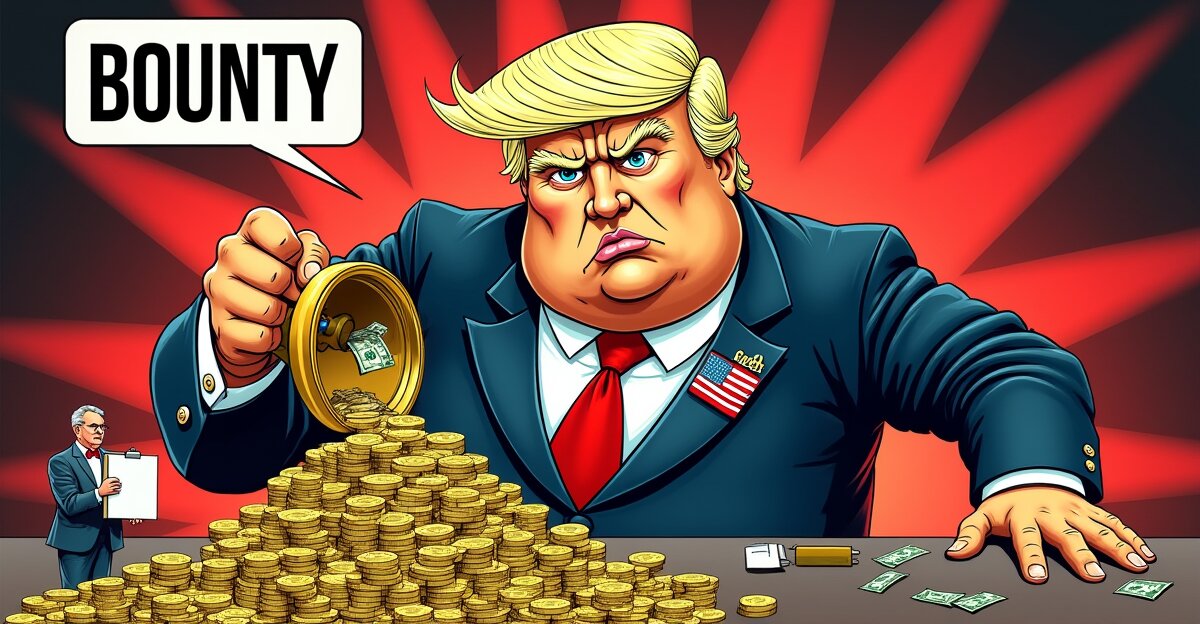
"Anybody reporting Voter Fraud in the past Elections, or the upcoming 2026 Midterm Election, will be paid $1,000,000 upon the arrest and conviction of those that created the Fraud!"
— President Donald Trump, Truth Social, October 26, 2026
The number is big enough to fit in a campaign flyer margin and small enough to fit in a presidential signature block: $1,000,000. On Monday, a week before Election Day, the president announced on Truth Social that anyone who reports "Voter Fraud in the past Elections, or the upcoming 2026 Midterm Election" will be paid the sum "upon the arrest and conviction of those that created the Fraud." The White House pointed to the post. Asked where the money would come from, how a tip would be submitted, or who would decide that a tip qualified, the Department of Justice answered with a single sentence that should have ended the discussion: "We defer to the White House."
Translation: the bounty has no funding, no mechanism, and no chain of command. It has one function. It exists to make the idea of a stolen election feel concrete enough to price, in the final days before the votes are counted.
This is not the first time a president has claimed a stolen election. What is new is that the claim comes with a payment schedule, and it arrives in the middle of a federal push to insert the government into state-run elections on a scale without precedent.
In August, the Justice Department began planning to send approximately 1,000 election monitors to polling places across the country for the November 3 midterms, first reported by Bloomberg. For comparison: 289 monitors were dispatched in 2022, and 714 in the 2024 presidential election. A Justice Department spokesperson confirmed this week that the monitors will deploy, though the full list of counties will not be released until Election Day. Maine was notified that federal observers are coming to the polls in Portland and Lewiston, the state's two largest cities and home to its largest share of immigrants.
The deployment's details are almost eerie in their modesty. In letters to the city clerks, a Civil Rights Division attorney set the monitors' rules of engagement: observe and take notes only. Dress in business casual. No Department of Justice identifiers. No conversations with voters inside the polling place. No firearms. The monitors will be there to watch. The design of the whole operation is to ensure no one watches them watching.
Maine's answer is the part of this story nobody outside the state has fully absorbed. Law enforcement training materials updated for the November elections now include the text of the federal statute that bars armed civil or military officers from posting at voting sites. The New York Times reported that Secretary of State Shenna Bellows's office has been running scenario planning for "potential federal interference in elections," and that a slide deck quoting the statute was shown to officers before the June primary and again ahead of the general election.
"This is the first time ever that we have had to engage in scenario planning to safeguard against potential federal interference in elections," Bellows told the Times. "It seems like the federal government is now adversarial to the states."
A state printing the federal text that keeps armed agents out of the polls into its police training deck is not a legal brief. It is a fire drill.
Bellows told the Maine Morning Star that her office will hold federal monitors "to the same standards and expectations as anyone else" who is at the voting point, and added a line worth framing: "We will monitor the monitors very carefully to ensure that they don't cross any lines."
The monitors did not arrive out of nowhere. They followed a months-long media campaign by the far-right Maine Wire, an outlet funded by conservative megadonor Leonard Leo, arguing that the state's Somali American community is running a voter-fraud operation. This month, a Maine Wire journalist was filmed at an early voting site in Lewiston City Hall, approaching people as they came in and out of the polls, filming them, and questioning them aggressively. The outlet's editor-in-chief has described the people seeking interpreters at the polls as "jobless Somali bums" and questioned whether the interpreters themselves are breaking the law.
The state took the complaints seriously enough to act. Lewiston posted notices that filming and photography are prohibited at polling locations, with the exception of selfies. "No one should be harassed or filmed without their consent by anyone," Bellows said, "whether that person is purporting to be a member of the media, or there for partisan political purposes."
Ben Chin, co-director of the Maine People's Alliance, put it more plainly: "Basically, if you were walking into City Hall and you were Black, you could expect to have this guy come up to you with his phone and ask you all sorts of rude and obviously racist questions." He allowed for the logic of it. "It's reasonable to wonder, 'Should I go down there right now?'"
Maine is one visible point of a much larger federal operation. The Justice Department said on October 20 that it had charged 113 people across 20 states with illegal voting or registration offenses in the seven weeks before the announcement. A Washington Post review of 180 comparable cases found that many of the defendants cited honest mistakes. New York Attorney General Letitia James issued a public reminder that federal officials may not "police the polls." The Arkansas chapter of the NAACP called the assignment of federal monitors to two counties in its state "intimidation, point blank."
The administration's legal record in this campaign is as instructive as its rhetoric. It has lost 26 consecutive court cases seeking unredacted voter records from the states. Last year, the Justice Department sued Maine after Bellows twice refused to hand over the state's full, unredacted voter rolls; a federal judge dismissed that suit in May. This month, the administration sued California over a list of more than 20,000 people it described as "likely" noncitizens.
The money is not just for fraud. In the same week, Trump and Vice President JD Vance unveiled a $25 million Fraud Whistleblower Incentive Program for tips on federal program fraud, and Trump told the room that the people willing to turn in their neighbors "are gonna become rich."
Maine's Senate race, in which Democrat Troy Jackson is trying to unseat longtime Republican Susan Collins, has become the test case for all of it. Asked at a campaign event by the Maine Wire about the role of interpreters at the polls, Collins did not push back. "Certainly only Americans should be voting in American elections," she said. "And it is troubling to me if people are being accompanied into voting booths and handling ballots in a way that is not sanctioned by law." The senator agreed, on the record, with the premise of the people filming voters at the polls.
Early voting in Maine ends today, and by November 3 the monitors will be standing in business casual in counties across the country, watching. In Lewiston, the no-filming notices are up, the police have been briefed on the statute, and the ballots are already in the box.
Maine has done what no state has had to do before: written the federal law that keeps armed agents out of the polls into its police training materials, the way you rehearse a drill for a fire the arsonist is standing next to. The state's message to the government that is coming to watch is already printed: observe the process, not the people, and if you cross a line, the state will monitor the monitors.
The question is no longer whether Washington intends to watch Maine vote. The question is whether a state can still tell its own government to stand down. The answer will come on November 3, in a small city where the police have been briefed, the notices are posted, and the first people in American history to be paid to turn in their neighbors have been told, in the state's own words, to cross no lines.
Comments (0)
No comments yet. Be the first to speak up.
Join the Riot
Login with Google to leave a comment.
Login to Comment