
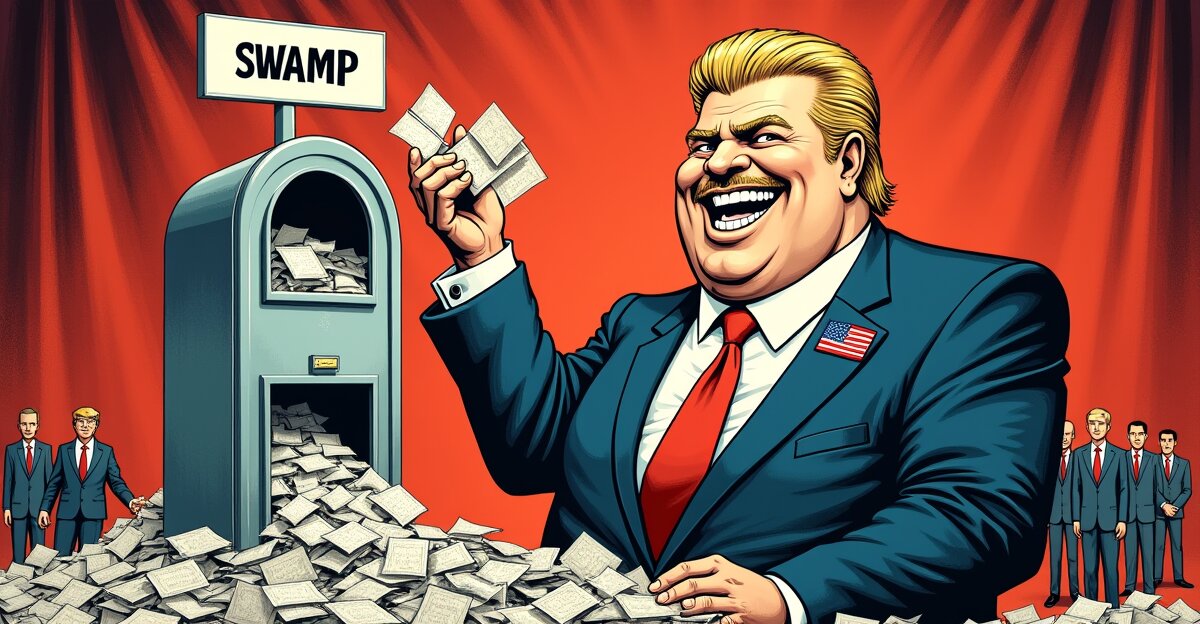
The man who built a second term on the claim that the ballot was broken just told his base to use the broken ballot.
"Whether you vote early, absentee, by mail, or in-person, we must 'swamp' the Radical Left Dumocrats with massive turnout!"
— Donald Trump, Truth Social, October 3, 2026
For most of his second term, the mail ballot was the centerpiece of American politics, not for what it is (a paper form in an envelope) but for what it allegedly is: a machine for stealing elections. It was the load-bearing wall of the 2020 fraud claim, the reason for the SAVE America Act, and the target of an executive order the president signed in March.
Last Saturday, the wall went down. Or rather, the man who built it walked over, put a hand on it, and said you may go through.
On Truth Social, Trump told Republicans that they "must use every appropriate tool" to win the midterms, and listed the tools in order of his new comfort: early, absentee, by mail, in-person. He promoted a GOP voter-getting operation called "Swamp the Vote." In a video posted with the announcement, he asked "every patriot" to "vote early, vote by mail, or vote in-person on Election Day, November 3rd."
On Monday, at the White House before a rally in Nebraska, the same sentence came out of the president's mouth as if it had always been there: "They can vote by mail if they want, because we seem to have no choice because a lot of people want to vote by mail, but a lot of very good people also want to vote in-person. You can do either."
Translation: in four days, the mail ballot went from a "Nation Destroying SCAM" to "every appropriate tool." The only thing that changed in between was the polling.
The about-face only makes sense against what came before it, because this was not a slow softening. It was a U-turn in front of a crowd.
In July, Trump said "mail-in ballots are inherently corrupt." That was a few weeks after a lower federal court enjoined the Postal Service's new ballot-mail rules, and he had spent August calling for the SAVE America Act, which would require proof of citizenship to register, holding up India as a model where "Less than 1% voted by mail."
Then, on September 14, the Supreme Court decided Postal Service v. California and refused to let the Postal Service carry out the parts of the new ballot-mail rule that survived litigation. The nationwide block stayed in place, days after some states had already started early voting under the threat of last-minute changes. The next day, Trump called the ruling "horrible" and returned to his old vocabulary: mail-in voting is "totally CORRUPT and out of control," and the whole practice is a "Nation Destroying SCAM."
He said all of this while voting, himself, by mail. The list is getting long: the 2017 New York mayoral election, the 2018 New York midterms, the 2020 Florida primary, and both Florida elections this year, the March special and the August primary. Every entry is the president's own ballot, delivered through the same postal service he has told the country is running a national fraud scheme.
Understanding why the president switched requires understanding what he was trying to do with the mailbox.
On March 31, 2026, Trump signed an executive order directing the Justice Department and the Postal Service to tighten the rules for federal ballot mail. The USPS rule followed. A coalition of states sued. A federal court blocked it. In August, the Supreme Court let it proceed, 6-3, "for now." In September, it let it die. A whistleblower told the Associated Press that the Postal Service had been under pressure to rush the changes anyway, and twenty-four states have sued over the agency's handling of the rule.
The administration's theory was simple: if ballot mail could be made more expensive, slower, and harder to audit than in-person voting, then in-person voting would become the dominant channel again, and in-person voting is the one channel the administration can surveil.
The theory lost. And a theory that loses stops being a principle and starts being a problem.
The explanation is in the numbers, and the numbers are not good for him. A Reuters/Ipsos poll completed Monday, two days before he told the base to use the mail, found Trump's approval at 32 percent, holding September's record low. Asked which party they would support in the midterms, registered voters preferred Democrats to Republicans, 44 to 37. Among independents, Democrats led 37 to 21. Democrats are taking chunks of GOP voters in the key Senate races, and the Iran war is still sitting on the gas price and the grocery bill.
A president at a 32 percent approval rating cannot tell the base that the most convenient way to vote is corrupt. He can only tell the base that every way to vote is now the correct way.
Roughly one ballot in three cast in the 2024 presidential election was submitted by mail, according to the Election Assistance Commission, and early and mail voting are already under way in the states that will decide Congress. Republican strategists have long worried that the anti-mail messaging was suppressing the exact voters it was supposed to protect: rural conservatives who live too far from a polling place to make a Tuesday morning trip. The strategy, in other words, was eating its own base.
Richard Pildes, the election-law scholar at New York University, told the New York Times that the president is "realizing that his efforts to change policy on mail-in voting have basically run aground at this point, and he's shifting gears."
Translation: the fraud machine was never about fraud. It was about control, and the control just ran out. When you can no longer lock the mailbox, you tell your people to use it.
Doug Heye, a Republican strategist, offered the party's official read of the reversal: it's too early to know whether Trump will keep promoting mail voting or return to calling it a scam. That last clause is the whole story.
There is a second irony the party has not addressed yet. When the president tells his base to vote by mail, he is also telling it to vote early, which means the ballots count down before Election Day, in the manner that produces the largest pile of verified votes before the thing he fears most: the count itself. The 2020 story ended with a week of waiting and a phone call to a Georgia secretary of state. The 2026 playbook, if it works, is a president who spent half a decade teaching a country to distrust the post office, now depending on the post office to save his party.
And if Democrats take Congress in November, the base he is asking to "swamp" will get to explain, over and over, why the president who swore the ballot was rigged needed to tell them which end of the envelope the stamp goes on.
The message of the last six years was never really about the mail. It was about whether the person who says "stolen" gets to decide when the count ends. Now the count is coming regardless, and it is coming by mail, and the man who made the mail the villain is the one asking you to sign the card and seal it.
The question was never whether Trump believed in the mail ballot. The question was whether it was useful. It is useful now.
Comments (0)
No comments yet. Be the first to speak up.
Join the Riot
Login with Google to leave a comment.
Login to Comment