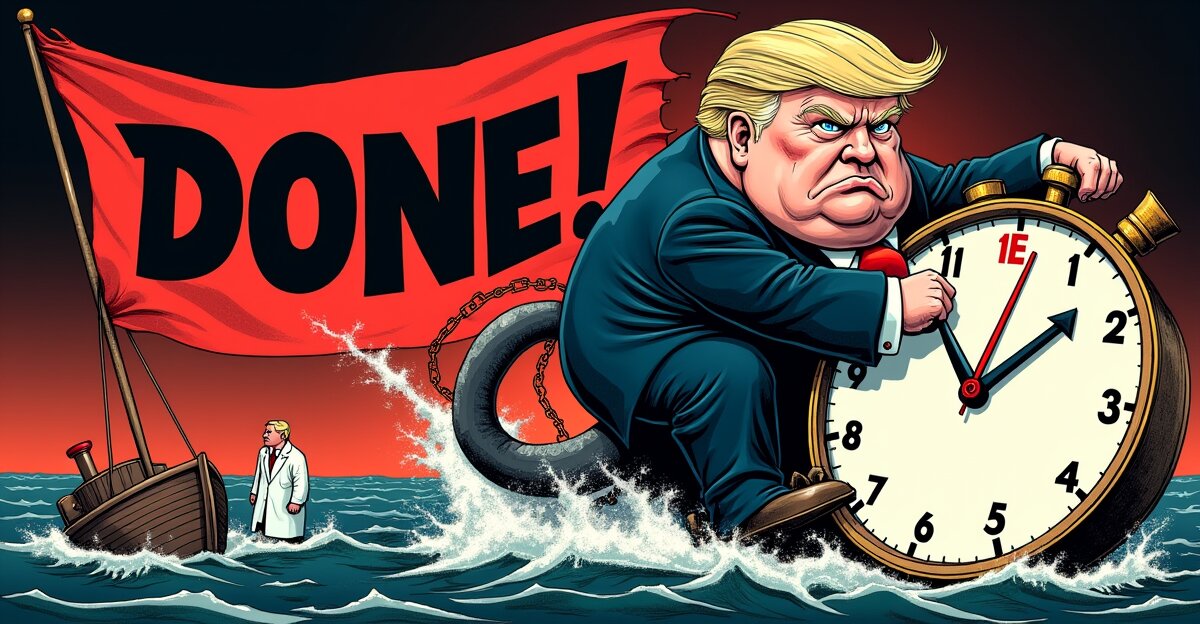
One week after voters sent the president a message about war, the president scheduled his next war on a radio call, with a deadline and a point person attached.
"I want to get Cuba done before I leave, yeah."
"We have a very good, talented guy for Cuba. His name is Marco."
— Donald Trump, phone interview with Hugh Hewitt, November 12
The question had been building for months: would the United States use military force to "liberate" Cuba? On Thursday, the president answered on a phone call, in the tone of a contractor sizing up a renovation. "I want to get Cuba done before I leave, yeah," he told host Hugh Hewitt. Asked whether he would order a short military operation, he said he would "certainly consider" it. By his own account, that was the first time he had attached a timeline to such an operation: finish it by January 2029. No operation was announced. No date was set. No trigger was described. Congress was not notified. The mission, if it happens, would be the first one sold to the country on a conservative talk show.
Translation: In the same week voters rejected his war, the commander in chief converted a war into a to-do list item.
The point person, it turns out, was already in the room. "We have a very good, talented guy for Cuba. His name is Marco," Trump said. "Marco Rubio, his parents are from Cuba, as you all probably know, and he would love to do that." The talk has been building all year. In February, the president floated a "friendly takeover" of Havana. In spring, he predicted the Iranian government would "not be the last to collapse," and added: "Cuba's going to fall too."
Rubio, the former Florida senator who now runs State, has spent three decades making the fight against Havana the axis of his career. Last week, at a Mar-a-Lago event, Trump said Rubio was "going to work on Cuba" and joked that the administration would drop him in by parachute. This week, in Paris, where Rubio met with G7 foreign ministers, the secretary called political and economic change in Cuba a priority for Washington. And Rubio posted on X about two weeks ago that anyone who "wants to create positive change in Cuba" should "seize this opportunity to make the change you want through a discreet [sic] partnership with the CIA." The post was coordinated with a CIA Cuba task force the agency stood up earlier this year. Trump also told Hewitt that he won the "Cuban vote" in Florida by a wide margin and believes he is more popular there now than at the time of the election, framing the move as something he would like to do for the Cubans who fled to the United States.
Translation: The president's plan for Cuba is a single name. That name has a family history with the island, a CIA task force on standby, and a parachute joke attached.
The timing is the part that makes this read less like policy and more like a grudge.
On November 3, voters handed Trump and the Republicans a historic defeat, giving the Democrats a House majority on the order of 260 members, up from 215, plus a Senate. The war was the issue. Trump has acknowledged that the Iran war, which began in late February with joint U.S. and Israeli strikes, was partly to blame for the Republican losses. Vice President JD Vance did more than acknowledge it, calling the war the "real reason" for the GOP rout.
And the war is not over. Talks with Tehran have collapsed, and the Strait of Hormuz remains a flashpoint. A post-midterm poll found two-thirds of Americans disapprove of the president. A separate survey this month found seven in ten Americans, including a majority of Republicans, want the Iran war to end. In a Senate where Republicans hold 53 seats until January 3, Democrats are weighing whether to use the lame duck session to cut off funding for the conflict, and at least four Senate Democrats have already vowed to reject any spending package that enables the Iran war.
Trump said Cuba could be handled "after the Iran thing is over." The trouble with that sequencing is that the Iran thing is not over, and now there is a second thing on the calendar with a personal deadline.
Translation: Voters just sent a message about war. The president replied with a follow-up request.
As for Cuba itself, the president calls it "essentially a failed" country that is "doing very badly," and he has credited American pressure with much of the state the island's government has fallen into.
He is not wrong about who to blame for the island's misery, if you count American policy as a cause. The pressure campaign began in January, when a U.S. military operation captured Venezuelan President Nicolás Maduro, who had supplied Cuba with subsidized oil. Venezuelan shipments to the island stopped. In February, the administration began blocking tankers bound for Cuba and sanctioning the companies that moved fuel to the island. It has sanctioned Cuba's state oil company, President Miguel Díaz-Canel, and relatives of former President Raúl Castro. On November 5, the State Department designated eight entities, two individuals, and five vessels tied to the transport of Cuban oil, and the Treasury sanctioned two Chinese firms for supplies to the Cuban military.
The results show up in the hospital records. According to a United Nations report, childhood cancer survival rates in Cuba have fallen from 85 percent to 65 percent since the sanctions escalation began, and infant mortality has doubled to 9.9 per 1,000 births. An April analysis by the Center for Economic and Policy Research put the excess infant deaths between 2017 and 2025 at 1,800.
"The Trump administration's 'maximum pressure' policy toward Cuba has already killed a lot of babies," said Alexander Main, co-author of the report. "And it's highly likely that even more babies are dying now, at an even higher rate than last year, as a result of the current U.S. fuel blockade aimed at Cuba."
This year's fuel blockade has produced near-total or total blackouts across the country, with shortages of fuel, food, and medicine. Experts at Just Security and elsewhere have argued the blockade amounts to an act of war. The U.S. government insists the sanctions target the military and security apparatus, not the population, and that Cuba's problems are the fault of its own government.
Havana has answered. Responding to Trump's prediction that Cuba would "fall fairly soon" and his claim that the United States would help the island "on humanitarian grounds," President Díaz-Canel wrote that "the future of Cuba will never be decided in the north." He called the fuel restrictions a "criminal blockade" and "collective punishment." On Wednesday, Foreign Minister Bruno Rodríguez Parrilla met in Beijing with Chinese Foreign Minister Wang Yi, who pledged Chinese support for Cuba against the sanctions and the blockade. China has helped build solar farms to reduce Cuba's dependence on imported fuel, and it has provided food aid and restructured Cuban debt. The joint statement did not announce new aid, but the symbolism did the work.
Aid has arrived from other directions too. In March, the first vessel of the Nuestra America flotilla from Mexico docked in Havana with medical supplies, food, and solar panels, and on March 30 a Russian tanker carrying 100,000 tonnes of crude arrived. Analysts quoted in coverage of Thursday's interview said further economic pressure is more likely than a military campaign. A war, they noted, would arrive at the most politically crowded moment imaginable: a defeated president's party, a lame duck Congress, and a Middle East war with no off-ramp.
Trump can "get Cuba done" before January 2029. He has, in fact, already done most of the work: the oil is cut off, the tankers are blocked, the sanctions tightened, the lights out. The one thing his administration has not yet tried on the island is a war.
Voters wanted one war stopped. He has scheduled another one, with a deadline, a point person, and a parachute joke attached.
Everything else is already done.
Comments (0)
No comments yet. Be the first to speak up.
Join the Riot
Login with Google to leave a comment.
Login to Comment