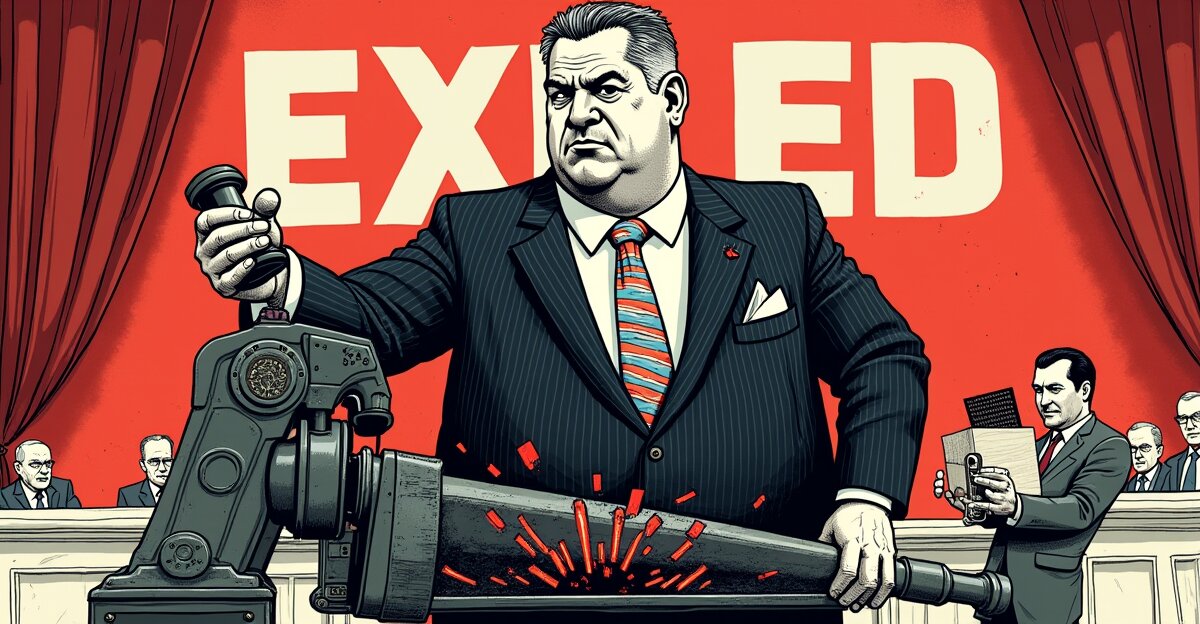
The Pentagon's favorite AI said no to killer robots and mass surveillance, so the secretary of war exiled it from the American defense economy, and a split appeals court just ruled the exile was legal.
"Cowardly act of corporate virtue-signaling that places Silicon Valley ideology above American lives."
— Pete Hegseth, Secretary of Defense, on X, February 27, 2026
The Department of War used to have a favorite AI. In July 2025 it signed Anthropic, the San Francisco maker of Claude, to a $200 million contract that made Claude the first frontier AI cleared for classified military use. The system did not sit in a lab. It worked in Operation Absolute Resolve, the January 3 raid that captured Nicolás Maduro, and the Pentagon kept calling it back. According to the company's lawsuit, Secretary Pete Hegseth himself described Claude as "exquisite" technology that the department would "love" to work with.
The favorite lasted about six months.
In the fall of 2025, while negotiating the Pentagon's GenAI.mil platform, the department asked Anthropic to let it use Claude for "any lawful use." The company agreed to almost everything except two things. Claude would not be used for fully autonomous lethal weapons, and it would not be used for mass surveillance of Americans. CEO Dario Amodei had spent years calling both uses "illegitimate" and "prone to abuse." The department's response was a deadline: agree to "all legal purposes" by 5:30 p.m. Friday, or be designated a supply chain risk.
At 5 p.m. Hegseth posted the word "cowardly," and by nightfall the company was exiled. The designation barred Anthropic from Pentagon work, but the scope went further. "No contractor, supplier, or partner that does business with the United States military may conduct any commercial activity with Anthropic," the secretary wrote. Two hours earlier, President Trump had ordered "EVERY Federal Agency in the United States Government to IMMEDIATELY CEASE all use of Anthropic's technology" and threatened that if the "Leftwing nut jobs at Anthropic" did not get their act together, he would "use the Full Power of the Presidency to make them comply, with major civil and criminal consequences to follow." Contractors got six months to divest.
The day after the ban, OpenAI signed its own Pentagon deal.
Translation: in this government, a vendor's conscience is a procurement defect, and the fix is a loyalty test.
The statute behind the designation was built for a different purpose. The 2018 federal supply chain security law lets the secretary of defense exclude a company from federal contracts when he finds a risk that "any person may sabotage" its products, and it was written to keep hostile foreign vendors out of American systems. One company had ever been publicly designated under it, a Swiss firm with alleged Russian ties. Anthropic, a domestic company with no ties to any adversary and a year of trusted classified work behind it, became the first American firm ever targeted. A former Trump advisor called the designation "attempted corporate murder." Harold Koh, the former State Department legal adviser, called it a modern bill of attainder: a specific punishment, imposed without a trial, for the crime of holding views.
Here is the part the briefs could not hide. The Wall Street Journal reported that U.S. strikes in the Middle East used Anthropic hours after Trump's ban took effect. The company's complaint alleged the department kept deploying Claude in strikes on Iran through February, the same month the designation went out. When pressed on the risk, the administration's answer was that Anthropic might keep a backdoor that could restrict even lawful uses after deployment, an allegation the company denies. The government's own examples of Claude "misbehaving" were narrow. In 2025, the model refused to process a set of prompts from the Centers for Disease Control about preventing the spread of infectious diseases. On another occasion, an Anthropic executive questioned a proposed military use that was already permitted under the company's terms of service.
Translation: the ban was real, and so was the dependency. The government exiled the AI in the middle of using it.
The court that eventually weighed that record was split.
Anthropic won its first round in San Francisco. On August 27, federal judge Rita Lin struck down the administration's broader blacklist under one military procurement statute, the one covering risks "that an adversary may sabotage" a system. The loss did not end the case, because the Pentagon had also leaned on the 2018 supply chain law, whose trigger is "any person," and that question went to the D.C. Circuit.
On Friday, a 2-1 panel upheld the designation. Judges Gregory Katsas and Neomi Rao, both Trump appointees, found the department had "ample support" for concluding that integrating Claude into its systems presented a national security risk. The company's safety code, they wrote, had "on more than one occasion" stopped Claude from performing tasks requested by government users, and a recent dispute over whether the contractual prohibitions barred Claude from use in "an ongoing overseas military operation" left the department "uncertain whether Claude would perform as needed and intended." The upshot, Katsas wrote, was that an over-constrained AI could freeze at the worst moment, while an unconstrained one could hallucinate a target. "Both possibilities present obvious national-security concerns," he wrote. "But in our republic, it is the president and the secretary of war who must determine how best to balance the competing risks."
Judge Karen Henderson, a George H.W. Bush appointee, dissented. Congress wrote the law to keep "hostile nation state and other bad actors" out of government systems, she said, and "that history supports Anthropic's reading." Her warning was aimed at everyone else in Silicon Valley. Suppose the secretary demands that the next AI vendor drop its use restrictions or share Anthropic's fate. "According to today's decision, that contractor will have a choice: Agree to the secretary's demands or risk being designated a national security threat."
One word in the statute is the entire difference between a company and a country. "An adversary." "Any person."
What the ruling actually settles is who pays when an AI refuses an order. The majority found the exclusion rested on Anthropic's "refusal to comply with an essential contractual obligation, not on its support for greater regulation of AI," and that the department gave fair notice and a chance to contest it. That is a fair description of a contract fight. It is not a description of a national security emergency, but the court decided that distinction is one the executive gets to draw, with the company footing the bill. Anthropic says it stands to lose billions in 2026 revenue. Its spokesperson Danielle Cohen said, "We remain confident in our position and are considering all options, including further review." The Pentagon did not respond to a request for comment.
The classified AI deals went to OpenAI, Google, and Nvidia. The difference, on the record, is that Anthropic is the only one of them that said no.
The question is no longer whether the Pentagon can demand unconditional access to its weapons AI. It can, apparently, and now a court has said so. The question is what the next company that reads the fine print and decides some lines are for a reason gets to call itself. In the D.C. Circuit, that name is a national security risk, and the sentence is exile.
Comments (0)
No comments yet. Be the first to speak up.
Join the Riot
Login with Google to leave a comment.
Login to Comment