Twenty-five years after the worst attack on American soil, the country's leaders told two false stories in a single week, and between them turned a national day of mourning into a sales pitch for the war already underway.
"We will never, ever forget. That's why we fight today. We don't have a choice."
— President Donald Trump, at the 25th anniversary ceremony at the Pentagon, September 11, 2026
The United States marked the 25th anniversary of September 11 the way this administration marks everything: with a ceremony, a lie, and a product. On Tuesday in the White House, President Donald Trump sat with the families of the dead and the first responders who carried them out, and told a story about the days after the attacks in which he, not the firefighters, was the hero. Three days later, in the shadow of the wing of the Pentagon the plane hit, his secretary of war told the nation that the country the United States is currently bombing "cheered on 9/11."
Both stories are false. Both of them are working.
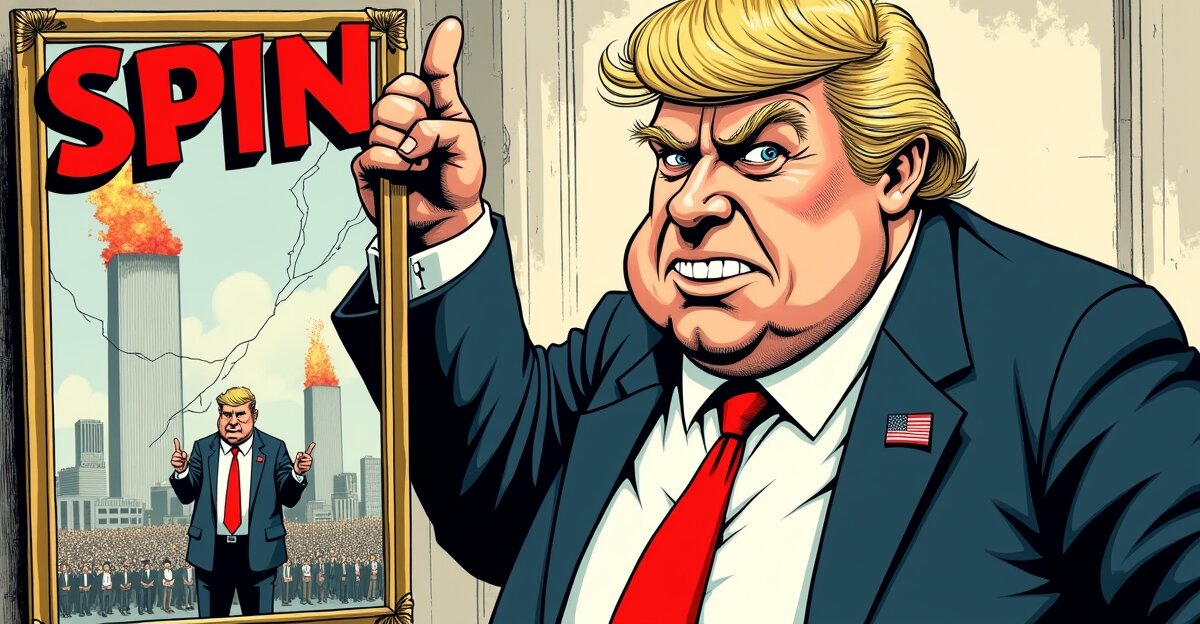
The White House version, in Trump's own words: "I was building a big building in New York, and I took the whole crew down there right after this happened, and they had no hesitation; everybody went down with me. It was raw, nobody had seen anything like it, ever." Then the centerpiece: "The steel building was creaking, really creaking, and we thought it was going to fall down. The truth is, it creaked a lot. It still creaks, but it never came down." And: "I'll never forget two firemen. We thought it was coming down on top of us, and two firemen, big, strong guys, and I'm not the smallest guy in the world, they grabbed me under the arm, said, 'Got to get out of here!' And they literally lifted me up."
The trouble with an 80-year-old president telling a hero story is that it can be checked. On the morning of the attacks, Trump was four miles away in his Trump Tower office, and that same day, on live television, he boasted that the collapse of the World Trade Center had left him with the tallest building in downtown Manhattan. Two days later, on September 13, he was documented walking around Lower Manhattan talking to reporters; the 2001 footage shows no trace of a Trump construction crew.
In 2019, Richard Alles, a retired New York City Fire Department deputy chief who oversaw the rescue effort, said he never saw Trump at the site. "He was a private citizen at the time. I don't know what kind of role he could have possibly played," Alles said. "I know of no one who ever witnessed him there."
The story is not new. Trump told vaguer versions on the 2016 campaign trail, including the line that he "helped a little bit" with clearing the rubble. But as journalist Ron Filipkowski put it, this is the most detailed version yet: "I know he's lied about his non-role in 9/11 rescue and recovery before, but never this level of detail." Filipkowski called it "stolen valor." "Instead, he created a fictitious event featuring himself, who did nothing, as the hero of 9/11."
When pressed on the timeline, Trump posted on Truth Social that he was "there, obviously not on the same day as the collapse, but shortly thereafter, with a large group of Construction Workers." The specificity is the problem. A vague boast is a lie. A detailed story with creaking steel and two big, strong firemen is a performance, and a performance needs a stage. This one came with an audience of the dead.
The money history of the story is almost as good as the story. In 2001, Trump said he would donate $10,000 to a recovery fund; the city comptroller's office later found the money never arrived. Fifteen years later, his foundation gave $100,000 to the National September 11 Memorial and Museum. In between, his business empire collected $150,000 from a post-9/11 recovery program, which he described as compensation for letting victims shelter in 40 Wall Street. The application itself asked for lost rent, cleanup, and repairs.
Translation: he has cashed in on 9/11 three times. Once for the rescue, once for the damage, and once for the story.
The Pentagon version is where the commemoration becomes the recruiting pitch. Secretary of War Pete Hegseth stood at the Pentagon on Friday and said the war with Iran, now in its sixth month, is the direct continuation of the war that began on a Tuesday morning in 2001. "Our warriors have fought an Islamic theocracy that has wished us death for nearly half a century, that cheered on 9/11, a regime that has sponsored terrorist attacks against Americans for decades, killing thousands, including our comrades in Iraq, in Afghanistan," he said, adding that American forces had "laid waste to the world's most prolific state sponsor of terrorism."
Trump agreed, saluting service members "working right now to ensure the world's No. 1 sponsor of terror, the Islamic Republic of Iran, will never, ever have a nuclear weapon." The 184 names of the Pentagon's dead were read between the tolls of a bell, and the president, six months into bombing the country Hegseth described as its enemy, told the families, "We were all New Yorkers that day."
The claim that the Iranian government "cheered on 9/11" is contradicted by the historical record. In the days after the attacks, President Mohammad Khatami condemned "the terrorist operations of hijacking and attacking public places in American cities" on state television. Supreme Leader Ali Khamenei, who was killed this past February in the opening salvo of the joint American-Israeli war on Iran, said at the time: "mass murder of human beings is condemned." A 2002 State Department assessment emphasized Iran's cooperation with American operations against al-Qaeda.
The country that condemned the attacks the day they happened, and cooperated in the response, is now the stated reason for the war. A war that has killed children in the bombing of a school in Minab, sent coffins to Dover, and pushed the Middle East into a wider regional fire is being sold on the strength of one slogan that was supposed to be about grief, not marketing.
The 25th anniversary shipped its standard edition of Islamophobia. Mayor Zohran Mamdani, the first Muslim elected to lead New York City, was greeted with a wave of vitriol over his attendance at Friday's ceremony; Rudy Giuliani, among others, said the mayor should skip it. CAIR reported a record 8,683 anti-Muslim and anti-Arab complaints in 2025. Its national executive director, Nihad Awad, put the pattern plainly: the trauma of 9/11 was exploited to "normalize illegal discrimination, empower hate groups, and launch forever wars across the Middle East that killed thousands of American soldiers and hundreds of thousands of men, women, and children."
The families, the people who are supposed to own this day, have started saying what they think. At the New York observance, Michael Massaroli, whose father died in the towers, told the crowd: "You do my dad's legacy and the legacy of all these victims no honor by using this tragedy to spread hate... this tragedy is just that, it's a tragedy." Terry Strada, whose husband Tom died at the World Trade Center, told the administration: "It has been one betrayal after another. President Trump can still change that."
The most honest line of the entire week came from a former national security adviser. Condoleezza Rice, who was in the room on September 11, 2001, said she carries "deep personal remorse" that those in authority did not "see the nature of the danger in time to prevent the attack." A real person in real authority, apologizing to the families for a real failure. The administration's version of that speech required a war, a creaking building, and two firemen.
The war historian Nick Turse wrote this week that the architect of the September 11 attacks "dreamed of the destruction of America," and that in the 25 years since, "his wish has come true." The promise made to the dead on September 11, 2001, was that nothing would be forgotten. Twenty-five years later, the country's leaders have demonstrated what that promise is actually for. The memory is not a monument. It is a loading dock, and whatever needs shipping this year, a war in the Middle East, a fear of a Muslim mayor, a creaking building, gets strapped on and labeled "never forget."
The question was never whether Trump lied about 9/11. He has done that for twenty-five years; this week he did it with new details, in front of the families. The question is how many more wars can be sold on the bodies of 2,977 dead. The answer, apparently, is every one of them. The dead are not being forgotten. They are being worked.
Comments (0)
No comments yet. Be the first to speak up.
Join the Riot
Login with Google to leave a comment.
Login to Comment