
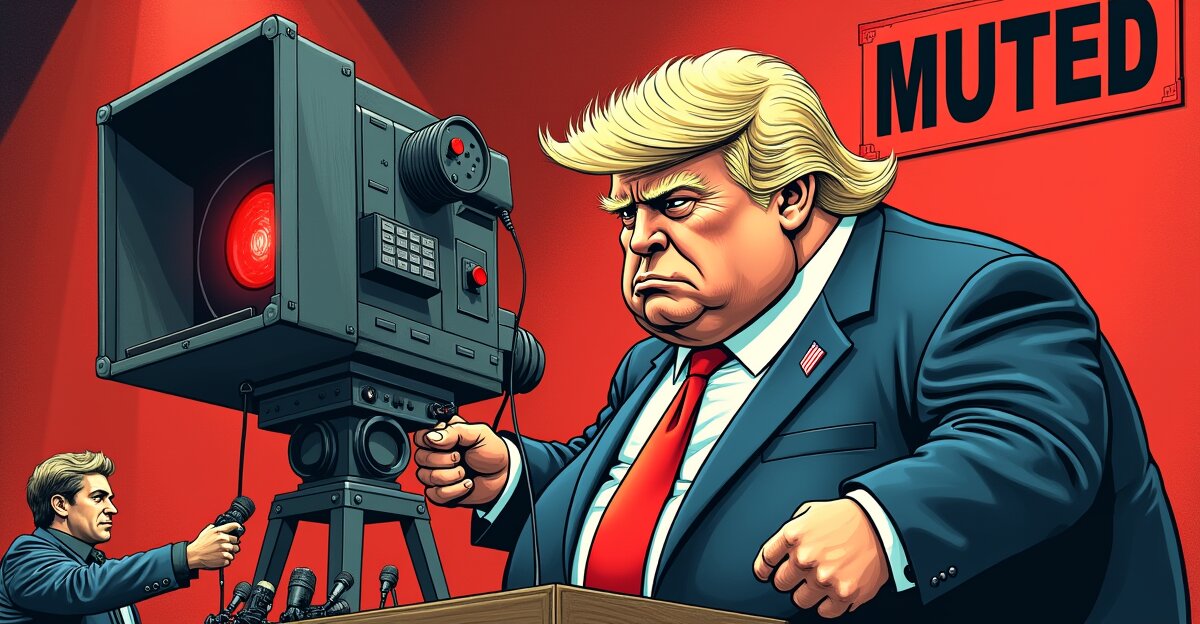
For a week, the United States was one social media post away from broadcasting the first publicly televised state execution in modern history. The feed went dark on Thursday. The firing squad did not.
"I think streaming the execution for all to see might have been a strong deterrent for the World to witness how America deals with Terrorists and SCUM like Hasan but, many very good and well-meaning people would rather not watch him die, through streaming, or through any other visual device. He will die, as scheduled, by firing squad, but this event will not be streamed."
Donald Trump, Truth Social, October 15, 2026
That post ended a story that began on Thursday, October 8, when Secretary of War Pete Hegseth sat down with a right-wing "news" outlet called Real American News and casually announced that the December 3 firing-squad execution of Nidal Hasan would be made public. "We'll make sure that people are able to watch it, that it's public, because people need to understand that there's serious consequences for these types of things," Hegseth said, after Acting Army Secretary Adam R. Telle signed an order setting the date. The Department of War's own "Rapid Response" account amplified the clip within hours.
Hasan is a former Army major and military psychiatrist. He carried out the 2009 Fort Hood shooting, killing 13 people, including 12 soldiers, and wounding 32. A military jury convicted him in 2013 of 13 counts of murder and 32 counts of attempted murder, and he has spent more than a decade on military death row.
The execution was always real. It will be, as Alternet's Chauncey DeVega notes, the first military execution in 65 years. The streaming was the new part, and according to The Intercept it would have been something that had never been attempted: the first known execution in history recorded and distributed by a government itself, rather than by a film studio or a militant group.
Translation: the Pentagon was not planning a news event. It was planning a premiere.
The administration's best-case framing is that the plan was an aberration. The New York Times observed that such a broadcast "has little precedent," and that released execution video is "most often associated with extremist militant groups like the Islamic State." That framing is accurate but incomplete, because it skips about 130 years of American history in which filming someone's death was a legitimate business model.
The first publicly filmed execution in the world happened in Liberty, Missouri, on December 17, 1897. William Carr, a farmhand convicted of murdering his daughter, was hanged while a cameraman from the American Phonographic Company operated a hand-cranked camera. The film, "The Hanging of William Carr," premiered in Kansas City and St. Louis, then toured the country. A year later, American Mutoscope and Biograph released "An Execution by Hanging" from Jacksonville, Florida, which the studio's catalog billed as "a very ghastly, but very interesting subject."
Thomas Edison's studio could not get permission to film the 1901 electrocution of President McKinley's assassin, so it cobbled together "Execution of Czolgosz with Panorama of Auburn Prison" from location footage and a mannequin doing the dying part. Edison also released "Electrocuting an Elephant," a 1903 film in which an elephant named Topsy was killed in public so the cameras could watch.
The novelty wore off, the gallows moved indoors, and for a century the closest America came to an execution livestream was the grindhouse circuit. "The Electric Chair" (1976) promised that "scenes in this picture were filmed in an actual death house." "Faces of Death" (1978) invited viewers to "experience the graphic reality of DEATH, close-up." When Saddam Hussein was hanged in Baghdad in 2006, a guard's cell phone video made its way onto American DVDs under the title "Sad Damn! Who's Sane?"
Translation: a government-produced execution livestream would not have been a break with American history. It would have been an update.
The backlash came quickly. A new ABC News/Washington Post/Ipsos poll found that 80% of Americans, including 64% of Republicans, opposed streaming the execution. Vice President JD Vance said he would not watch. Sen. Thom Tillis, a North Carolina Republican, called the plan "beyond disgusting." Rep. Austin Scott, a Georgia Republican, observed that live-streaming executions "is what jihadists do." The president of the U.S. Conference of Catholic Bishops, Archbishop Paul S. Coakley, expressed "shock and great sorrow" and said the decision was "a barbaric promotion of a culture of death." Amnesty International, which keeps these scorecards, reminded everyone that in 2025 only two countries carried out documented public executions: Iran and Afghanistan.
The last time an American execution was public in any meaningful sense was in Owensboro, Kentucky, in 1936. Rainey Bethea, a young Black man convicted of raping an elderly white woman, was hanged before a crowd estimated at 20,000. By all accounts it was festive: people ate candy, drank soda, and put children on their shoulders to get a better view.
Translation: the line between 1936 and 2026 is one Truth Social post wide.
So why did the feed go dark? The reported reason is the most surreal part of the whole affair. According to CNN, Trump had doubts about the imagery: footage of the American military executing Hasan, who has been paralyzed from the waist down and uses a wheelchair because of wounds from the 2009 attack, risked turning the Fort Hood shooter into a celebrated martyr. A president who has spent his career arguing that optics are the only fact that matters decided that, in this case, the optics were against him.
Hegseth's spokesperson Sean Parnell said Trump and Hegseth "discussed the decision ahead of time." NBC framed the week the way it has framed many weeks this year: the White House overruled Pete Hegseth again. Hegseth still has the firing squad. He just doesn't have a broadcast window.
It is worth asking what the president was doing the rest of that week, because the answer provides context. On Wednesday, at a rally in Bullhead City, Arizona, Trump said that people who "leak" information to the press should be shot, then added that journalists are "almost as bad." That same day he posted a string of videos of animals attacking people, including footage of William Chapman, a former child actor, being mauled to death after entering a tiger enclosure at Yorkshire Wildlife Park, captioned "Don't ever mess with nature! President DJT." Hours later he posted an AI-generated video of himself play-wrestling and hugging the same tiger. He also posted a video of deportation flights, captioned "This is where we send our killers, drug dealers, and thugs."
Translation: the stream went off the air. The appetite for violent spectacle did not.
The clinicians and historians who study violence and authoritarianism were not surprised by either the announcement or the reversal. Bandy Lee, a psychiatrist and editor of "The Dangerous Case of Donald Trump," wrote that live-streamed public executions "may seem like shocking new violence, but they are the exact extension of the president's dangerous mindset we have been warning against." Ruth Ben-Ghiat, the historian of fascism, added: "This is an escalation of an attempt to normalize extreme violence, ritualize violence, militarize the country, and make violence entertaining so when they ask you to commit violence in their name, you will be ready."
Neither of them is describing a policy. They are describing a rehearsal.
So where does that leave us? On December 3, at Fort Hood, the firing squad will fire whether or not anyone is watching. The immediate families of the victims may attend in person if they so choose, and in Trump's words they "deserve to witness JUSTICE!" The rest of the country is on its own: no stream, no premiere, no world audience.
The stream went dark on schedule. The firing squad did not. The line between the acceptable and the unthinkable was tested again this week, and it held only because breaking it became, for about a week, politically expensive. The cameras are still out there. The feed is still live. The next announcement will not require a week of public disgust to kill. It will only require a smaller audience.
Comments (0)
No comments yet. Be the first to speak up.
Join the Riot
Login with Google to leave a comment.
Login to Comment