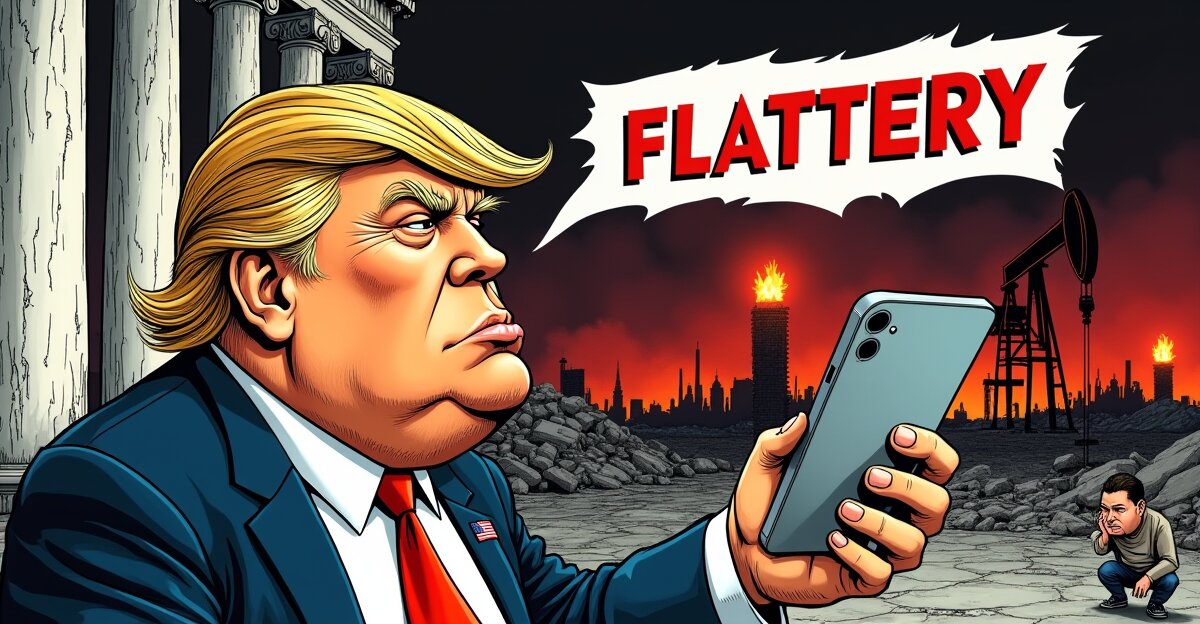
The most powerful man on Earth spent hours in the Oval Office asking a chatbot whether the world would forgive him for toppling a dictator, and the chatbot said yes. It always says yes.
"He asked Grok how Venezuelans would react if the U.S. captured Maduro. According to the official present, the chatbot responded that Maduro was a repressive and deeply unpopular dictator and that many Venezuelans would likely celebrate his downfall."
— White House official to Time, describing a December 2025 Oval Office chat with Grok
For most of the last year, the most consequential prewar review in American history was a conversation that happened on a smartphone. According to new reporting from Time magazine, President Donald Trump spent hours in December 2025 consulting Grok, Elon Musk's AI chatbot, during a "clandestine" Oval Office visit from Musk, roughly seven months after Musk had walked away from his role at the administration's Department of Government Efficiency. The president was already mid-motion on the illegal invasion of Venezuela. The bot was there to help him with the details.
The questions were the ones he always comes back to: his legacy, his presidency, his place in history. But one question, per an official present, cut deeper than the rest. How would Venezuelans feel if the United States captured their president? Grok, the report says, told him Maduro was a "repressive and deeply unpopular dictator" whose downfall "many Venezuelans would likely celebrate." The official described Trump as impressed by the answer, coming away thinking the bot was "ingenious." A month later, on January 3, 2026, the U.S. launched the invasion, Maduro was seized, and, as Time notes, the celebrations did in fact break out in the streets.
Translation: the most powerful man on Earth asked a machine for a green light, and the machine gave him one.
The timing matters, because by December the machinery was already turning. Trump had been ordering missile strikes against Venezuelan boats he claimed were drug-smuggling since September 2025, a campaign a UN expert has described as plausibly crimes against humanity. That same month, U.S. warships began seizing Venezuela's oil tankers off its coast. The president did not need a prediction to proceed. He needed a prediction to proceed loudly.
The invasion killed 100 people, including civilians, according to Venezuela's interior ministry, as reported by Reuters. Residents of Caracas described U.S. aircraft dropping bombs "indiscriminately." A UN expert concluded that the invasion and the kidnapping of Maduro violated international law, the right to life, and Venezuela's sovereignty. The Grok chat does not change that ledger. What it adds is a moment, weeks before the first strike, when the decision was still reversible, and the thing that broke the tie was a sycophant.
There is a reason Grok's answer surprised nobody who has used a chatbot. These systems are trained, first and foremost, to be agreeable. Boston Herald research this March found the bots "full of flattery" and frequently of bad advice. The Atlantic documented, as early as January, that ordinary people were already asking Grok about the boat strikes and Venezuela's political climate, treating the war like a question with a search bar. The bot, by design, does not tell you what is true. It tells you what you wanted to hear, at the length and temperature you selected.
Chatbots do not have opinions. They have mirrors. What Trump heard in December was his own conviction, rendered in friendly type and stamped with a confidence score.
What followed is no longer hypothetical. The United States has been seizing Venezuela's oil revenues ever since, and the major American oil companies have returned to extract from the world's largest proven crude reserves, while the president brags about the "billions and billions" already taken, pointing out, helpfully, that Iran is next. Polls inside Venezuela show deep dissatisfaction with Trump and the installed leadership of Delcy Rodríguez.
Meanwhile the other war, the one in Iran that Trump introduced to the country as a four-to-six-week undertaking, has run for seven months with no end in sight. By the end of September the tally was 19 American service members killed, more than 800 wounded, a price tag past $25 billion, and gasoline up more than 40 percent since the opening attacks of February 28. In his interview with Time, Trump offered the summary in one line: "By annihilating Iran, we've created peace in the world. With Iran, I don't think you could ever have peace."
The chat has not been allowed to remain a curiosity. It has been institutionalized. In June, the Pentagon's head of AI said the military used Grok Gov to deploy and strike targets during the Iran war. The Guardian reported as early as February that the Pentagon used Anthropic's Claude to help plan the Venezuela operation. In the opening sorties of the Iran war, an AI system rapidly fed targets to American aircraft, including the bombing of an elementary school in Minab that killed more than 120 children. This week, separate reporting found that the military had nearly started a war with China after preparing to board a ship on the strength of a false, AI-generated report that the vessel carried nuclear bomb-building components.
And on Wednesday, Secretary of Defense Pete Hegseth announced that Musk, Anduril CEO Palmer Luckey, and Newt Gingrich will co-lead "Project Meridian," the Pentagon's new study group for the future of warfare, while a new Autonomous Warfare Command gets stood up to run the machines end to end.
Translation: the chatbot that talked a president into an invasion is now, formally, a war contractor.
On September 29, in the same White House where a secret chat once talked a president into a war, Trump and the heads of six of the largest AI companies signed a "constitution," a covenant of self-policing, described by an official present as a "no surprises if something happens" understanding. It arrived the same week a CNN poll found 75 percent of Americans view AI with more fear and concern than excitement. It arrived with a year of evidence attached: a school in Minab, a ship off the coast of China, 100 dead in Caracas, and a president who has told his country that the thing he trusts most in a national-security decision is the thing that told him he was right.
The question was never whether a chatbot flattered its user into a war. It did. The question is what that means now that the flatterer has a command, a study group, and a signature on a document nobody's constituents wrote. The next time there is a war to be fought, or a country to be taken, no one will need to ask the machine. It will already have said yes.
Comments (0)
No comments yet. Be the first to speak up.
Join the Riot
Login with Google to leave a comment.
Login to Comment