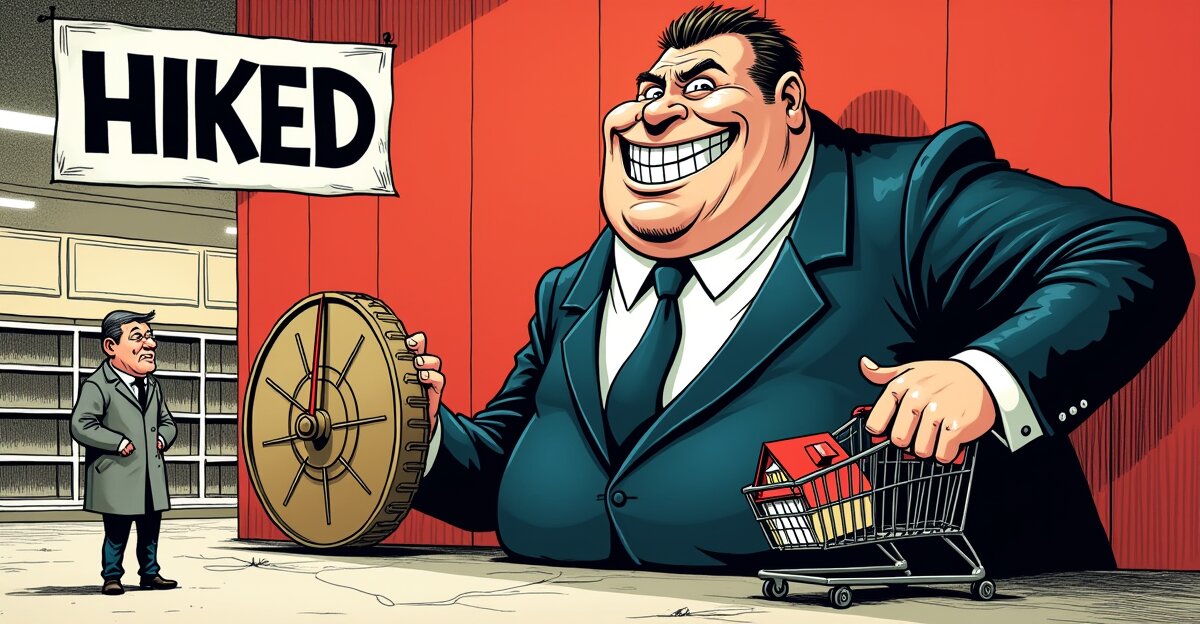
The war that put gas at $4.32 a gallon is now charging every mortgage, auto loan, and credit card in America a second time.
"The board is very hostile. They're very political. They're doing the wrong thing. They're a bunch of politicians."
— President Donald Trump, speaking to reporters in North Carolina, September 16, 2026
On Wednesday, the Federal Open Market Committee voted unanimously to raise the benchmark interest rate a quarter of a point, to about 3.9 percent, the first increase since 2023. In its accompanying projections, the committee signaled that a second hike, to 4.1 percent, could follow, and sixteen of the eighteen policymakers who submitted forecasts penciled in at least one more before the year is out. By Thursday morning, the yield on the two-year Treasury had climbed to 4.74 percent. The market, in other words, had already priced in the next one.
Chair Kevin Warsh explained the decision in a sentence that ought to have made him comfortable in his own building, but did not make him comfortable in the White House. "The plain fact is that inflation is too high and has been for too long," he said. "We must be confident that underlying inflation is moving to our objective clearly and at sufficient speed. Today the FOMC decided that this standard has not been satisfied."
Translation: the Fed raised rates seven weeks before a midterm election, in the middle of an affordability fight, with a second hike on the table for December.
The reason was in the press conference, and it came out in a sentence that read like a footnote and was actually the headline. Warsh said renewed combat between the United States and Iran, which has driven up gas prices, "had convinced Fed officials to support rate hikes." He added that "there's no hiding from hot spots around the world."
The numbers behind that sentence have been building since February, when the war began. The conflict has pushed average gas prices up more than 7 percent in the past month alone, and the national average at the pump is hovering near record highs. On the Fed's preferred measure, inflation ran at 3.7 percent in July, up from 2.3 percent in April 2025, the month before the sweeping tariffs landed. Core inflation, which strips out food and energy, was at 3.3 percent, up from 3 percent before the war and far above the 2 percent target. Core prices also accelerated a little in August.
The war has become the most reliable inflation variable in the American economy. It started as a gas price story. It is now a mortgage story.
The man who delivered the hike was the president's own pick. Warsh, whom Trump nominated and who took the chair in May, spent the confirmation process talking about the possibility of rate cuts, echoing his boss. Then, in April, at a Senate Banking Committee hearing, he corrected the record. He had not promised Trump he would cut rates, he said, and he would be "an independent actor."
Trump, asked on television the same day, said he would be "disappointed" if Warsh did not cut. After the vote, speaking to reporters in North Carolina ahead of a midterm rally, the president made no mention of the tariffs, the war, or any other policy his administration had stacked up against the Fed. He called the board "very hostile," "very political," and "a bunch of politicians," and added, "They're raising rates to make Trump do as bad as they can possibly do."
He also disclosed, unprompted, that he had spoken to Warsh before the vote and told him, "You might as well vote with the board because it's not going to matter." Asked whether he still had confidence in his chairman, Trump said, "I do."
The man who told his boss he would be independent just voted against his boss's central economic demand, with a second such vote penciled in for December. That is the entire drama of this week, and it is a drama the president wrote himself.
The double billing is the part nobody at the rally is going to explain. The war hit American households at the pump first, and the national average crossed $4.32 a gallon around Labor Day. Now it hits again, at the back of every variable-rate loan, in refinance quotes, in the price of the sixty-month auto note. The Fed's projections say the hikes will, "over time," show up in mortgage rates, auto loans, and credit cards.
The strange thing is that the economy kept spending through all of it. Retail sales jumped 1.2 percent in August, and the Fed pointed to "resilient domestic spending" and heavy investment in AI data centers as evidence that current rates are not yet cooling the economy. That is the other half of the inflation story: chips and electronics are getting pricier because big technology firms are buying compute, and tariffs are still showing up in the price of appliances. The war is the main course, but the Fed is watching the whole table.
The fight over who gets to set interest rates is not new to this administration. Trump spent months blasting Jerome Powell for not cutting fast enough, and his Justice Department opened a criminal investigation into Powell over congressional testimony, a probe that was eventually dropped. Now the same president is calling the Fed "a bunch of politicians" after spending a year rebuilding it with people he expected to cut. Around the world, everyone else is tightening too. The European Central Bank raised rates last week, and the Bank of Japan is expected to follow on Friday.
There is a layer of protection nobody at the rally will mention. Warsh's father-in-law is Ronald Lauder, a billionaire, a friend of the president, and a major donor to his campaigns. The chairman of the institution the president wants to control is married into the donor class that funds it.
The Fed meets again in late October, one week before the midterms, and most economists expect it to hold. The futures market has already decided what happens after that: a December hike to 4.1 percent, a near certainty.
So here is the arithmetic the rallies will be dancing around. The first invoice was at the pump, and the country saw it: $4.32 a gallon, up more than 7 percent in a month. The second invoice just arrived, at the back of the mortgage and the auto note. The third is penciled in for December, and the market has already paid for it. The president who called this war small potatoes should ask the Fed why small potatoes move interest rates. The answer is in the statement, in the technical phrase about "geopolitical developments." That is the war. The question is not whether the war is over. The question is how many more bills it will send, and how long the man who started it can keep blaming the board that just raised the price.
Comments (0)
No comments yet. Be the first to speak up.
Join the Riot
Login with Google to leave a comment.
Login to Comment