
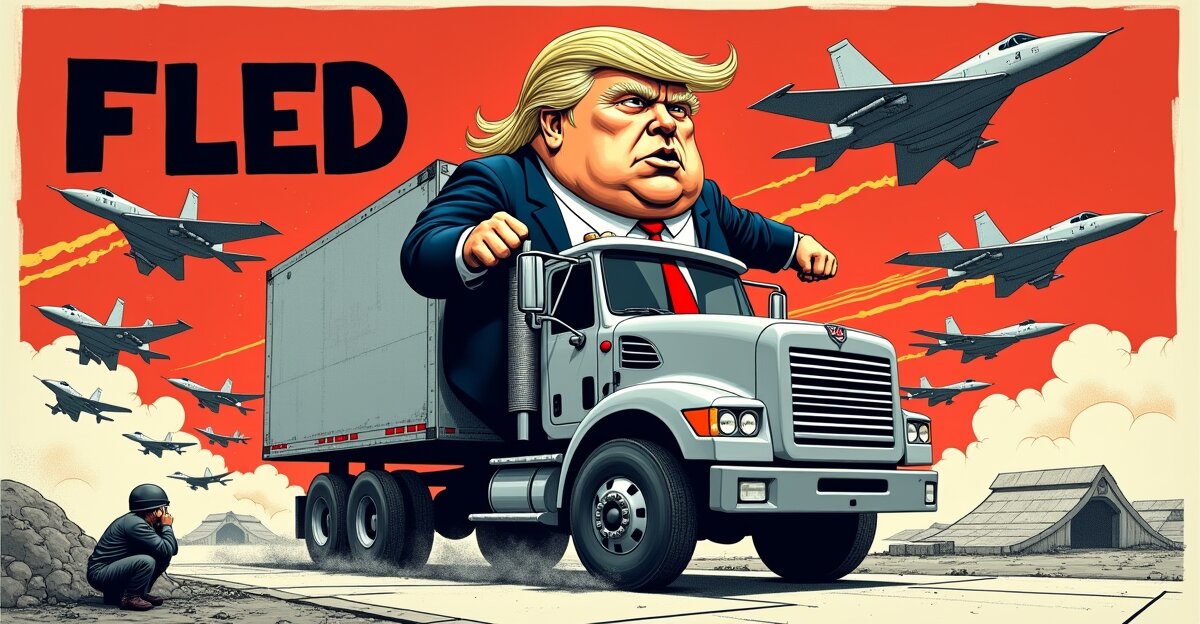
The United States declared this war over in July. In October, its bombers ran home from England, because the military could no longer protect them.
"I'm not concerned at all."
— Admiral Brad Cooper, CENTCOM commander, on 60 Minutes
On Sunday, the U.S. Air Force did something no American general wants to admit in writing. It packed up 12 B-1 bombers from a base in England and flew them home. The reason was not a declared enemy strike. It was a threat: a "sophisticated plot," in the words of one U.S. official, to hit RAF Fairford with multiple drones, a scheme so unsettling that the Pentagon decided the safest place for its own warplanes was on American soil.
The base, 100 miles west of London, has launched U.S. bombers for the war against Iran since the conflict began. British police arrested a dual U.K.-Iranian national in central London after a security incident at the base in late September; six men in all were taken into custody and then released on bail. Prime Minister Andy Burnham said there were "strong indications" Iran played a part. Iran denied involvement, though its Revolutionary Guard had been explicit for months: any base used to attack Iranian territory is a legitimate target.
Asked about the withdrawal, Trump admitted there were "some threats" and added that leaving the aircraft in place would only tempt an attack.
Translation: the country that once garrisoned the globe now evacuates its bombers when a rumor of a drone plot surfaces in the English countryside.
Fairford is a symptom. The disease is the war itself, which the White House declared over three months ago and has been quietly losing ever since.
The official U.S. toll now stands at 19 service members killed and roughly 900 wounded, and most of the deaths have come since July, after the administration announced the conflict had ended. A Pentagon inspector general report found that Iranian strikes "damaged and destroyed hundreds of buildings and structures" at U.S. bases in Kuwait, Bahrain, Qatar, the UAE, Saudi Arabia, Iraq, Oman, and Jordan. Air Force personnel alone endured more than 1,200 "alarm reds," the code for imminent attack, during 38 days earlier this year, according to Air Force Chief of Staff Gen. Ken Wilsbach.
In March, a drone strike on Kuwait's Port of Shuaiba killed six U.S. troops, the deadliest single attack of the war. In July, an Iranian attack on Muwaffaq Salti Air Base in Jordan killed three soldiers who, a defense official said, were "not actively engaged in anti-aircraft activity" when they were hit. Dozens of U.S. aircraft have been destroyed or damaged: four F-15s, 12 KC-135 refueling tankers, as many as 30 MQ-9 drones.
"Base posture in the region may never recover," one official told The Intercept. A war that is declared over keeps killing.
The math of defense is the harshest of all. In the first 16 days of the war, the U.S. and its allies burned through more than 11,000 munitions, according to the Royal United Services Institute. Between February and July, the Pentagon spent about 65 percent of its Patriot interceptor stock, leaving fewer than 830 of a prewar 2,330, according to the Center for Strategic and International Studies. THAAD interceptors have fallen from more than 450 to fewer than 270.
Every interceptor is a choice, and the choices are getting worse.
The home of the Fifth Fleet in Bahrain, the region's most critical U.S. logistics hub, was struck at the start of the war. The Pentagon claimed for months that operations were not significantly affected. Last month, acting Navy Secretary Hung Cao conceded that "they blew the hell out of Bahrain." A Wall Street Journal investigation put rebuilding the Fifth Fleet headquarters, barracks, and communications towers at more than $400 million. With the home port knocked out, the Navy is feeding a flotilla of more than 24 ships, including two aircraft carriers, with food and fuel hauled from Diego Garcia, more than 2,000 miles away, on 14-to-18-day logistics cycles.
And yet the CENTCOM commander told 60 Minutes he was "not concerned at all" about the safety of U.S. troops. CENTCOM did not answer whether Cooper would resign if soldiers were killed or wounded in the next attack.
There is one man in this war who has shown he knows how to leave.
In July, with U.S. intelligence warning of a possible Iranian attack on Air Force One during a NATO summit in Ankara, Trump snuck into a catering truck and switched onto a military jet to leave Turkey, according to reporting from PBS NewsHour and The New York Times. At the summit he had called himself Iran's "No. 1 target." The catering-truck escape became a fixture of the war's mythology, a photo op no one staged.
What separates the president from the troops is not courage. It is mobility. Trump can leave. The airmen on 1,200 alarm reds cannot. The sailors on 18-day resupply cycles cannot. The 19 already dead cannot come back.
Meanwhile the war is expanding on a map the White House declines to discuss. Last week, U.S. forces withdrew from Iraq, ending more than two decades of American operations there. Baghdad declared October 1 a "Day of Sovereignty and Independence." In Yemen, the Houthis have taken nearly the entire Red Sea coast, including the shipping lane at the Bab el-Mandeb strait, and this week claimed more than 200 Saudi-backed fighters killed or wounded. And as the bombers leave England, the USS Theodore Roosevelt and an amphibious group carrying more than 7,000 sailors and 2,000 Marines are sailing for the region, which could put three carriers on station by the end of October.
One U.S. official described Iran's strategy as "go for broke," a bet that it can absorb economic ruin longer than the United States can sustain a failing war, a naval blockade, and fuel prices that refuse to fall. So far, the evidence favors the side with the longer fuse.
Trump, for his part, is already shopping the next chapter. "Iran's been decimated. So the only question is, it'll either be the easy way, or the hard way," he told reporters Saturday, as if the past eight months were a scheduling hiccup rather than a war.
The question the war now poses is not whether America can win. It is whether America can protect the places where it sits. The bombers are back in the States. The Fifth Fleet is a line item to be rebuilt. The interceptors are a fraction of the shelf. And the president who promised a few weeks is still weighing, in his words, the easy way or the hard way.
The war declared over has not ended. It has simply become a series of evacuations: bombers from England, a president from Ankara, troops from Iraq. The only ones who did not leave are the ones who could not.
Comments (0)
No comments yet. Be the first to speak up.
Join the Riot
Login with Google to leave a comment.
Login to Comment